

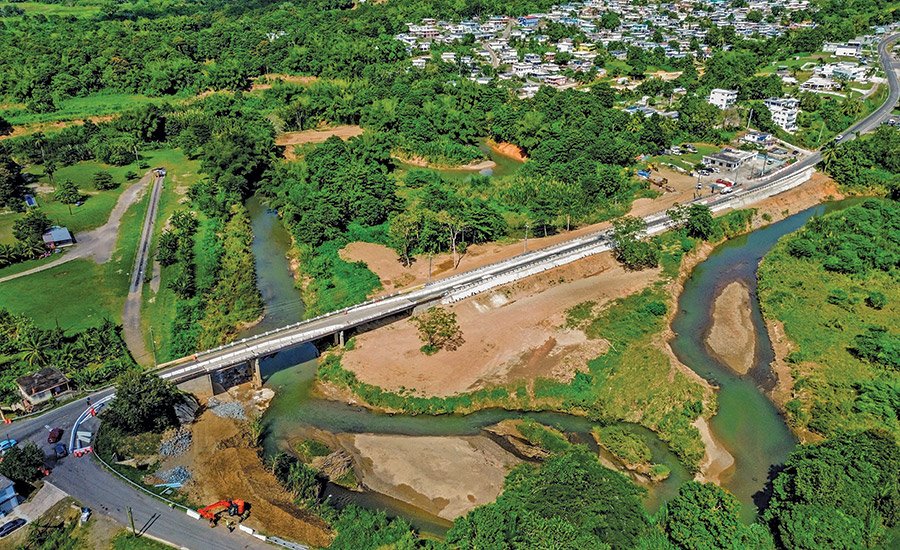
Emergency stabilization of the embankment of the PR 110 road at KM 10.2
Moca, Puerto Rico
BEST PROJECT
Sent by: International GeoStabilization
Owner: Puerto Rico Highway and Transportation Authority (PRHTA)
Principal Design Firm/Geological Hazard Mitigation Contractor: International GeoStabilization
General contractor: Constructora Hartmann, SE
Civil Engineer: Infinite engineering
PR 110 is a narrow, well-traveled two-lane state highway in Moca, northwestern Puerto Rico. Near km 10.2, the northern approach embankment to the bridge over the Culebrinas River had been settling and failing, cracking the pavement and threatening the only practical route for the surrounding community.
A $2.7 million repair was ordered under the main contract of the Puerto Rico Highway and Transportation Authority. The result is a permanent roadway widening and stabilization system designed for a 75-year service life along both sides of the bridge approach, a combined repair length of approximately 362 meters, reinstatement of a full-width roadway carrying two 10.5-foot traffic lanes.
The owner’s plans for stabilization of the failed embankment initially called for driving sheet piles tied with tie rods and faced with erosion control blocks. On such a narrow road, this meant the mobilization of teams that could not live with the live traffic, forcing the passage to be completely closed and a long detour for the community. When Hartmann Construction asked GeoStabilization International if there was a better way, GSI designed a top-to-bottom grouted nail and column stabilization system installed with excavator-mounted drilling rigs operating within a single lane. Both sides of the embankment could be stabilized sequentially, with one side working under a single-lane closure while the opposite lane carried traffic, meaning the road never had to close.

Photo courtesy of Constructora Hartmann, SE
The stabilization system combined several techniques in one integrated section. A reinforced concrete nail wall up to 8 feet high with shoulder construction widened the roadway, while vertical, self-drilling soil nails up to 20 feet long and a vertical soil nail cap reinforced the base of the wall. An array of grouted columns up to 20 feet deep installed through the existing pavement arrested ongoing settlement of the embankment fill, and horizontal and strip drains provide long-term drainage. An articulated concrete block erosion control system is located on the lower embankment.
Completed on time and on budget, the project was concluded after just five months and the road reopened in October 2025.
