

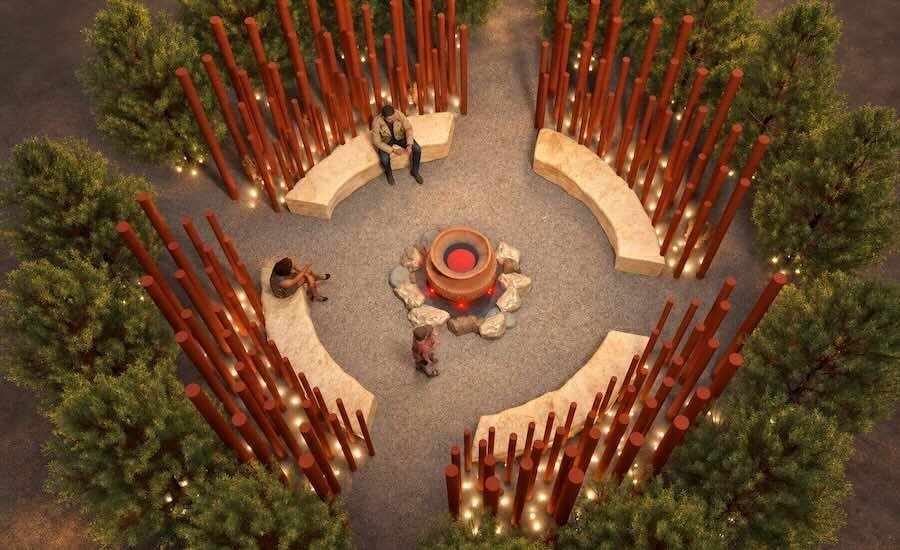

Another construction project to revitalize Boston’s Franklin Park is underway, with preliminary designs recently released for the White Pine Gathering Place, the city’s first permanent indigenous monument recognizing the history and culture of the Wampanoag tribe.
The design was unveiled less than two months after Massachusetts’ highest court gave the green light to continue work on a professional women’s soccer stadium in a different section of the park designed by Fredrick Law Olmsted.
The new project is being planned for the Scarboro Hill section of the park. Mashpee, Mass.-based SmokeSygnals is designing it in collaboration with the Wampanoag Consulting Alliance and Boston city officials.
Steven Peters, creative director of SmokeSygnals and a citizen of the Mashpee Wampanoag tribe, says the project “creates a functional space … for tribal communities to come in and have a ceremony and start the healing process,” he told WBUR.
Efforts to finance the project, which he estimates will cost $2 million, are underway from private and city sources, he said.
The design evokes Wampanoag creation stories and the tribe’s relationships among people and with the land, water, and future generations. It features live white pines to form an outer circle, while an inner circle of weathered steel columns is reminiscent of cedars. “At the center, a large clay pot evokes Maushop, a benevolent cultural hero of the Wampanoag and Mohegan cultures and their story of creation,” the project’s website says. Stone seating, water, inscriptions and small statues of mythical, human-like creatures from Native American folklore called Puckwudgies “invite visitors to move through the space, find history and gather.”
The design process has included representatives from the Mashpee, Aquinnah, and Herring Pond Wampanoag tribes, who participated in workshops, advisory meetings, and design reviews.
“The project is being shaped through a community-driven process based on Wampanoag voices, stories and values,” according to the project page on the SmokeSygnals website.
The memorial “began with questions rather than a predetermined design,” the project’s website says. “What should an indigenous monument represent? What stories should it carry? How should people live it? What responsibilities should it have to the generations that will come after us?”
The monument will be built in the coming years… as a piece of the ‘Un-monument | Re-monument | De-monument’ program that funds local artists to reimagine who monuments and monuments honor.
