

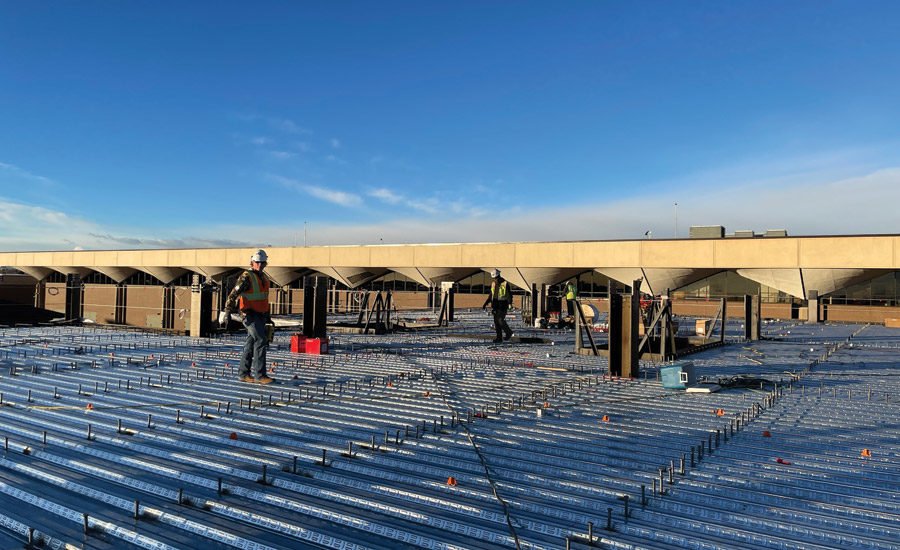
The world’s largest training facility for full-motion flight simulators is growing even bigger with the addition of Building H at the United Airlines Training Center in Denver.
The 157,777-square-foot facility, located on a 23-acre site near Stapleton International Airport, will bolster United’s plan to hire 10,000 pilots by 2030 with 12 new full-motion flight simulator bays to provide training support.
The four-story, $123 million project also includes offices, classrooms and a pedestrian bridge connecting the new spaces to existing campus buildings.
Work began with a more modest vision before Turner Construction hired architecture firm BRPH to respond to a request for proposal for a fall 2021 expansion of United’s existing F Building.
“United made a pretty bold move during COVID; it didn’t get smaller, it didn’t lay off pilots and start buying planes,” says Mark Adams, the airline’s director of planning, development and corporate real estate for the Rocky Mountain region. “As you buy planes, everything else has to get bigger. We needed more pilots and mechanics and hangars and more simulator training facilities.”
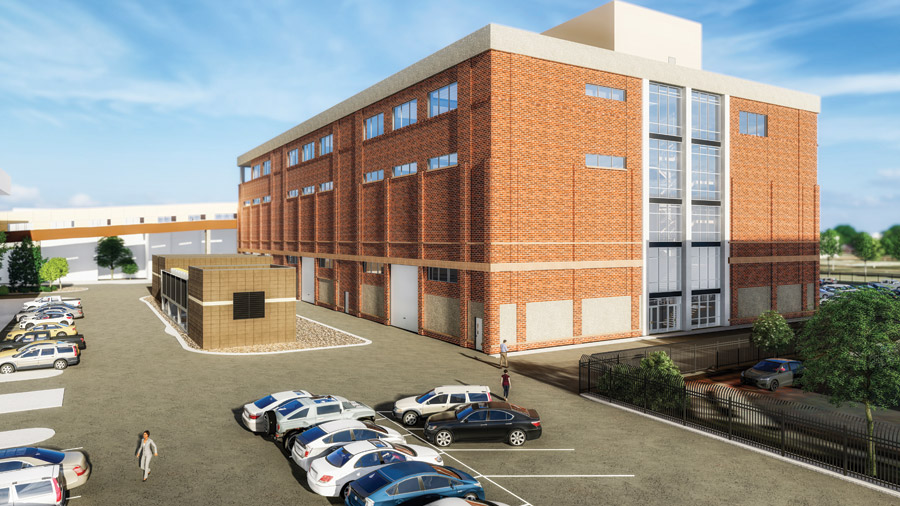
On the upper floors are offices and classrooms, along with a fourth-floor lounge area that offers panoramic views of the Rocky Mountains.
Image courtesy of Turner Construction
bag of tricks
As other airlines canceled multibillion-dollar simulator orders from manufacturer CAE Inc. from Montreal, United was in buying mode.
“Even before we had the contractor and designer on board, we knew when the first two simulators were coming,” says Adams, with the airline initially issuing an RFP for a six-bay expansion.
United “was figuring out what it really wanted to build on the existing campus,” says Dan Wilder, a Turner project executive in Denver. “We came to the final interview with 3D printed models of about 10 different options” for the campus.
Jim Hillier, vice president and national architecture practice leader at BRPH, likened the session to playing dominoes. Early moves showed that only four bays were feasible, not six.
“As you buy planes, everything else has to get bigger. We needed more pilots, mechanics, hangars and simulator training facilities.”
—Mark Adams, director of planning, development and corporate real estate, Rocky Mountain region, United Airlines
“At the same time, we demonstrated [United] which could add two additional 12-sim bay buildings to the campus,” he says. “We not only gathered options for expanding the campus, but also pricing for a review of what each option would mean moving forward.”
The interview turned into an exploration of possibilities, with the help of 3D models.
Team members “kept pulling pieces out of their little bag of tricks,” says Michelle Martin, president of Civil Innovations LLC and owner United’s representative on the project. “They were moving the pieces and it really changed the way everyone saw that building that was expected.”
According to Wilder, “it became more of a working session than a formal interview for a new project.” He says: “We completely turned around [the RFP] boss,” telling United executives that “We understand that’s what you’re asking, but you’re going to run out of sim bays again months after we finish this project.”
Subsequently, United moved to the concept of a new building with 12 simulator ships topped by two levels of offices and classrooms. The fourth floor includes several fixed-base simulators and an outdoor lounge with panoramic views of the Rocky Mountains.
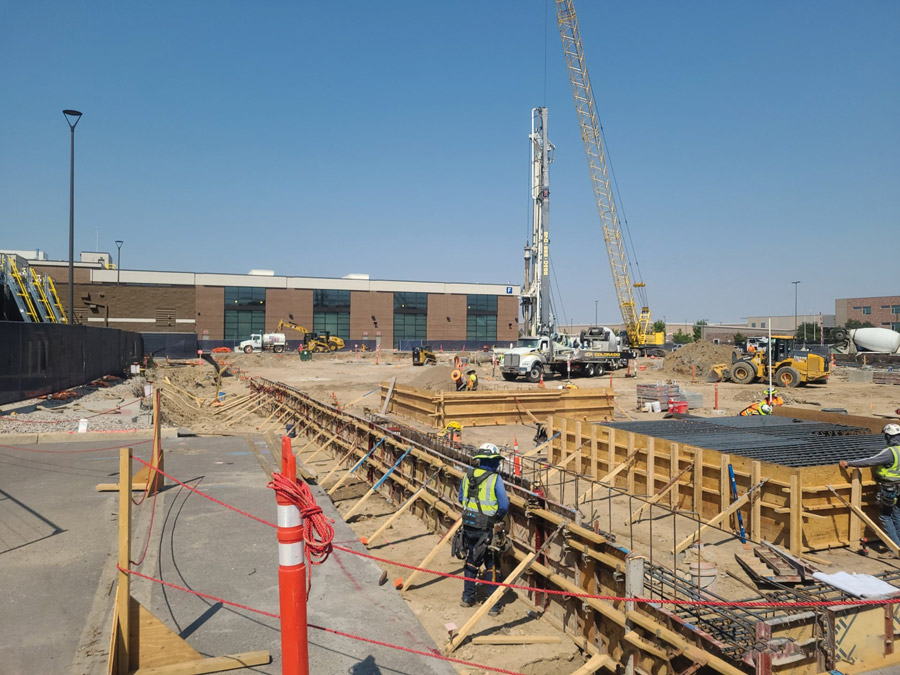
The project includes more than 6,000 m3 of concrete and 300 tons of rebar.
Photo courtesy of Turner Construction
Turbocharged schedule
Turner and BRPH won the design and build job in December 2021, started construction in July 2022 and broke ground on the structural steel in early 2023.
“Mark Adams told us, ‘You’ll never hear a client say this again, but the budget is actually secondary on this one. We have to get to the schedule,”’ Wilder recalls. “The need was immediate. They needed more [simulation] bays and classrooms and office space as soon as humanly possible.”
This was in part because the Federal Aviation Administration was already scheduled to certify the simulators before construction began. “If you miss your FAA certification date, you’re not going to get another date around the corner,” adds Martin.
Closing the campus to accommodate construction was not an option. “It runs 24 hours a day and we only close it two days a year,” says Adams. “All of the 16,000 to 17,000 pilots that we have right now have to come through here at least two days a year every nine months.”
There were a number of other challenges associated with the tight timeline. Design and permitting required a breakneck pace and labor was scarce. Earthmoving was no small task, either, with unmarked utilities and “veins of trash” from the site’s past uses as Stapleton’s roadway and landfill, Wilder says.
“Two and a half months to close after the structural steel is a bit unheard of. It allowed us to start all the interior MEP work much sooner.”
—Dan Wilder, Project Executive, Turner Construction
Contractor Elite Surface Infrastructure cleared the site while Turner performed the concrete work, which included a total of 6,500 cubic meters of concrete and 315 tons of rebar. Turner further sped up the schedule with a strategy of “taking the foundation and superstructure out of balance for the building,” Adams says.
Working closely with the City of Denver and the Denver Fire Department, the team was able to have the first two bays separately permitted and released under a phased occupancy permit for United to make beneficial use of from ‘June 1, 2023.
“Those operational simulators, which are used now, were behind the classified partitions,” notes Wilder. “In January, we basically reversed [United’s] the occupation of the building and those provisional partitions have been removed in order to be able, in a short month, to link all these systems and finishes to the rest of the building”.
A new certificate of habitability was then issued for the building, which was re-inspected and returned to the airline. “It was like a double occupancy delivery, but it was perfectly suited to what United needed and asked for,” says Wilder.
A paneled exterior wall system manufactured by E&K Cos. helped Turner reach the goal of the first two bays. It took about 10 weeks to go from excess to full shutdown.
“We have the design concept, but they [E&K] it really helped put flesh on the bones,” Wilder adds. “Two and a half months to close after structural steel is kind of unheard of. It allowed us to start all the interior MEP work much earlier.”
Adams credits the project’s more than 1,000 workers with achieving the goals set by Turner and BRPH. “All the subcontractors, 100 percent, were from the Denver metro area,” he says.
“We had 124 subcontractors on the job, and we were able to do everything locally, which I thought was pretty huge,” she notes, adding that of those 124 companies, 37 were diverse contractors — minority-owned and women-owned businesses.
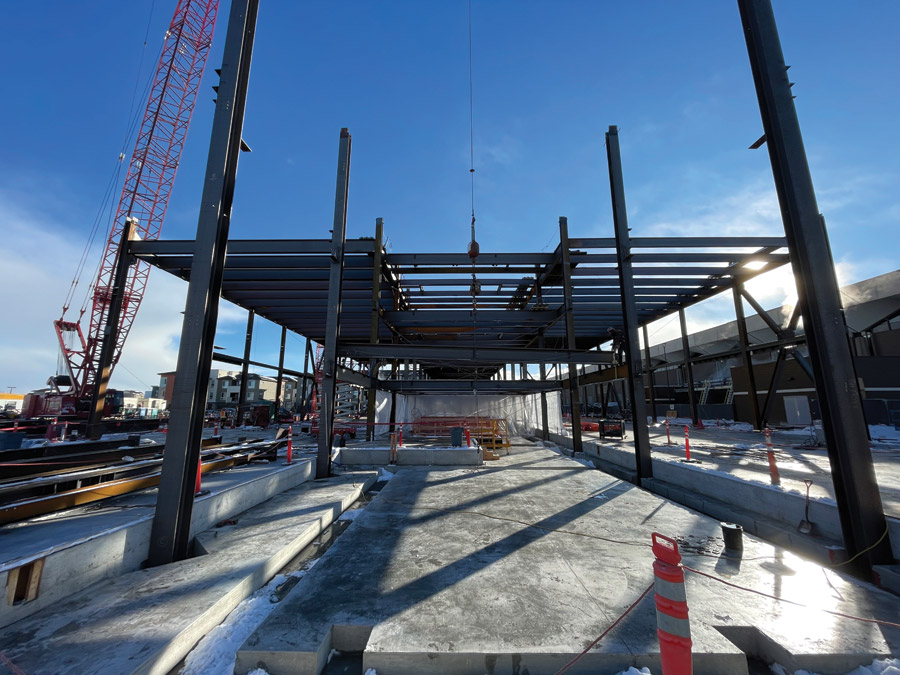
The structural steel finished in early 2023, just about six months after the break-up.
Photo courtesy of Turner Construction
Power Points
According to Wilder, “This is a very heavy, MEP-intensive building with many special systems.”
He adds that subcontractors Extreme Fire Protection, Encore Electric and Murphy Mechanical began their construction work before the building was closed. “Having these three companies on our team was very beneficial, he says. “We couldn’t have done it without them.”
Hillier noted that the simulator’s power requirements required an assessment of campus electrical consumption.
“Some of the campus systems were underutilized by the actual power demands of the equipment,” he explains. “Once we went through that assessment, that gave us an opportunity to make recommendations about what we could do with new equipment moving forward to try to leverage some of their existing systems.”
The effort was also guided by ambitious goals for energy efficiency and sustainable operations. United has “high goals to be carbon neutral here in a short amount of time, and in addition to meeting the new Energize Denver standards, many of the things, ideas and systems that went into the building are very new and vision of the future,” Wilder. he says That includes a Power over Ethernet lighting system, which studies have found can be 40 percent more efficient than AC-connected LED lighting, he adds.
forward thinking
With the construction of Building H complete, the plan is to install and certify two simulators per month until the end of 2024. “In 40 years. [simulator bays]we were the biggest, and now we’re adding 12 more for 52, so we’re definitely the largest full-motion simulator training facility in the world,” says Adams.
United is already designing its next simulator facility on the airline’s 114 acres near Denver International Airport, and the airline is expected to issue an RFP this spring.
“We need to finish by the end of 2027,” Adams says. “Once again, I’m on deadline before I’ve even started the project.”
