

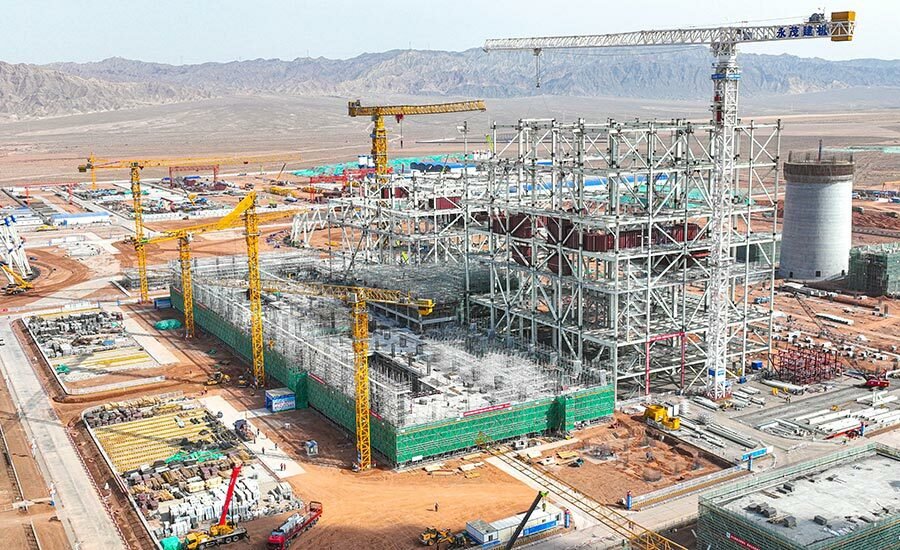
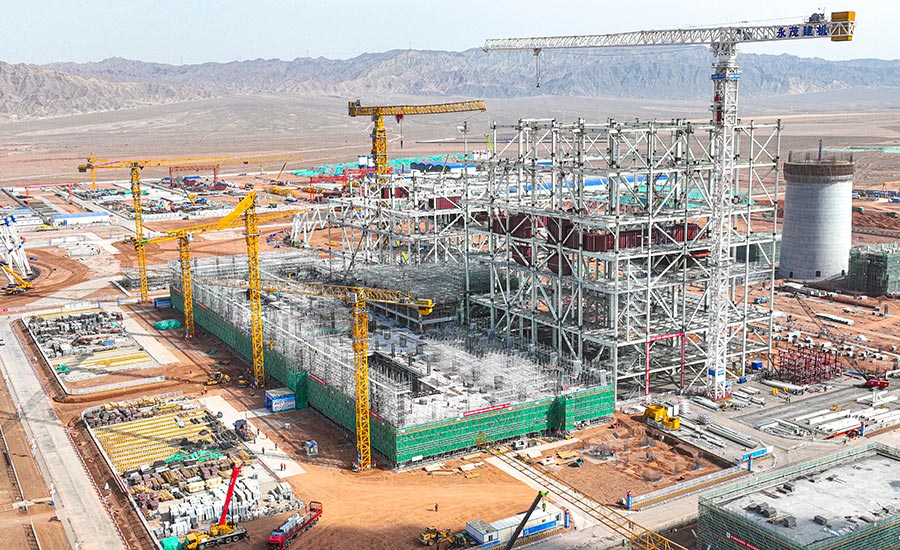
China doubles with more coal power after a decade for a decade towards renewable energy, and officials revealed their approval of a large amount of new orderly capacity last year. The construction of plants to produce an estimated of 94.5 GW of power from the coal that began in 2024 represents the highest level of new projects or resumed through the fuel source since 2015, which contrasts the constant decrease observed between 2015 and 2021.
Although China is still the largest investor in the world in solar and wind energy, the government focuses on coal energy is evident in the slowdown retirement of aging plants, and the closures fell from 13 GW in 2020 to only 2.5 GW last year, according to national statistics.
Most of the new projects are megaplants with capacities greater than 1 GW located in Shandong and Inner Mongolia, developing state giants such as China Energy Investment Corp and Huaneng Group. The Guangdong Taishan project, which uses ultra-supercritic technology, is among the largest, with a capacity of more than 1.2 GW. Foreign companies, although they are prohibited from the property or construction of energy projects in China, supply technology and experience. Companies like GE, Siemens and Mitsubishi have provided turbines, automation systems and emission control technologies.
The change in politics took place after a decade when President Xi Jinping made his efforts to promote the most favorable agenda in China’s climate after the United States retired from the Paris Agreement during the first term of President Donald Trump. But economic slowing, increasing unemployment, fear of larger labor losses if coal mining is restricted and energy security needs have forced China’s policymakers to make the change, according to observers.
Coal mining and energy companies are closely linked to China, says Christine Shearer, responsible for projects in the San Francisco Market Research Firm, Global Energy Monitor, adding that more than three -quarters of recently approved coal energy projects in the country were funded by mining companies or energy groups with mining operations. They are also state -owned companies with a significant influence on policies that are endorsed by powerful unions, he adds.
The increase in the new construction of electric power plants was preceded by a significant rise in coal mining permits, with more than 200 GW of coal capacity approved between 2022 and 2024, mainly in large provinces producing coal such as Xinjiang, Mongolia Inland, Shaanxi and Gansu. These stakeholders are “moving quickly to ensure growth before the policy space is narrowing” under the climate goals of China 2030 and 2060, according to Qi Qin, China analyst at Central Think Tank for energy and net research, adding that local and provincial governments justify the expansion of coal capacity as an essential for energy safety and local economic growth.
“Although some authorities argue that more coal power is needed to” deal with “the country’s electrical system, a more flexible and efficient network could reduce the need for additional coal capacity,” says Shearer. The expansion threatens to derail the commitment of President Xi Jinping of maximum emissions before 2030. “From the perspective of the energy system, the additional coal power is not necessary if China continues to improve the efficiency of the network and extend the renewable energy to the current pace,” adds Qi.
Change of coal and climate
Whether China’s new commitment to coal power diminishes world efforts to combat climate change, or a temporary measure of stabilizing a struggle economy not only depends on its electricity generation in the coming years, but also on the crisis of world energy markets.
The resurgence of coal raises issues on the future of China’s renewable energy projects and concerns about whether the largest issuer in the world carbon dioxide is adopting modern pollution control technologies to minimize emissions.
The country added 356 GW of wind and solar capacity at the end of 2024, of course equivalent to the total capacity installed in the United States. The Central Government is still committed to expanding it, as it is 1,200 GW combined for 2030.
Critics argue that China’s double investment both coal and renewable creates conflicting dynamics, mining their efforts to reduce emissions.
“China unfolds ultra-supercritical and supercritical coal technology, which can operate at higher temperatures and pressures (above 600 ° C and 30 MPA) to improve thermal efficiency and reduce coal consumption,” said Enr.
The country has also adopted combustion gas disulfurization systems and selective catalytic reduction systems for cutting sulfur dioxide and nitrogen oxide emissions, but carbon recruitment and storage technology is maintained in its childhood, with less than 10 large -scale projects in operation, he said. Mercury emission standards in China are also significantly more important than international norms, without technologies dedicated to reduction.
Global implications
However, there are signs of a possible adjustment of policies. The reports indicate a decrease of more than 30% in the new coal permits issued at the beginning of 2024 compared to the end of 2023, which analysts suggest that they can reflect the increasing concerns about the overcapacity and stability of the network. However, the expectation of coal energy can still be expanded in the short term.
The country now represents 93% of the new coal energy construction worldwide, according to Global Energy Monitor and Center for Research on energy and clean air.
The geopolitical concerns of instability and energy safety, exercised by the Ukraine conflict, have strengthened China’s commitment to domestic energy production. Richardson-Barw said that “the U.S.’s decline in international climate commitments has had a blow effect, potentially weakening global pressure on China to reduce emissions.”
He said that changing dynamics also influences other development nations such as India, Indonesia and Vietnam, which continue to expand their coal capacity despite climatic promises.
China’s push to expand coal energy generation also seems to have promoted President Trump to find a similar effort in the United States, according to a social media site at the end of March 17, which said that “my administration authorized to start producing energy immediately with a beautiful net coal.” An earlier administration executive order has called for more fossil fuels production, claiming a “energy emergency” in the United States, but white house officials did not publish more details on their coal energy strategy.
Coal now constitutes about 15% of United States electricity generation, less than half in 2000, says that the United States Energy Information Administration, with the Secretary of the Interior of the United States, Doug Burgum, speculating this month in Houston in the Megaconference of the Craweek Energy Sector S&G P. Closed installations.
But observers point to a number of restrictions, including high costs, in the restoration of the significant coal power, says Bloomberg.
Vickie Patton, from the Environmental Defense Fund, said that “dictating the use of more coal would be essentially a huge tax on the North -American people, increasing the costs of electricity and care costs … and bring the United States to the wrong direction.”
