

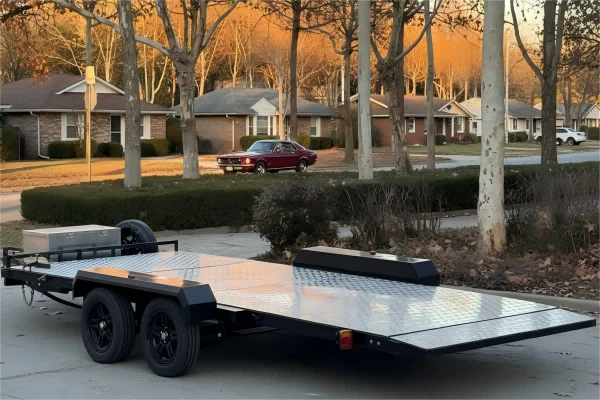
Choosing the right car trailer size isn’t just about placing a vehicle on the deck. For sports car owners, the wrong trailer size can lead to damaged spacers, scraped bottoms, an unstable trailer and long-term wear and tear that is easily avoided with better planning. This guide focuses on how to select the right car trailer size for sports cars, especially low-clearance vehicles, using real-world operating experience rather than generic specifications.
Wheelbase and overhang geometry create additional challenges. A sports car may not be particularly long overall, but its approach angle is limited by the front overhang. In practice, this means that the load angle matters more than the overall length of the trailer. Cars tend to scrape not because the trailer is too short, but because the transition from floor to deck is too aggressive. Sensitivity to weight distribution adds another layer of complexity. Sports cars often have a lower center of gravity and a different front-rear balance compared to SUVs. Small tongue weight errors can result in trailer sway at highway speeds or reduced braking control. This is why the trailer size of sports cars cannot be evaluated using general purpose transportation logic.
Before choosing a trailer, it’s important to understand the typical dimensions of sports cars and how those measurements factor into trailer size decisions. Most modern sports cars fall into three broad categories: compact roadsters, performance coupes, and supercars or track-focused builds. Compact roadsters are relatively short, but still sit very low. Performance coupes are wider and heavier, while supercars often combine long wheelbases with extremely low ground clearance.
Ground clearance benchmarks matter more than horsepower or curb weight. In practical terms, low clearance usually means less than five inches on the front bumper or splitter. Vehicles below this threshold require careful control of the ramp angle and deck height. A powerful car with adequate clearance is often easier to load safely than an underpowered car with aggressive aero components.
Trailer width plays an important role in day-to-day use, especially for sports cars that are wide in relation to their length.
Trailer brakes are essential for controlling downhill speed, managing heat build-up and executing emergency stops.
Compact sports cars can sometimes be transported on shorter trailers, but clearance and axle configuration remain critical considerations. Performance coupes typically benefit from mid-length trailers with wider decks and balanced axle configurations. These configurations provide predictable load behavior and stable towing. Supercars and track-focused vehicles typically require longer decks and tilting bed designs. Whether the trailer is open or closed depends on usage and storage needs, but load geometry remains the primary concern.
Choosing the right size car trailer is ultimately about reducing risk at every stage of transport. Trailers between 18 and 20 feet provide sufficient deck length to improve load geometry while maintaining stable towing behavior. When combined with a tilt platform, tandem axle setup, and electric brakes, this setup minimizes stress on both the vehicle and the driver. Selecting a trailer that is slightly larger than the minimum allows for safer loading, accommodates future changes, and provides long-term reliability.
