

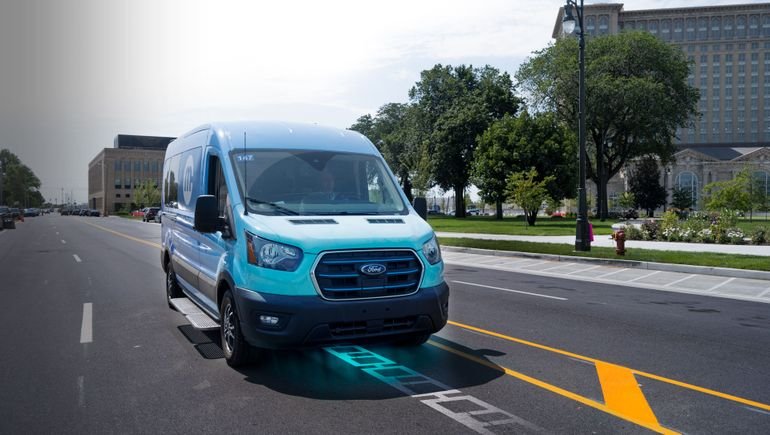
A transportation innovation district in Detroit recently demonstrated a wireless charging road, a technology intended to allow electric vehicles to move or park along the road to charge their batteries without plugging them in.
The quarter-mile electric highway was designed by Electreon, which was awarded the $1.9 million contract by the Michigan Department of Transportation in early 2022 to develop a wireless charging highway. The roadway is one of the technologies designed at Central Michigan, the billion-dollar innovation center and subsidiary by Ford Motor Company.
To enable the electric way, crews rubber coated copper coils installed down the road, which is located on the Michigan Central campus in Detroit’s Corktown neighborhood. When electric vehicles equipped with Electreon receivers pass over embedded copper coils in the road, the batteries are charged wirelessly. Michigan Central and Electreon demonstrated the wireless charging technology on a strip of road last week with a Ford E-Transit commercial van equipped with an Electreon receiver.
As electric vehicles gain popularity, ensuring that charging infrastructure is available and accessible has been a priority for automakers and governments. In July, BMW, General Motors, Honda, Hyundai, Kia, Stellantis and Mercedes-Benz said they would collaborate in a joint venture to install at least 30,000 high-powered electric vehicle chargers along major roads and in the urban areas of North America. The first charging stations will open in the US next summer.
Yesterday, Ford Pro, the commercial arm of the automaker and utility provider Xcel Energy said they would partner to install them. 30,000 electric vehicle charging points for business fleets by 2030. They will start first in Colorado and Wisconsin next year.
The Biden administration also has a goal to build on 500,000 EV chargers all over the country
Roadside charging technology “can be the catalyst to accelerate the interest and acceptance of electric vehicles for all consumers,” said Bradley Wieferich, director of the Michigan Department of Transportation. he said in a statement.
This technology can also mitigate “range anxiety” – the fear that an electric vehicle battery will run out of power before it can reach a charging station. However, a recent Recurring survey found that a person’s range anxiety drops substantially after actually buying an EV.
Electreon is working similar roads in France, Sweden, Germany, Norway and Italy. Michigan’s wireless charging highway is expected to be open to the public within the next few years. When complete, it will be a mile long.
Central Michigan was the creation of Ford executive Bill Ford Jr. with the aim of becoming a technological center developing mobility solutions for a community.
