

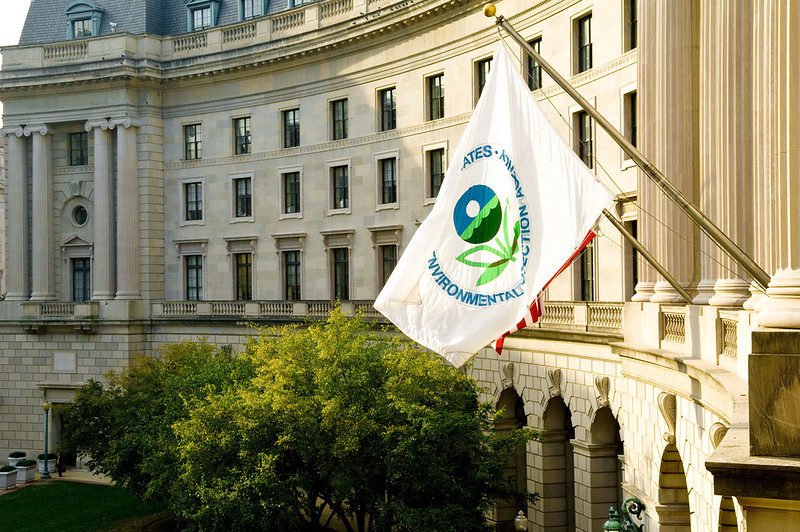
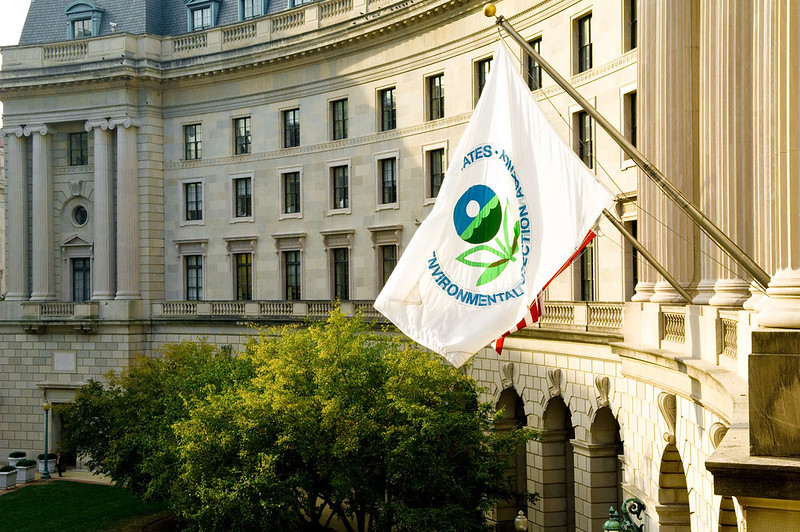
In a move it says will improve the health of millions of people and reduce soot pollution, the US Environmental Protection Agency announced on February 7 that it was reducing the amount of fine particulate matter allowed in the air.
The final rule, an update to the National Ambient Air Quality Standards (NAAQS), lowers the allowable amount of fine particulate matter, also known as PM2.5, from 12 micrograms per cubic meter to 9 micrograms per cubic meter.
Exposure to fine airborne particles, also known as soot, is a known cause of asthma in children and adults, and has been linked to a number of respiratory illnesses and other health problems. Because soot production is tied to industrial production, many lower-income and disadvantaged communities are exposed to high levels of fine particles.
“Soot pollution is one of the deadliest forms of air pollution, and it affects our most vulnerable communities,” EPA Administrator Michael Regan said at a press conference. “Stronger air quality standard announced today is based on science.”
Dr. Doris Browne, former head of the National Medical Association, which represents approximately 50,000 black doctors and medical professionals, noted during the briefing that the stricter standard has numerous public health benefits, including preventing 4,500 premature deaths and more than 800,000 cases of asthma symptoms. . The EPA’s Regan added, “Healthy people equal a healthy economy. We don’t have to sacrifice people to have a healthy, booming economy.”
Industry retreats
But manufacturing and construction groups had already opposed the proposed lower limit, citing how millions of dollars spent on emissions control equipment and other initiatives have helped reduce the country’s PM2.5 levels by more than a third in the last 20 years.
EPA’s final rule has already sparked some industry protests. “This new rule strikes at the heart of the U.S. cement industry’s ability to meet the Biden administration’s infrastructure goals, as it would lead to fewer operating hours at plants, which would mean layoffs, as well as less American cement and concrete at a time when the country needs it most,” Portland Cement Association President Mike Ireland said in a statement.
Under the new NAAQS, states will have several years to put plans in place to meet the new PM.25 levels. The EPA estimates that it is unlikely that any state will need to have its plan in place before 2032. Based on EPA projections based on historical sensor data, nearly every county in the US is expected to meet the new rule in 2032, with only 52 counties not meeting the standard of 9 micrograms per cubic meter. Of those 52 counties, 23 would be in California.
But a looming threat to withhold federal highway funding from noncompliant states could complicate much-needed infrastructure work, said American Highway and Transportation Builders Association President Dave Bauer.
“EPA’s final rule is not only unnecessary, it would also make it more difficult for many state and local transportation agencies to access funds from the bipartisan 2021 infrastructure bill aimed at reducing traffic congestion and greenhouse gas emissions. greenhouse effect,” Bauer said in a statement after the agency’s announcement.
Sen. Shelley Moore Capito (W.Va.), the ranking Republican on the Environment and Public Works Committee, criticized the new rule as unrealistic. “To comply with this rule, states will have to limit development across large areas of the country, threatening manufacturing and energy projects, limiting economic growth and leaving millions of Americans behind to deal with the negative consequences.”
Across the aisle, Senate EPW Committee Chairman Tom Carper (D-Del.) said, “I applaud the EPA for finalizing this strong clean air rule that will safeguard public health and the environment “. Carper had previously sought to tighten the NAAQS for PM2.5 and in 2020 criticized the Trump administration for choosing not to develop new standards.
