


On Oct. 23, President Donald Trump approved major disaster declarations for three states while rejecting similar requests from Illinois, Vermont, Maryland and Wisconsin, a series of Federal Emergency Management Agency decisions that appeared to follow a partisan line, according to public records and Associated Press reports.
FEMA approved major disaster declarations for Alaska, Nebraska, and North Dakota in response to summer and fall storms that caused widespread coastal and inland damage, allowing for both individual and public assistance. But he denied similar requests elsewhere.
RELATED
The White House order moves most of FEMA’s emergency response to the States
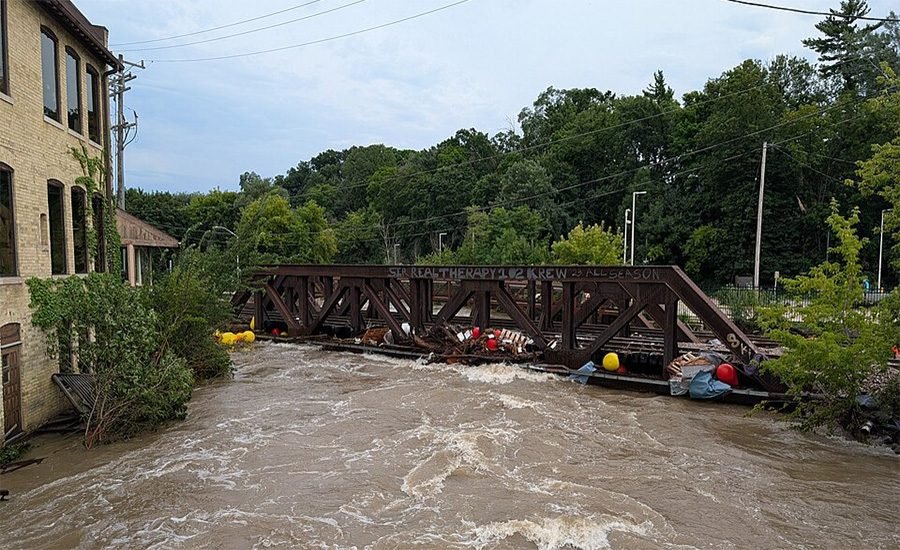
In Wisconsin, the agency rejected a request for public assistance for six counties affected by the August floods, saying “the program is not justified.” Similarly, Maryland’s request for aid after the May floods and its appeal were rejected. Vermont’s request for public infrastructure repairs due to flooding in July was also denied, as was Illinois’ request for disaster aid after storms in mid-August.
Trump highlighted Alaska’s approval in a social media post, writing that he was “approving $25 million to help Alaska recover,” adding, “It’s an honor to hand over to the Great State of Alaska, which I won BIG…I will never let you down.”
Blue states get the cold shoulder
Illinois Gov. JB Pritzker (D) requested a federal disaster declaration for five counties — Boone, Cook, Kane, McHenry and Will — after storms and flash flooding Aug. 16-19 caused widespread damage. Senators Dick Durbin (D) and Tammy Duckworth (D) urged the administration to approve the request, citing torrential rains and destructive winds.
Maryland Gov. Wes Moore (D) blasted FEMA’s pushback after the summer floods, saying, “This result is not only deeply frustrating, but it ignores the devastation caused by historic flooding in Appalachia and leaves Marylanders alone. President Trump and his administration have politicized disaster relief, and our communities will pay the price.”
In Wisconsin, Gov. Tony Evers (D) called the denial of aid to six counties “disappointing and short-sighted,” saying it “sends a message to our communities that they are on their own and that the Trump administration does not believe that more than $26 million in damage to public infrastructure is worthy of assistance.” Wisconsin’s denial covered Door, Grant, Milwaukee, Ozaukee, Washington and Waukesha counties.
A brief letter from FEMA to the state explained that “After evaluation of damage assessments, the public assistance program is not warranted.”
Vermont officials also expressed frustration after weeks of delays despite widespread flooding that damaged roads, bridges and culverts across the state.
FEMA thresholds and policy face new scrutiny
FEMA’s public assistance program funds the reconstruction of public assets such as roads, bridges and utilities. When they are refused, local governments must bear the costs or postpone the work.
While FEMA hasn’t released a denial rate since 2025, its most recent open data list shows 17 denials so far. ENR reviewed the agency’s “Declaration Denials” data set, but was unable to access the current 2025 approval data because FEMA had not yet made it publicly available. However, a year-to-date analysis of denials found nine in states led by Democratic governors and eight in states led by Republicans, a roughly even split.
Disaster declarations approved
Alaska (October 22, 2025): West Coast storm damage in early October. Federal assistance approved for coastal recovery programs.
Nebraska (October 23, 2025): Severe storms, straight-line winds and flooding August 8-10. Major disaster declaration granted for several counties.
North Dakota (October 23, 2025): August strong storms. The declaration of severe disaster is approved for the affected communities.
Requests denied
Wisconsin (October 23, 2025): Flooding August 9-12. The state requested public assistance for six counties; FEMA determined that assistance is “not warranted.”
Illinois (October 23, 2025): State asked for individual assistance after mid-August storms; request denied
Vermont (October 24, 2025): July 10 flooding roads and damaged bridges. The State’s request for public assistance has been denied.
Maryland (October 24, 2025): Western Maryland flooding May 12-14. Initial and appeal requests for public assistance; both denied.
Source: FEMA
The balance sheet suggests the pattern may reflect evolving FEMA eligibility criteria rather than overt political preference, although the clustered timing of these latest decisions has drawn public scrutiny.
The president has also been vocal in the public comments that have led to the partisan conclusion since the start of his second term.
In January, Trump signed an executive order establishing a FEMA “review board” to evaluate the agency’s structure and spending priorities. The order said “there were serious concerns of political bias at FEMA and that agency funds had been used for programs related to incoming migrants.”
The White House said the move was intended to “restore accountability and ensure FEMA’s resources are directed toward natural disaster response,” Reuters reports. However, critics saw it as an attempt to centralize control over disaster relief decisions.
A review by the Government Accountability Office found that about 18 percent of major disaster requests between fiscal years 2020 and 2023 were denied, reflecting stricter scrutiny of what qualifies as “severity and magnitude.”
Historically, GAO reported that presidents approved about 86 percent of requests between 2004 and 2011, and independent analysis found that approvals exceeded 85 percent between 1991 and 2011.
