


This audio is automatically generated. Please let us know if you have any comments.
Matt Hedke is director of VDC Solutions at contractor Barton Malow in Southfield, Michigan. The opinions are the author’s own.
Technological breakthroughs often occur after some trial and error, but their success is not accidental. Industry-changing innovations require careful planning, a deliberate process, and most importantly, a commitment to innovation and empowerment to “fail forward.”
Empowering team members to innovate from the top down is critical to continued growth and new ideas, but empowerment without an organized process is not only inefficient, it can also be costly. We found that while our people were continually pushing forward and developing creative solutions, much of it happened in silos, resulting in pockets of innovation with no framework to maximize it.
It was then that leadership began a deliberate effort to develop a scalable a process that teams across the organization could repeat, resulting in a more widespread deployment of tests to change the game even further.
To ensure cost and time efficiency, it was important to first bring together our innovation team, which included people from different roles across the organization for the initial review of any potential innovation. Our first priority was to build a smaller team with many roles represented to determine organizational success metrics and alignment alongside the project.

Matt Hedke
Permission granted by Barton Malow
These metrics include potential savings and how to measure them, the effect on factors such as safety, cost, and schedule, and may vary from project to project.
Once metrics are established and an idea ticks the boxes to move forward, it then moves to a larger group based on the problem, project and proposed solution. This group includes project and executive team members who work together to narrow down solutions before starting major research and advancing to the demonstration phase. If the demo phase is successful, it’s time to officially pilot the concept.
Before we deploy any resource, we make sure there’s a clear problem our innovation would solve, we have a clear picture of the target audience, and we make sure everyone on the team understands how we plan to measure success and support the proposed solution If something ticks all those boxes, we roll it out across the company.
Creating efficiency through robotics
A recent technology that is currently being tested in many of our projects is the use of robotics to laser print designs on concrete slabs. Often, the design area is condensed and may have some restrictions on the use of space.
Dusty Robotics’ field printer is essentially a laser beam printer that works much like a Roomba, moving around the site based on inputs from the CAD file created by the VDC team. The team works to identify what needs to be designed or printed based on the needs of the project (things like interior wall lines, layout areas, notes and design of various operations down to 1/16 inch) using CAD files from the coordinated BIM model. to create the necessary documents.
Once the documents are reviewed and approved, the JSON files are sent to the robotic printer, which then follows these documents to print the line work onto the floor or slab.
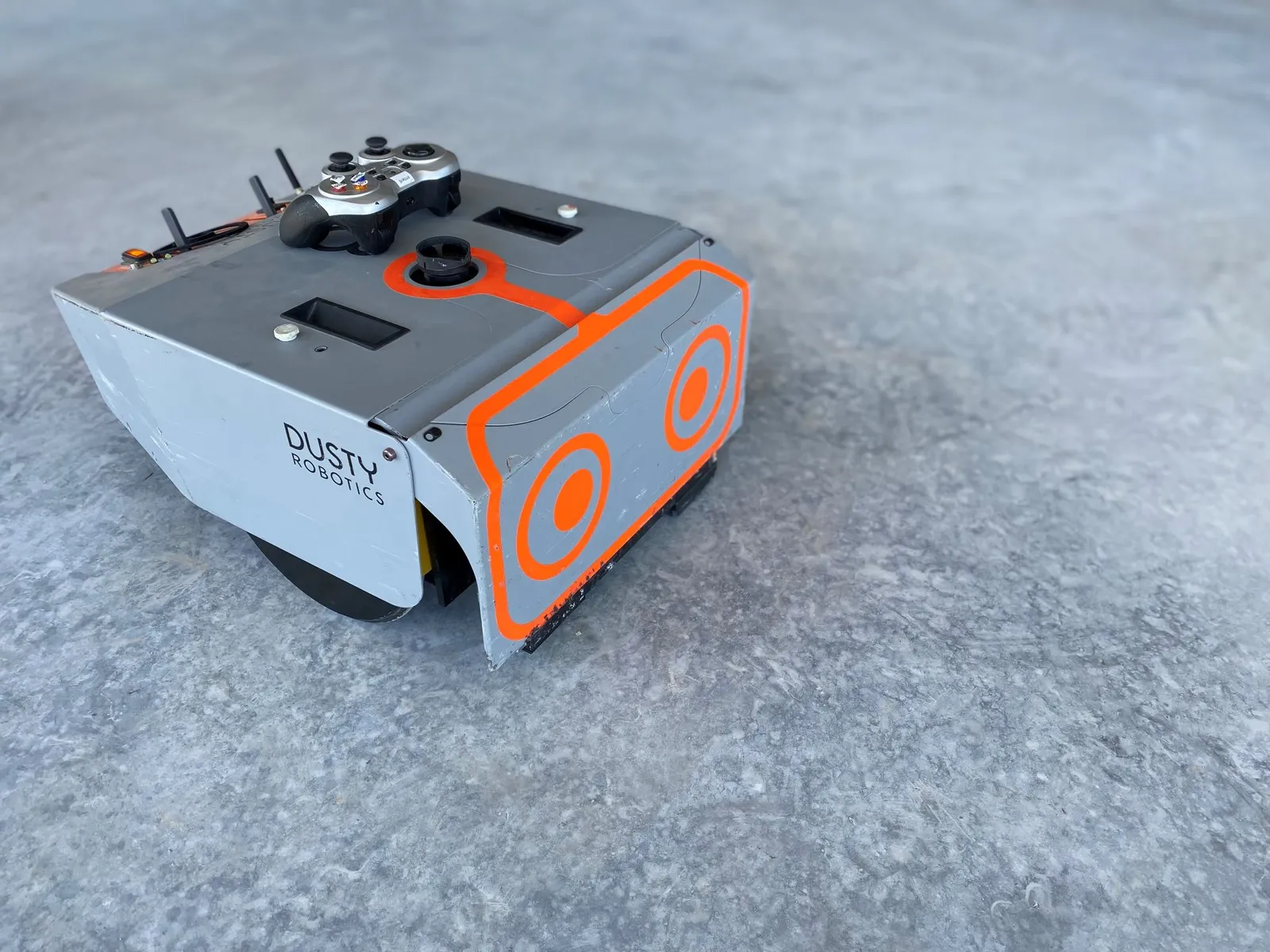
Dusty Robotics field printer
Permission granted by Barton Malow
Project teams across the organization are using this robotics technology and are seeing results with multiple vendors and use cases. Some of these include:
Distribution of the prefabricated floor. Tasked with building on the ground floor, loading floors with material and lifting that floor into place is common practice on Barton Malow’s LIFTbuild projects. In a recent project, a laser-printed robotic layout enabled completion of the layout on each floor, including material staging areas, notes and multi-trade design immediately after the floors were cast, but before the material was loaded into the slabs for the elevator. .
This was critical to the overall schedule and proved to be of great benefit not only to the pre-planning and layout of various trades, but also to improved safety by reducing manpower in the place in a small area.
Distribution of the interior wall. The use of laser-printed robotics for the layout of interior walls has also proven to be highly productive. Not only does it speed up the design process, but it also allows our centralized VDC design team to clean up drawings for design issues before they’re on site. As the team is creating the JSON files for the printer, we are collaborating with the project team on sequence, build plan, potential issues or RFI in the design in advance so that we can increase the efficiency of the file .
Using robotic technology, the JSON files were created in two weeks, and Dusty Robot printed 10,700 linear feet of wall line, 972 linear feet of text, and 1,071 total text objects in 45 hours of Dusty Robot runtime, according to Wade Tolle, centralized design. team member This is significantly faster than traditional design methods.
Barton Malow is committed to continuing to test technology in our projects. This includes leveraging innovation to improve projects and benefit our workforce.
When deployed and applied correctly, these innovations have the added benefit of increasing the efficiency and longevity of our people in the field. Finding solutions to improve our customers’ outcomes is important, but so is maximizing future advancements to help our people innovate the future of the industry efficiently, effectively and safely.
