

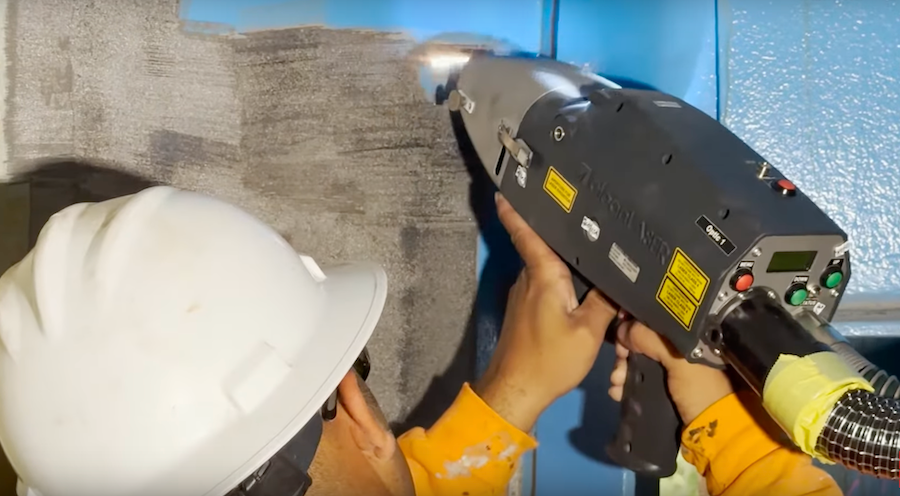
It’s not just a ray gun and it’s not a handheld vacuum cleaner.
But a 1,000-watt laser that crews recently tested on a Connecticut Department of Transportation bridge worked as a combination of both: vaporizing paint and rusting the 36-inch ends. steel H-beams with a laser then capturing vaporized waste by suction with a fume extractor filter unit.
Unlike traditional methods of abrasive blasting, chemical pickling or power tool cleaning, the 14-day operation required no heavy equipment, containment systems or traffic closures.
The pilot project, which ended last month, came about thanks to an Instagram video.
Jagdeesh Gopal, director of bridge engineering at GM2, a consultant to the state DOT, saw the laser being used in a manufacturing setting. “We were doing a kind of repair for … where I thought it could be used directly,” he says. “I went down that rabbit hole and investigated what had been done to the bridges.”
The Virginia Department of Transportation has used laser ablation coating removal for bridge maintenance for several years, after Dino DeFendini, field services manager for DRMP Inc., saw a demonstration by laser supplier Adapt Laser. “It’s great to see how it’s gone,” he says. “The machinery footprint is more compact, the laser is more powerful and precise, and it doubles how we normally remove paint using DOT procedures.”
He adds: “Disposal costs are reduced to 10% of what they would normally be. [The waste] it doesn’t have to be so contained in the same way. Reduces shipping costs and footprint. Use 150 to 300 gallons of diesel almost daily with standard [methods]”That eliminates that.”
For the Plantsville Bridge, contractor Best-Tec removed paint and rust from the girder ends in 36 locations before welding the shear tips to the girder web. The temporary cover suspended from the bridge girders allowed access. The laser ablation equipment was delivered to the site and operated from an enclosed trailer that did not interfere with traffic or the use of the pedestrian walkway. The laser’s power source was kept on the equipment trailer while the beam was delivered via 150-foot-long fiber optic cables to a hand-held laser effector, according to Best-Tec.
Technicians swept the laser beam across the surface, removing paint and rust to expose clean base surfaces. Vaporized paint and oxide debris were immediately captured in the laser end effector by suction from a filter unit. The extractor had three stages of filtration: particle filters with a self-cleaning mechanism, activated carbon for gas and a high-efficiency particle air filter.
The sand blast would have generated between 9,000 and 12,000 pounds of spent shot blasting material mixed with hazardous paint residue. According to Best-Tec and Adapt Laser officials, the waste generated by the laser ablation coating removal process was approximately 40 pounds of dry powder.
“It’s the greenest disposal method—you can’t get any greener,” says Greg Kleinrichert, vice president of Best-Tec. “You’re bringing the incinerator to the paint, not the other way around.”
This laser abrasive method has been used in the automotive, welding, military and aerospace industries, but is still relatively new to the infrastructure world. Tim Niemeier, vice president of Adapt Laser, hopes the Materials Performance and Protection Association will soon adopt a standard and technical guide for the method.
According to the American Association of State Authorities and Transportation Officials, bridge painting is done by highway agencies every five to 15 years as a preventive maintenance activity to extend the life of steel bridges.
Laser ablation coating removal “offers significant cost savings, health and environmental benefits over traditional methods,” according to the association’s website. “It reduces the release of airborne pollutants to extremely low levels, which in turn improves industrial hygiene and worker safety, requires less personal protective equipment and improves the safe disposal of hazardous waste.” In addition, it is “highly effective and efficient, as no containment structure is needed and one-off ‘tweaks’ or repairs can be made.”
The process is “slightly more expensive per square foot” compared to traditional methods on major removal jobs, DeFendini says. [the technology] it continues to improve, which will decrease significantly over time.” He adds that VDOT has been cost-competitive for bridge maintenance: “Maybe not for 3,000 square feet of steel, but for 200 square feet, it’s very competitive.”
Gopal adds that the process is slow. “The laser can only remove certain amounts of paint at a time. But it cleans to a nice finish that’s almost perfect for the application” of new paint, he says. As the cost of lasers comes down, more workers can use them in tandem, he adds.
Kleinrichert agrees that the technology has potential to increase the speed and types of applications. “We expect the lasers to go up to 2,000 watts or other levels,” he says. “I see this expanding for different applications, such as removing salts that corrode metal.”
Niemeier adds that the technology lends itself well to the future automation of this particular construction task: “Robots will do it,” he says.
