

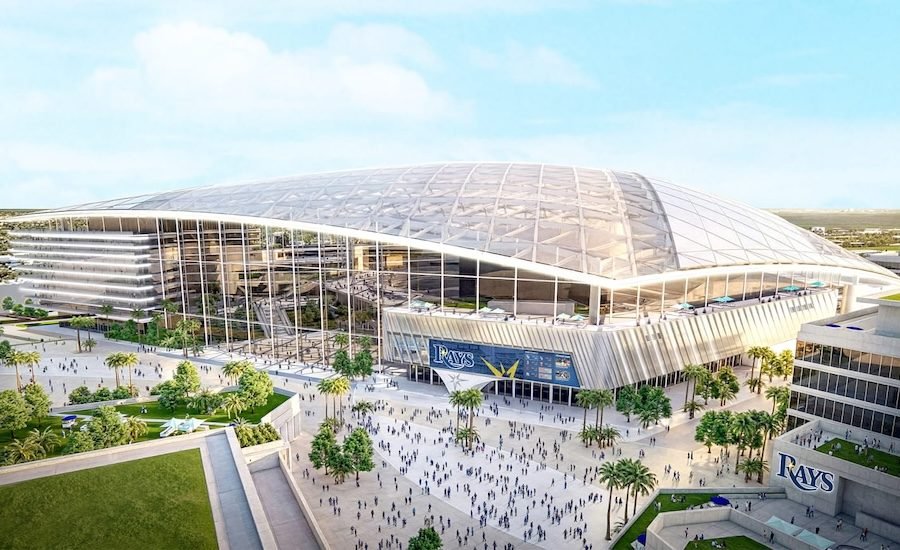

The Tampa Bay Rays have released the first set of concept drawings for their $2.3 billion mixed-use stadium project to be located on a 113-acre site leased from Hillsborough College in Tampa.
Plans call for a 31,000-seat stadium, smaller than any existing permanent Major League Baseball stadium, to be open in time for the 2029 season and offer multiple seats, concourse areas and year-round event spaces. An adjacent “Champions Quarter” neighborhood could include “hotels, commercial space, multifamily buildings, sports and health-related buildings, commercial buildings, parking structures, restaurants and other related buildings,” according to the team’s January 2026 non-binding memorandum of understanding (MOU) with the university.
No contractor has been named for the project, which the Rays say is being designed by a Populous-led team that also includes Gensler, Kimley-Horn, RCLCO, Beck, Walter P Moore, Terracon and ME Engineers. Mortenson had been tapped for an earlier plan to build a $1.3 billion stadium for the Rays as the centerpiece of a proposed redevelopment of St. Petersburg’s 86-acre historic gas plant district. The stadium component was abandoned shortly after a new ownership group took control of the team last September.
Known as Hillsborough College’s Dale Mabry Campus, the proposed development site is across from Raymond James Stadium and adjacent to George M. Steinbrenner Field, the New York Yankees’ spring training facility that served as the Rays’ temporary home last season after 2024 Hurricane Milton tore fabric panels from the dome roof and damaged areas of the Tropicana building. The repairs are expected to be completed in time for the team’s first home game in 2026, the first of three seasons remaining on its contract to play at the 36-year-old multi-use stadium owned by the City of St. Petersburg.
The Rays’ MOU with Hillsborough College, which calls for a minimum 99-year lease for the new stadium and mixed-use property, says construction of the stadium and mixed-use development “shall be done in a manner that minimizes interference” with the school’s operations and activities, including demolition of existing campus structures and construction of temporary facilities. In addition, new academic facilities are to be built on a portion of the site that will remain under university ownership.
According to local news reports, the cost of building the stadium is to be split between the Rays, Hillsborough County and the city of Tampa, with the team paying at least half and covering overpasses, repairs and maintenance and future capital improvements. All mixed-use elements must be privately financed.
