

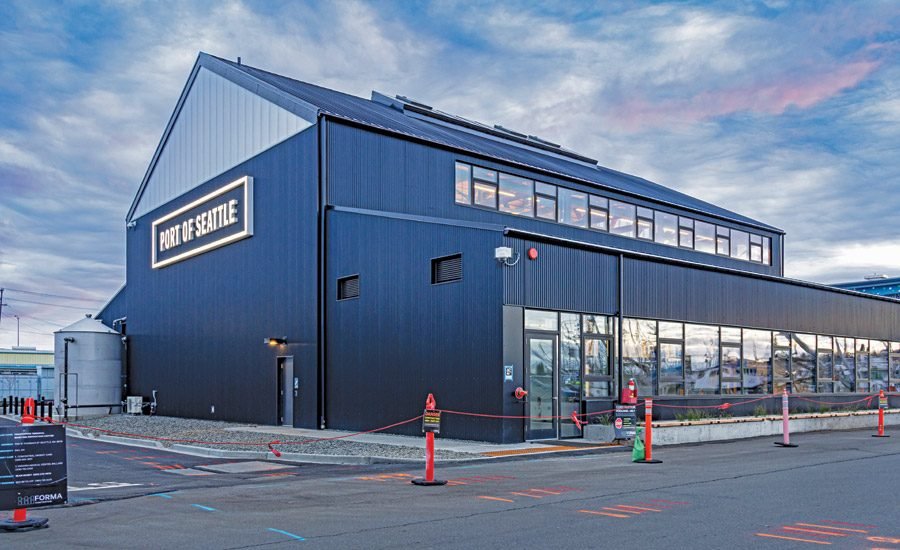
The 1914 wooden boat supply building at Seattle’s Fisherman’s Terminal had a lot of history. This history also caused the structure to sink and lean into the waterfront fill, leaving it a precarious site, a non-obvious choice for rehabilitation as a Living Building Challenge (LBC) project.
The Port of Seattle worked with the Miller Hull Partnership and Forma Construction to restore what is now the Maritime Innovation Center, reusing the historic wooden beams to create a building envelope that mimics the original. The project also replaced the piles below the sinking section in Salmon Bay, creating a seismically reliable concrete and rebar slab that houses the structure. The team then installed a number of LBC-ready components, including a complete gray and black water reuse system.

To preserve the historic character of the building, the design team had to build within the same envelope, although they were able to create more usable space within the structure by adding modern elements.
Photo courtesy of the Port of Seattle
“Converting a 100-plus-year-old facility into a sophisticated building, especially an environmentally sustainable Living Building Challenge, posed many challenges that we were excited about,” says Kyra Lise, the port’s director of real estate development. “It’s the kind of vision that the port needs to continually modernize.”
With ground broken in May 2024 on the $37 million project, the port-owned building reached substantial completion in February, although work is underway on site to wrap up construction before tenant improvement requests are made. It will be leased by Washington Maritime Blue as a collaboration center for a confluence of major maritime industry stakeholders.
Located in Salmon Bay, east of Ballard Locks in Seattle, the site is no more than 45 feet from buildings in use on either side, giving crews a narrow footprint to rehabilitate the structure, which was moved approximately 106 feet to the parking lot so crews could make new pilings and lay a new slab.

Crews reused the historic building’s envelope and wood, but added a steel bracing system to meet seismic codes. The braced frame is now interlaced between existing wooden trusses and columns.
Photo courtesy of the Port of Seattle
From the jump, crews knew the existing piers and piers were rotten. And with codes updated over the past 100 years, the port had to adopt the same footprint for the new structure, forcing the port to replace piers and repair floors characterized as “black mayonnaise,” says Lise.
“We’re in seismic design category D, the most difficult apart from having a failure,” says Mike Jobes, director of Miller Hull Partnerships and design lead at the Center for Maritime Innovation. “It’s a major liquefaction zone. It’s all filled in. It wasn’t just about repairing the batteries, it was about replacing them.” This required lifting the structure, moving it and then grabbing the piers and soil before moving the building back to the new supports.
The movement of the building’s thin skeleton, essentially a timber truss roof system, proved precarious due to the condition of the building. Subcontractor DB Davis LLC had to lift the building, place it on rollers and move it in small increments. Thanks to the settlement, crews had to realign the building and create a bracing system for lifting and lifting to make sure it was level.


The design team reused every piece of wood from the historic site that was not contaminated. Some of the pieces remained in their structural form or were merged with new construction to level the building. Some timbers that were not part of the structural elements of the center were used as roofing or for other features.
Photos courtesy of Miller Hull
“When we took the building apart and took the skin off, we found the old structure,” says Kelly Purnell, Port of Seattle project manager. “We couldn’t see everything, it was covered. Some of the columns were bent almost 3 inches and some of the columns were sitting on a block of nothing. We had to splice the columns to make them the same length, there was so much change in the way the building sat.”
The next tricky part was maintaining this level during the move. “It was an interesting challenge,” Purnell says. “When we moved it, it wasn’t a completely flat surface.” The entire site was settling on bad soils, and the building moved inches at a time with constant adjustments to keep it level.
“There is a new structure woven between the old structure.”
— Mike Jobes, director of Miller Hull Partnerships
Engineers contemplated dismantling and reassembling, but with the truss joints so old, there were concerns that the structure would not fit back together. Moving it eliminated the assembly, which Jobes says “was worth it.” Crews removed two wings of the building’s barn and reassembled them to make moving the main structure easier.
Located in a significant zone of soil liquefaction, repairing piles was not the answer. Jobes says they replaced the existing piers with thirty-nine 24-in. steel piles driven 90 feet deep to support the structural concrete and slab and rebar cap up to 3 feet thick. “This slab is so sturdy that it will hold up after the apocalypse,” says Jobes. “It’s an incredible foundation that took some serious effort and cost.”
Driving the stacks required depth. “What was described to us was the first 25 feet that the piles were oozing,” says Jobes. “He didn’t take any driving.”
To bring the building up to code, the design reused the historic wood truss system and enhanced it with a new steel frame, alternating between the existing wood trusses and columns and the new green steel. “There’s a new structure woven in between the old structure,” says Jobes. “It’s clear which is old and which is new. We basically have a whole new building inside the existing building, almost a changing seismic code data landscape.”

The reused materials help the building retain its historic character but also reduce the carbon impact of the project.
Photo courtesy of the Port of Seattle
During the final movement, Jobes says the structure was literally hung from a crane, like a shirt on a hanger, and the columns were different lengths due to settlement, requiring new column bases at varying heights.
In the end, the port kept the building’s historic 15,693 gross square meters envelope, preserving the original dimensions of the structure.
Purnell says dealing with the floors was always going to be tricky, with wooden piers rotting and leaving voids in place. Although the team knew they would find many surprises centered in the soil, they were not prepared to discover a 5,000-gallon riveted tank underground. “I still had old fuel from who knows what at the time,” Purnell says. “It had to be corrected.” The team also encountered an archaeological find and settlement issues when working with existing utilities.
“If you name it, we found it out there,” says Purnell. “It was a lot of banging for a while there. What we had considered the biggest risk was the known unknowns.”

The Maritime Innovation Center will serve as a hub of activity on Seattle’s waterfront, providing a visible example of the fusion of historic and modern elements.
Photo courtesy of the Port of Seattle
Dealing with the old and adding the new didn’t even consider the LBC component of the project. Chris Hellstern, director of sustainability at Miller Hull Partnership with expertise in the Living Building Challenge, says he is proud of the way they repurposed the building. “The idea of being able to take a 110-year-old structure on a working waterfront and rehabilitate it is new to the Living Building Challenge,” he says. “It’s the oldest renovation and the first on a working waterfront.”
Hellstern says opting for an LBC project aligned with the port’s energy and water goals while becoming the greenest port in North America. One of the key benefits was the reuse of existing building materials to reduce embodied carbon. The team hosted the old school trades. Craftsmen reworked the solid wood of the old structure into hand-crafted laminated wood decks. Jobes says that virtually every piece of wood that wasn’t contaminated was reused in some way. A derelict interior portico built of wood was key to this, and parts of the old wood were reclaimed as oversized benches for the interior of the building and served as bollards outside.
Arguably the most unique element brought by the LBC was that the building drew its own gray and black water from the site. With Seattle’s already strict energy codes, the port stepped up to the plate with an efficient envelope, a geothermal exchange system, photovoltaic panels and all-electric systems.
“I hope people take away that these types of buildings are possible today,” says Hellstern, noting that the biggest challenges were not related to the LBC and that even a risk-averse agency like a port can take on such a project. “It shows a path for so many other organizations across the country.”
