

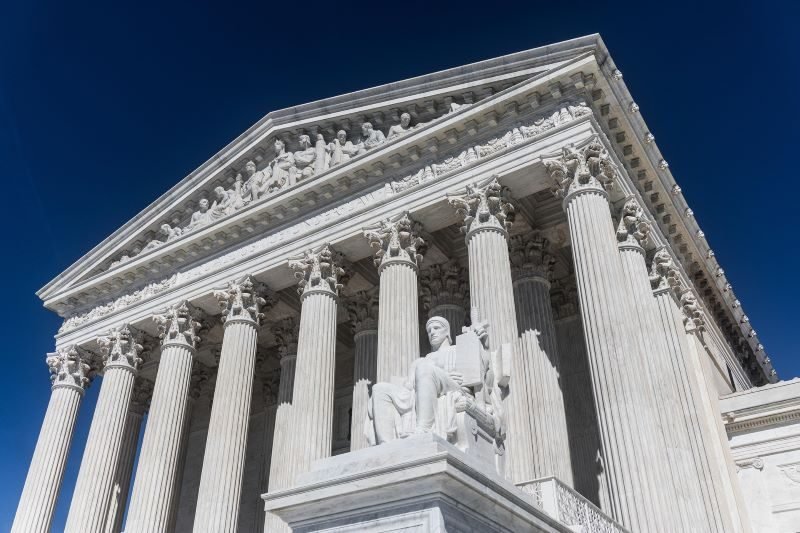

Supreme Court justices appear likely to agree with President Trump that he can fire appointed leaders of some independent agencies at will, after hearing arguments and questioning from government lawyers and former federal trade commissioner Rebecca Slaughter on Dec. 8.
Slaughter is challenging his firing by Trump in a case that could redefine how more than a dozen agencies operate and shift power from Congress to the executive branch.
Lawyers for Slaughter, a Democrat, argued that she should be reinstated because of a 90-year sentence, Humphrey’s Executor v. United Stateshaving said that Congress had the authority to limit the president’s ability to fire independent agency heads for cause. Humphrey’s Executor the scope has been consistently limited by the decisions of the last two decades and the court’s conservative justices appeared to agree with the Trump administration that barring the president from firing FTC commissioners except in cases of “inefficiency, dereliction of duty, or malfeasance in office” violates the constitutional separation of powers between the three branches of government.
The Roberts Court has shown a willingness to review cases that have stood as precedents, such as this one Chevron v. Natural Resources Defense Council — when the majority of judges feel that these precedent-setting cases were wrongly decided or improperly applied by later rulings.
Loper Bright Enterprises v. Raimondothe decision that overturned Chevron last year had broad implications for construction, as agency heads no longer had the ability to interpret the law to create policy for four to eight years, deciding the impact of what defines “waters of the United States” or other legal terms. Slaughter’s decision may affect construction projects even more directly, as Trump has already removed members of the National Labor Relations Board as well as the FTC appointed by his predecessors, and the Federal Energy Regulatory Commission and Nuclear Regulatory Commission could also see their makeup changed by an emboldened Trump administration. Even the National Transportation Safety Board could see new members alter its oversight role in investigating highway and railroad accidents.
Some see this deregulation as overdue, however, as agency heads in several administrations were able to block change in everything from labor relations in workplaces to energy policy to deal with the AI boom.
“Independent agencies emerged a century after the ratification of a Constitution that never contemplated fourth branch centers of power. This makes impeachment authority a core constitutional function rather than a modern aberration. The anomaly is not only Humphrey’s Executor; it is the administrative state itself,” Clyde Wayne Crews of the Competitive Enterprise Institute wrote before oral arguments in the case began.
Under questioning, Attorney General John Sauer struck a similar tone, saying that independent agencies like the FTC are a “headless fourth branch” with limited government oversight and that, in general, “independent agencies are not accountable to the people.” He said the 90-year-old precedent, Humphrey’s executor, “must be overturned.” describing the ruling as a “decaying shill with bold and particularly dangerous pretensions”.
Sauer found unlikely agreement, apparently, in Chief Justice John Roberts, who prefaced one of his questions by saying that historical precedent “has nothing to do with what the FTC looks like today.”
Associate Justice Sonia Sotomayor, however, told Sauer that his argument would put agencies like the NLRB and FERC “at risk” without the benefit of congressional protection from executive action.
Associate Justice Amy Coney Barrett answered their questions that Congress had a legislative veto, which — until the Supreme Court ruled it unconstitutional — allowed it to override decisions by administrative agencies. Congress may have been willing at one time to give independent agencies like the FTC broad powers, he said, because it knew it could overrule the agency’s decisions. Now, he argued, independent agencies are not accountable to either Congress or the president. Without that check on their powers, independent agencies have become “something that Congress didn’t intend,” he said.
