

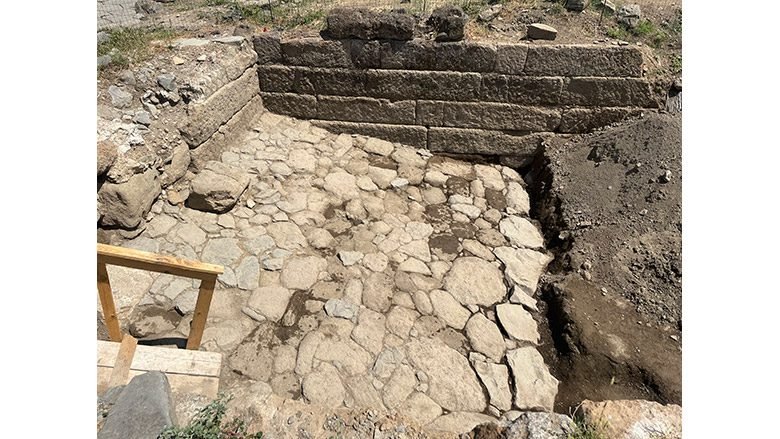

At the ancient Roman city of Gabii, just 11 miles east of the Eternal City, a team organized by the University of Missouri discovered a large stone-lined basin, partly cut into the rock, that members say is an example of early engineering ingenuity.
Dating to around 250 BC, and possibly earlier, the structure is one of the earliest instances of monumental Roman architecture beyond the temples and city walls. “The basin is a well-preserved example of skilled Roman stonework from the 4th and 3rd centuries BC,” says Marcello Mogetta, professor of Classics, Archeology and Religion at the university, who leads the team.
The basin’s precise stonework, integration with the natural terrain and long-lasting stability can offer valuable lessons for modern builders, showing how thoughtful design, durable materials and harmony with the environment can produce structures that stand the test of time. “Basins like this are rare, and this one predates Roman concrete and hydraulic mortar. Its design also shows how ancient engineers used the natural slope of the terrain—part of the ancient volcanic crater next to which Gabii was built—to their advantage,” he adds.
Gabii, once a powerful neighbor and rival of Rome, was first settled during the Early Iron Age, but was largely abandoned by 50 BC, with only limited resettlement. Unlike Rome, the site was not buried under centuries of later construction, allowing its streets and building foundations to remain remarkably well-preserved, a feature that offers a rare window into early Roman life, according to Mogetta.
“Gabii offers a detailed view of the development of Roman cities, from the first huts to stone houses. Its layers also allow us to study building materials such as Gabine stone and the volcanic ash used in Roman construction,” he notes. “The basin shows how public spaces and infrastructure were developed in the city.”
Researchers began exploring the area where the basin is located in 2022, and a year later discovered a large surface of natural rock called basalt pavement, made of volcanic rock, which completely hid the basin.
“Once we removed some of it, the edge of the basin became visible,” he says. “By 2024, the entire rim was exposed, and by 2025 we discovered a paved ramp going down into the rock-cut basin.
More work is being done to find out what the basin was for.
“Excavating the original soil at the bottom will tell us if it was fed by a spring or water table and if it was mainly for practical uses (supplying water to nearby buildings) or if it had a symbolic or sacred function,” says Mogetta.
One team member, Rome-based architect Carlo Moda, who has been involved in the Gabii dig since 2008, says learning about ancient construction techniques can influence modern ones and that the basin can be important, especially as countries deal with water shortages.
“The discovery of the water basin provides modern engineers with new insight into the water management of the ancient Latins,” he says. “In our times of water crisis, the experiences of the past can be enlightening in combining ancient knowledge and modern technology.”
Moda adds that working on the Gabii project—with its archaeologists, conservators, art historians, and others—has been a constant source of inspiration for my work. The interdisciplinary approaches offered by a project like this are stimulating and provide opportunities for my professional growth and knowledge.”
The project also includes experts in surveying, laboratory analysis, and environmental studies who help document the site, analyze artifacts, and assess flooded areas.
The team plans to continue excavating the basin in 2026, also studying an unexplained and unidentified feature discovered through thermal imaging scans, which may be a temple or other type of large civic building.
The Gabii project was started in 2009 by the Kelsey Museum of Archeology at the University of Michigan. Mogetta became project director in 2024. The University of Missouri now has the permit to dig, with 2025 as the first year of its three-year project.
The team is also studying whether civic spaces or religious centers emerged first. The answer could shed light on whether politics or worship had a greater influence on shaping the early monumental landscapes of Roman society.
As they piece together the clues, team members aim to piece together the story of Gabii – its rise, prosperity and decline – and the wider story of Roman architecture, construction and engineering and its continuing impact on the modern world.
