

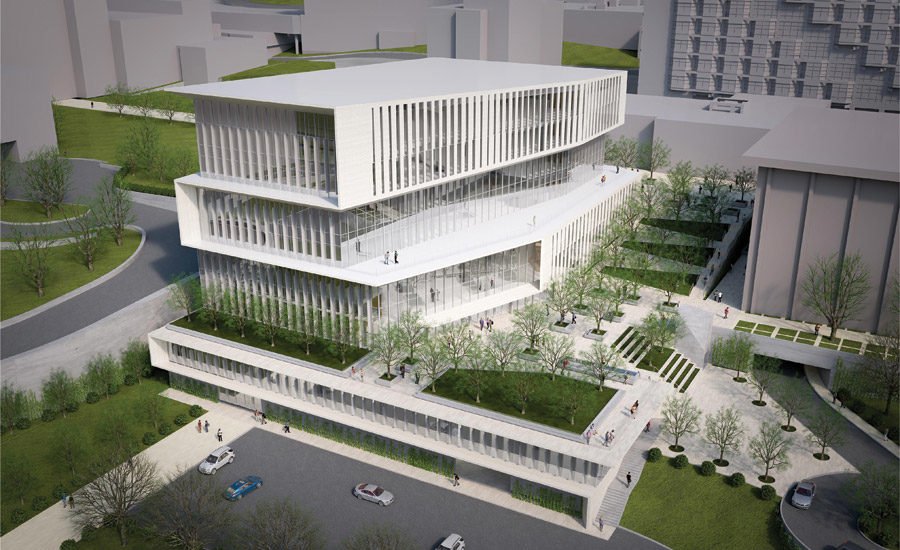
Along the crest of the University of Utah campus in Salt Lake City, the $185 million Spencer Fox Eccles School of Medicine is poised to help create “a new culture of learning” when open in 2026, supporting three key areas: education, research and clinical care. The 211,000-square-foot project will house the medical school and center for the university’s health sciences campus, one of about a dozen projects underway on the Salt Lake City campus.
Originally conceived before the pandemic, the project was approved by the Utah Legislature in 2017 with an initial state commitment of $50 million. It received a significant boost from a $110 million landmark gift from the George S. and Dolores Doré Eccles Foundation and the Nora Eccles Treadwell Foundation in 2021.
This funding supports project construction as well as medical education and research programs. The financial support and involvement of the Eccles family throughout the design process provided the opportunity to create an iconic gateway to the health sciences campus. “[It’s] a building that not only fulfills the aspirations of the program, but also has a distinctive presence on the health sciences campus,” says Mehrdani Yazdani, design director of Yazdani Studio at CannonDesign and design architect for the project.
The medical school will include a pavilion to serve as a central hub for global health-focused groups currently spread across campus. The building will house medical education spaces, including adaptive classrooms, a state-of-the-art advanced simulation center and a gross anatomy lab. Common areas such as the forum and learning centers are designed to foster collaboration between students, faculty and the state’s medical community.
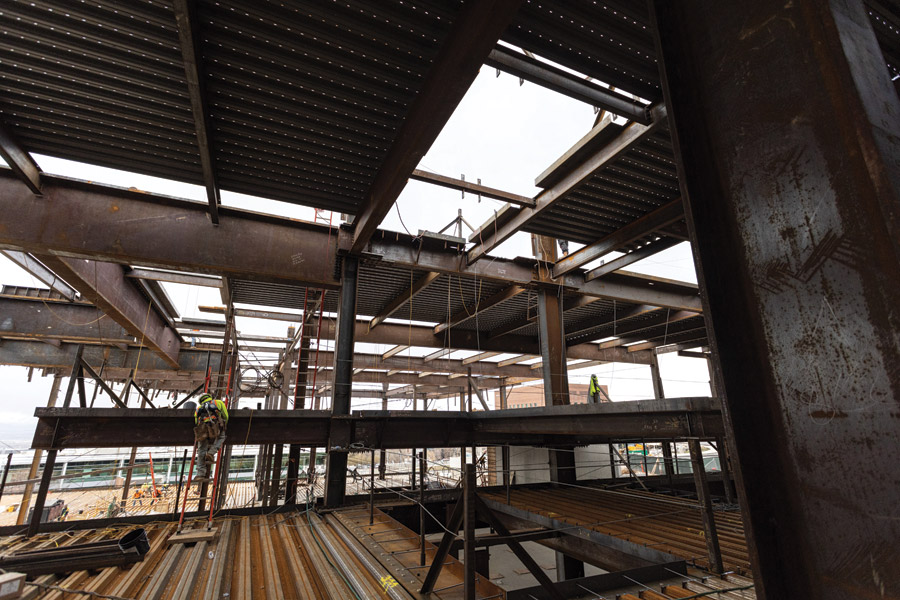
Structural steel is rising to create a landmark entrance to the health sciences campus.
Photo courtesy of Jacobsen Construction
Balancing act
Accommodating the myriad of program requirements was just one of many challenges. The site’s location near the top of the sloping campus meant the team had to work with a 40-foot differential from the highest to the lowest point.
“When we started looking at the project, we said that while there is this challenge with the slope and with the descent, it also presents an opportunity to create a gateway to the health sciences campus,” explains Yazdani. Existing pedestrian walkways on campus affected design decisions, he says.
“It starts to weave a variety of both east-west and north-south circulations on multiple levels,” he says, adding that this allowed the team to create multiple entry points and develop a mass that recedes to allow a space of two floors and an outdoor patio. The design attempts to engage the campus on multiple levels, with the lowest level of the west building allowing entry for students coming from the academic campus,” says Yazdani.
“In general, all the utilities that feed the hospital ran through the footprint of this site.”
—Chris Field, vice president and project executive, Jacobsen
Beyond the slope, other issues plagued the site, such as existing utilities serving the hospital being located below a parking lot and a driveway running through the middle of a site that was also limited to three sides by the existing buildings.
“Typically, all the utilities that feed the hospital ran through the footprint of this site,” says Chris Field, vice president and project executive for Jacobsen, the project’s builder. Crews spent about a year and $40 million relocating those critical services to “make a new place,” he says. This work, along with much of the structural concrete, is already finished. The silhouette of the building becomes more and more visible as the steel continues to rise. “It literally … touches three buildings,” says Field.
The third level of the new school will eventually integrate with the first level of the Eccles Health Sciences Library, connecting a building built with the Eccles family’s first gift nearly 50 years ago to the current structure that be possible thanks to the last gift from the family.
Both the foundation and the university were involved throughout the design process, as was Jacobsen, who first brought in key business partners to help solve the project’s complex problems.
“We spent a lot of time with the university working on organizing the spaces,” says Celestia Carson, director of VCBO, the project’s architect of record. Factors include circulation, access, ease of use, visibility, privacy, security, collaboration, along with sustainability and display plans. “We have these stunning panoramic views of the valley, but we’re also balancing that with energy code compliance that limits the amount of visible glass we have in a building,” he says.
“This is a very iconic project and a very thoughtful and meticulous design. You’re dealing with very visionary people,” says Field. Jacobsen helped manage the decision-making process with nearly four full-time estimators and preconstruction managers assigned to the project. They implemented target value delivery while the design team worked with multiple concepts aimed at achieving the owner’s goals.
“When we’re going to make some of these decisions, we’re going to sit down and test it against the criteria and against the element,” says Field, noting such critical factors as sustainability or speed to market, student comfort or aesthetics. as examples.
“What looks very simple in the geometry of the building was essentially incredibly, incredibly difficult to solve.”
—Celestia Carson, Director, VCBO
The project is also aiming for LEED Gold certification. “In areas like the forum, everything is open, [and] the glass is much more open and visible, and in traffic areas [is] behind, that’s where we have this alternating wall and window pattern,” says Carson, adding that the approach helped meet Utah energy code requirements without compromising the owner’s desire for a clean, glassy look.
The structure and envelope and associated “ribbon” design scheme presented other challenges that required full team collaboration. “There is a ribbon-like element that wraps back and forth along the facade of the building and juxtaposes the curtain wall portion of the building with the perforated openings,” explains Yazdani.
This approach was a response to the cascading volume of the building, which also served to break up the mass of the eight-story building. Because the building is nestled into the hillside to the east, it has only four floors.
“You see this very strong gesture that ripples across the facade, created by an overhang,” explains Carson. “What looks very simple in the geometry of the building was essentially incredibly, incredibly difficult to solve.”
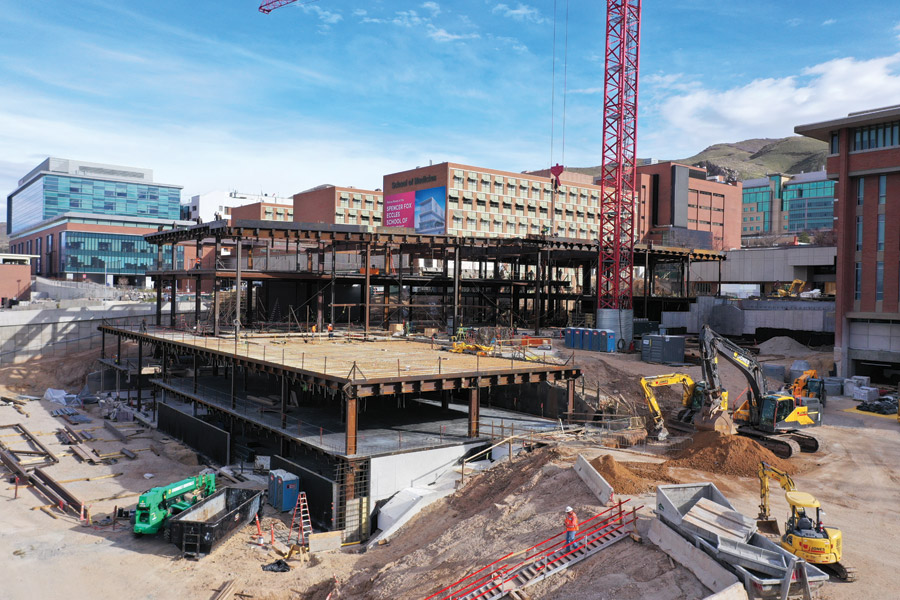
Crews must carefully coordinate to erect a structure in a tight spot surrounded by three existing buildings.
Photo courtesy of Jacobsen Construction
Collaborative execution
The team originally pursued a strategy of structurally unifying the brow and completing the wrap on the vertical surface, Carson says. After working through the impacts of this approach with Jacobsen’s team and Reaveley’s structural engineers, effort was redirected to incorporate the front into the envelope, extending the structure and matching the loads with steel. DuraFuse frames help the structure against seismic forces. The entire exterior envelope, including the curtain wall, is being fabricated off-site by JR Butler in Denver.
Once inside, the building’s inhabitants are led by design. “We created what I call a walk through the building,” says Yazdani. It begins at the lowest level at the west entrance, welcoming users with a two-story lobby and an open staircase that connects to the third level and beyond with open meeting rooms, conference areas, and collaborative and academic spaces . The centerpiece is a multi-story forum where faculty and students will meet for large group presentations and informal dialogue.
Other interior spaces and mechanical systems benefited from computational fluid dynamics modeling, which helped address the specific exhaust needs of gross anatomy spaces. The technology is being incorporated everywhere and will be especially useful in medical simulation spaces.
Running the project on a busy active campus is another current challenge for Jacobsen and his business partners. Ongoing noise and vibration monitoring and regular meetings with adjacent building managers help reduce impacts to critical health activities. On-site crews maintain a constant vigil to redirect and keep pedestrians away from the site.
“At the end of the day, we are a guest on campus. We’re charged with continuing its mission … which is health care and research,” says Field. But in addition to furthering that mission, this building will “transform the university,” Carson says.
