


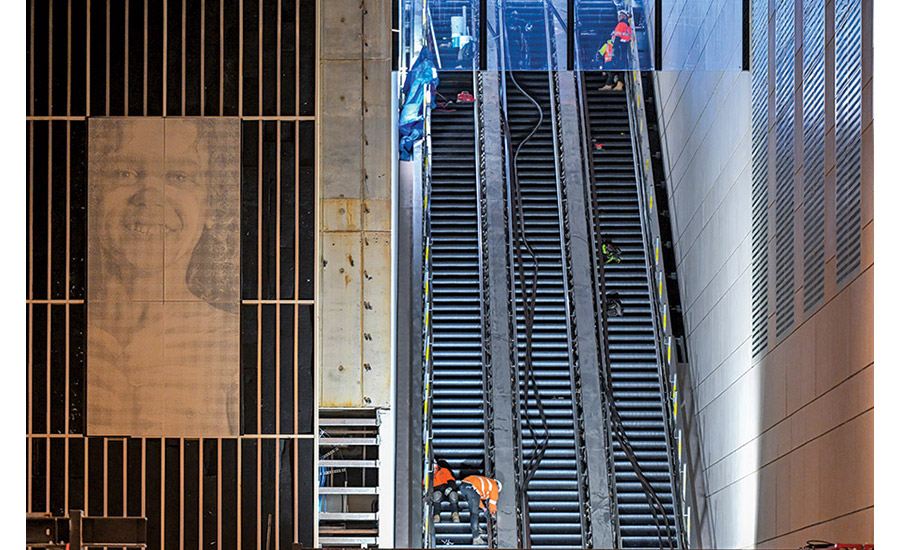
Wars and political tensions increase, and so does migration. Expectations are also growing that artificial intelligence will transform life and business as we know it. But it’s worth noting right away that the escalator, a marvel of mechanical engineering over 100 years old, is also an escalator that provides downward traffic for a continuous flow of people. We need a lot of both.
Since the escalator first came into use around 1896, it has transformed our sense of space. No longer limited to an elevator car or a staircase, humans could ride a kind of mechanical carpet outdoors and penetrate large indoor spaces, reaching new levels within a structure with relative ease and sometimes , an enlightening broad perspective. Who hasn’t loved walking up department store escalators looking at meadows of gowns and dresses? Does stepping on and off moving steps stop being at least a little fun at any age?
Escalators are so critical to mobility within the building that a large airport or multi-platform train station or transportation hub could not exist without them. Over the years, we have come to appreciate the good, and some of the bad, that this system brings. We know all modern miracles since the use of fire has had a drawback. You or your clothes can get caught in the tread, and fires and accidents have occurred. Who hasn’t experienced a situation where someone has fallen backwards on an escalator, or there’s been a jam at the top or bottom because people aren’t getting in or out fast enough?
Climbing, as well as de-climbing, was a big part of the recently completed year of construction. The industry needed material cost inflation to de-escalate a bit, and it has, as have interest rates. Unfortunately, construction plans for new buildings have also slowed considerably, and we hope that this sector of the market has a parachute attached and does not crash.
But to be honest, the fundamental tensions of business life still seem to play out: How can designers produce accurate, high-quality plans with such an emphasis on speed and cost? Will young people devote their careers to design and construction work in sufficient numbers to meet industry needs?
Finally, will government and industry be able to properly maintain the once magnificent but aging physical infrastructure that the world already has, including vertical transportation? Without a doubt, one of the biggest frustrations of anyone’s day is when you expect an escalator you see to take you somewhere, especially if you’re tired or late, and it doesn’t work. This is a real desolation.
