

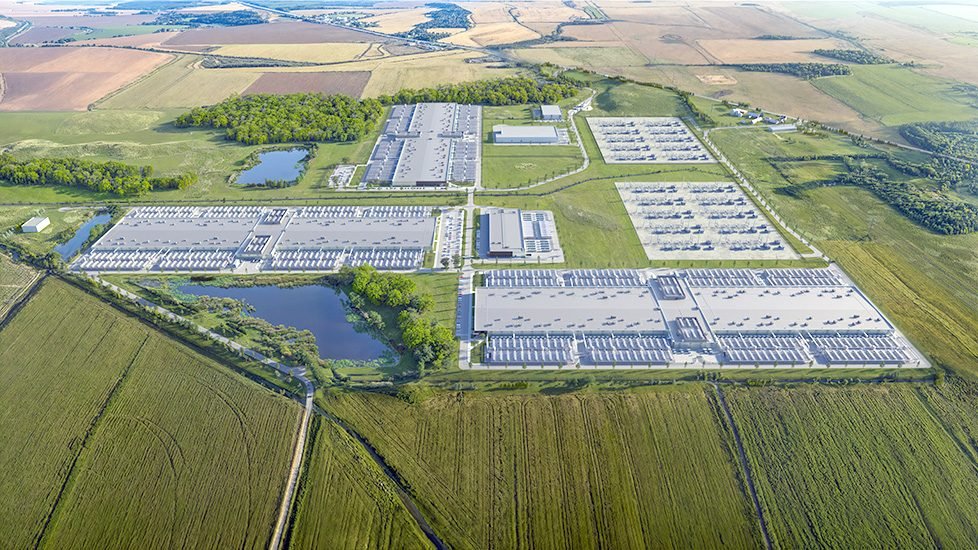

A $16 billion hyperscale data center under construction outside Ann Arbor, Michigan, has secured financing backed by Blackstone and other institutional investors, even as the project’s power supply agreements now face a legal challenge before the Michigan Court of Appeals.
Related Digital, the developer of the Saline Township, Mich., campus, said April 24 that the financing includes equity from both the company and funds affiliated with Blackstone, as well as debt anchored by accounts managed by PIMCO. The company said the financing remains subject to customary closing conditions.
“The strength of this funding is a powerful validation of what we’ve built at Related Digital and the critical role this project will play in America’s digital future,” said Jeff Blau, CEO of Related Cos. and president of Related Digital.
The project, developed for Oracle and its client OpenAI, underscores the demand for high-capacity computing infrastructure linked to artificial intelligence, according to Blackstone.
“Demand for digital infrastructure continues at an impressive pace, driven by AI and the broader digitization of the economy,” said Nadeem Meghji, global head of Blackstone Real Estate. “We are excited to support the largest investment ever made in the state of Michigan … as it delivers this critical AI infrastructure.”
The 250-acre, three-story campus is under construction, 550,000 square feet buildings, year approximately 80,000 square meters central building and two dedicated substations, with a full build expected to deliver more than 1 gigawatt of computing capacity.
At this scale, the project, known as “The Barn,” will rank among the largest data centers in the US
Looking for quick answers on construction and engineering topics?
Try Ask ENR, our new intelligent AI search tool.
Ask ENR →
Detroit-based Walbridge is a general contractor with Blaze Contracting handling the earthmoving, according to Related Digital. CORGAN is the architect of record, Atwell LLC of Shelby Township is civil engineer and kW Mission Critical Engineering is MEP engineer, according to the December 2025 site plan filing.
Construction began in the first quarter of this year and is targeted for completion in the fourth quarter of 2027.
The campus is designed with a closed-loop, air-cooled system to limit water use and will seek LEED certification. In particular, the project is designed with only 12 emergency generators, compared to nearly 600 in a data center of comparable scale, thanks to the battery storage infrastructure that ensures the facility’s power supply.
RELATED
Report: Billions of dollars in data center construction risk not insured
Legal challenge for DTE-Oracle contracts
At issue are special contracts between DTE Electric Co. and Green Chile Ventures LLC, an Oracle subsidiary identified in regulatory filings as the project’s power buyer.
The Michigan Public Service Commission approved the contracts on December 18, 2025, allowing DTE to serve the facility with long-term custom agreements structured for unusually large loads. The commission said the deals could only go ahead if they “ensure that no responsibility for costs is transferred to other customers,” framing the approval around taxpayer protections and setting a framework for future high-burden cases.
DTE sought approval through an expedited and ex parte process, arguing that it was necessary to support the development and financing of the project. The filing package included a 19-year primary supply agreement that required the data center to pay at least 80% of its contracted electricity demand, regardless of actual usage.
An accompanying energy storage agreement calls for Oracle to finance the development of 1,383 MW of storage capacity over 15 years, with DTE owning and operating the storage facilities, while Oracle receives market revenue from its operation in the wholesale electricity markets operated by independent system operator Midcontinent.
Along with the main agreements, six additional contracts governing three dedicated battery storage facilities were filed and have since become the focus of the legal challenge.
RELATED
States push data center breaks to buy time to measure impacts
Michigan Attorney General Dana Nessel filed an appeal with the Michigan Court of Appeals on April 17, challenging the MPSC’s conditional approval of the DTE-Oracle contracts. In the filings, Nessel argues that the contracts should have been subject to a contested process that would have allowed outside parties to conduct legal discovery, present witnesses and formally scrutinize the agreements before approval.
“I have sought a contested case review of these data center contracts since they were first filed in October, and the law requires it,” Nessel said.
The attorney general’s filing argues that the commission improperly relied on a limited exemption under Michigan’s utility law that authorizes ex parte approval only for rate changes that will not increase costs for customers, and that DTE’s own application acknowledged that the contracts did not meet that standard.
The Natural Resources Defense Council, the Michigan Environmental Council, the Sierra Club and the Citizens Utility Board of Michigan had pressed similar arguments in previous filings.
“Although billions of dollars and massive amounts of energy will be needed to serve the proposed Oracle data center, DTE has done little to back up its claim that the project will not somehow increase costs for everyday customers or undermine Michigan’s clean energy laws,” Shannon Fisk, an Earthjustice attorney representing those groups, said in a statement.
The commission denied the groups’ requests along with the attorney general’s motion to reopen the case in a unanimous vote on March 27, setting the appeal now before the court. MPSC Chairman Dan Scripps defended the commission’s decision, saying the conditional approval included “some of the strongest consumer protections in the country and is consistent with literally decades of applicable precedent.”
If the appeal is successful, the case could be sent to a full contested proceeding, which could require public disclosure of the drafted commercial terms and a formal evidentiary review of DTE’s cost protection claims.
RELATED
Data centers, AI drive industry momentum in Q1
Large load: taxpayer risk and network implications
At full construction, the Saline Township facility is expected to draw about 1,383 MW of power, more than 10 percent of DTE’s projected 2026 system peak of about 10.71 GW, according to intervention documents. Project backers say the structure protects existing customers.
In its funding announcement, Related Digital said the project is expected to generate approximately $300 million in savings for DTE ratepayers by contributing to fixed network costs. According to DTE Energy spokesman Ryan Lowry, as reported by the Michigan Advance, Oracle must cover the cost of all assets needed to service the facility, including the three battery storage facilities and any network upgrades needed to maintain reliability for other customers.
When asked specifically by ENR about the extent of any transmission or distribution improvements needed to serve the load and the nature of the guarantees and credit protections in the energy storage agreement, Lowry declined to provide additional information beyond the publicly available documents.
Opponents argue that the wording of the agreements makes independent verification impossible. The MPSC’s Dec. 18 order confirms that the energy storage agreement includes early termination payments and credit and collateral requirements, but the specific terms of those provisions remain shielded from public review.
The attorney general’s filing questions whether the guarantee is adequate to protect ratepayers if the data center fails to meet its contracted power demand, leaves the state early or enters bankruptcy, noting that Nessel’s office did not know which exit rate provisions would be finalized before December 2027, as DTE prepares for the construction phase.
Construction advances as regulatory stakes rise
Despite the ongoing appeal, developers say the project is moving forward.
“The rapid progress at our Saline Township data center highlights the urgency and scale of building America’s next-generation AI infrastructure,” said Mahesh Thiagarajan, executive vice president, Oracle Cloud Infrastructure.
“Together with our partners, we’re not just building a data center, we’re creating high-quality jobs… [and] driving long-term economic growth,” he added.
Project sponsors say the development will create more than 2,500 union construction jobs, more than 450 on-site jobs and more than 1,500 jobs countywide.
DTE has disclosed that it is in talks with hyperscalers for up to 6 to 7 additional gigawatts of load beyond the Saline Township project, including co-located demand that utility officials say would likely require new gas-fired generation.
Because the MPSC has not established standardized rate provisions for high-load data center customers, the contracts and the process used to approve them are being looked at as a template.
“Our utilities are preparing to bring on massive new data centers in the coming years,” Nessel said. “In these first contracts, precedents, we must have clarity from the Court and hold the MPSC accountable before the law.”
How the Michigan Court of Appeals rules on the issue of legal authority could set the stage for public oversight of utility-scale AI infrastructure deals, not just in Michigan but in states where similar proceedings are taking shape.
