

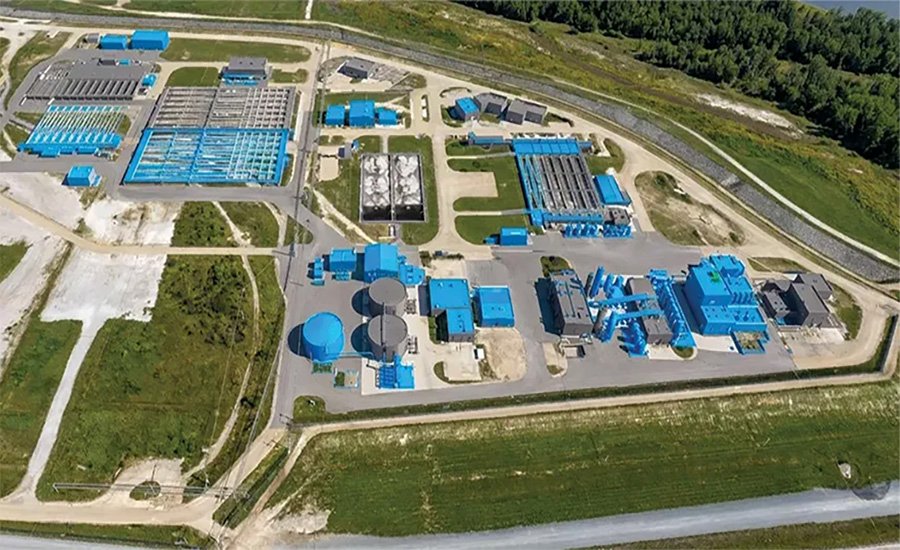

The US Section of the International Boundary and Water Commission issued a revised contract award on Oct. 13 to PCL Construction, the contractor on a design-build team with engineer Stantec, expanding the scope of Phase 1 of the South Bay Wastewater Treatment Plant expansion to eventually treat 50 million gallons per day of wastewater from both sides of the border.
The revised contract increases PCL’s award to $552 million for the expansion of the plant’s primary treatment facilities, with substantial completion scheduled for 2031.
Sewage has been flowing from Mexico into the Tijuana River and into U.S. neighborhoods like Imperial Beach for at least the past two decades. When the Stantec/PCL team initially won the contract to expand the plant in 2025, US IBWC Commissioner Chad McIntosh called the situation unacceptable and promised to speed up a solution. The $552 million contract remains within the project’s initial projected cost of $600 million, but that figure does not include the expansion of the plant’s secondary treatment facilities. Frank Fisher, a spokesman for the U.S. IBWC, said additional funds will be needed to grant the secondary treatment work.
“Substantial completion is scheduled for May 2031,” said Jeff Newman, PCL’s chief operating officer. “The installations will be completed throughout the duration of the contract. As the installations are completed, they will be placed online to further shield the plant.”
Scope changes in the initial works package for the first phase of construction include the removal and replacement of existing roofs; replacement of process equipment and piping, electrical equipment and means of odor control; installation of new window seals; replacement of roll-up doors and emergency showers and eyewash stations; and painting and coating of existing facilities. Long-term equipment covered by the revised contract includes standby generators and associated apparatus, medium voltage apparatus, positive displacement blowers, submersible solids handling pumps, dewatering centrifuges, stainless steel sliding doors and stop registers. Portions of the primary treatment expansion scheduled for completion within the 1,643-day construction schedule include a new integrated header, a new chemical system, two additional primary settling tanks, a new sludge thickening and storage system, and a new 12 kV electrical building with new switchgear and transformers.
The larger plant expansion also requires 10 new secondary sedimentation tanks and seven new activated sludge tanks. These facilities are part of the secondary treatment expansion and are not included in the $552 million award, according to the US IBWC.
Newman said Morley Construction was awarded the large concrete package for the project and PCL will build some of the ancillary facilities. PCL will also perform mechanical work itself. Southern Contracting won the electrical work and Technical Systems Incorporated will be the control systems integrator. All long lead items have been purchased and work is underway on several early works packages, Newman said. Shoring, dewatering and excavation of the structures for the expansion will begin in the coming weeks, he said.
The sewage crisis in the Tijuana River basin led to groundbreaking research from the Scripps Institution of Oceanography on aerosolized pollutants, such as the emission of sulfur dioxide gases from river hotspots between Tijuana and the Pacific Ocean.
— Bryan Gottlieb contributed to the reporting of this article
