


While U.S. steel mills continue to produce high-quality, low-carbon structural steel made from scrap melted in electric arc furnaces, the challenges of providing new products for hot construction markets, sourcing scrap to create more steel, and generating the electrical power needed to do so remain daunting.
The American Institute of Steel Construction invited reporters to Cartersville, Ga., last month to tour Gerdau SA’s suburban Atlanta steel mill.
“What’s really driving demand for our product lines is the development of solar and renewable energy projects,” said Adam Parr, director of communications and public affairs at Gerdau. “They use a lot of it [structural steel] beams Data centers are, of course, a huge market, as distribution warehouses have been for Amazon and others. Those have been some of the real growth areas.”
RELATED: 3Q 2025 Costs Report: Prices Rise as Delayed Tariff Impacts Hit Jobs
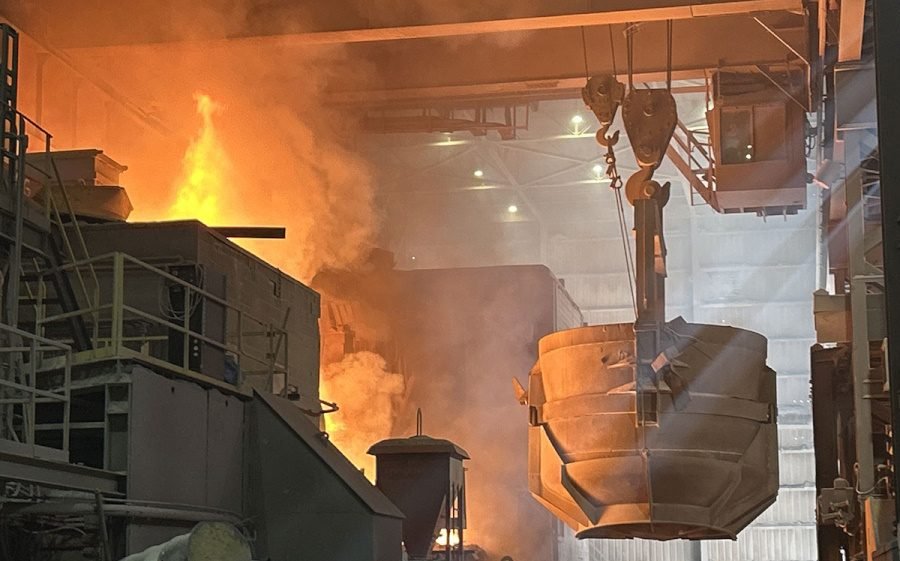
A tour of the 50-year-old Gerdau plant provided views of the company’s modern hot-rolled steel production processes using its EAF and ladle metallurgy furnace. A 115-ton scrap and flux bucket was poured into the furnace and melted with electricity, oxygen and natural gas before being fed into production lines and cast to create structural steel products.
Employees monitor temperature, composition and chemistry from the safety of lecterns with cameras that monitor the LMF’s molten steel to ensure proper temperature, shape and consistency. EAF hauls its supply buckets 25-30 times a day to produce the flat products in Cartersville.
Gerdau’s rolling mill was producing MC12 channels on the November day ENR visited, a form of structural steel with flat, parallel flanges, distinguishing them from standard C-shaped channels, capable of going back and forth through a process known as reverse roughing to create strength and shape through multiple passes of the rollers. Staying ahead of customer needs is a constant challenge for Gerdau, whose plant is rated for 1.2 million tonnes a year but produces around 1 million a year as a more “realistic” figure to account for mandatory maintenance and safety shutdowns.
Heading to data centers
“If you look three years ago, what everyone was talking about was solar energy,” said Rodrigo Canova, vice president and general manager of Gerdau Cartersville. “It used to be lean solar. Now we’re talking a lot more about data centers. What’s the construction trend going to be in the next three years, and how ready will you be to react quickly?”
Canova said that contractor customers are reacting to market trends almost simultaneously with the plant itself. With the various lengths of rolled steel available at the mill, Gerdau supplies more than 7,000 individual products with distinctive product codes from Cartersville with 70% of its steel transported by truck with close access to Interstate 74 and 30% by rail. Canova said such a diverse mix of structural steel products for contractors keeps the mill competitive.
“We have 210 different ones [steel] sections produced here, that gives a lot of competitive advantage, because people can come and buy a package of this, a package of this, a package of that,” Canova said. “That’s what we call the one-stop shop.”
All flats and angles are stocked in the mill’s 150-acre warehouse with approximately 2,000 tons of finished product available for on-site purchase. A 90 MVA transformer feeds the Cartersville plant with power supplied by multiple sources from supplier Georgia Power. Canova said Gerdau Cartersville was once Georgia Power’s largest customer in the state, but is now behind several data center customers.
Tariff impacts and price increases
While Gerdau executives praised the Section 232 tariffs against foreign steel and aluminum, they said those measures alone are not enough to ensure a healthy domestic steel market. Although Gerdau is a Brazilian company based in Buenos Aires, it has been producing steel in Cartersville since 1975.
“Even with the 50% tariffs, there’s still material coming in, based on growth, and what we’re seeing from the Organization for Economic Co-operation and Development and others, they expect by 2027 there will be more than 700 million metric tons of excess capacity in the global market,” Parr said. “There are many threats to the steel industry and so even with 50% tariffs in place, there is material coming in.”
Hot-rolled coil steel prices have risen about 30% over the past year to 2025, but Parr and Canova pointed to the volume of steel still entering the U.S. market despite the 50% tariffs as a concern.
