

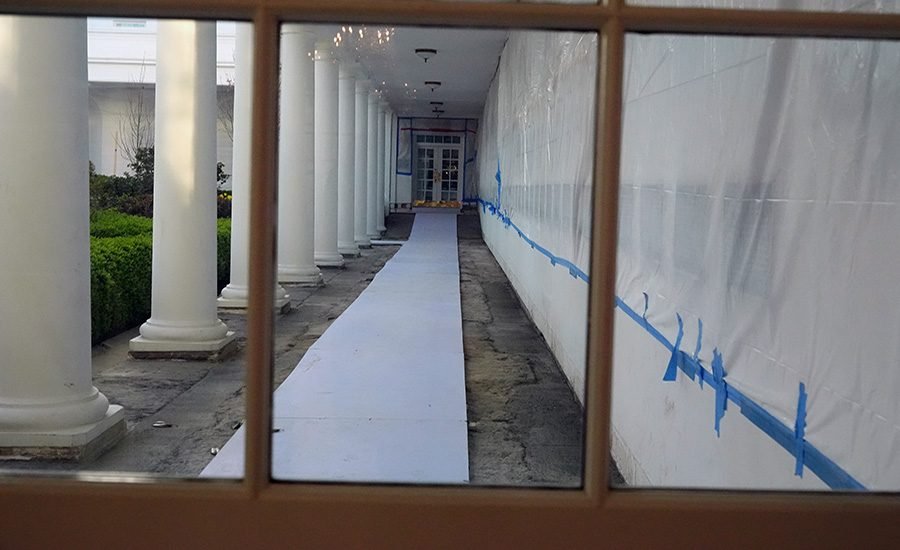

On March 31, a federal judge ordered an immediate halt to construction on President Donald Trump’s planned White House State Ballroom, forcing the roughly $400 million project into legal and procedural limbo just as it reaches a critical transition to higher work.
U.S. District Judge Richard J. Leon granted a preliminary injunction requested by the National Trust for Historic Preservation, finding that the administration likely lacks legal authority to proceed without express approval from Congress and halting the project at the threshold of vertical construction.
“Unless and until Congress blesses this project through legal authorization, construction must stop!” Leon wrote in a 35-page memorandum.
The ruling establishes a rare procedural split:
At press time, the ballroom remained on the National Capital Planning Commission’s April 2 agenda as pending business, with commissioners scheduled to deliberate and vote on final site and building plans.
The court’s order halting construction effectively decouples project approval and construction tracks, apparently allowing federal planning to continue while physical work is halted pending congressional action or a reversal on appeal.
The United States Commission on Fine Arts approved the ballroom’s final design in late February. The pending NCPC vote represents the final federal planning approval required before full above-grade construction can proceed.
Looking for quick answers on construction and engineering topics?
Try Ask ENR, our new intelligent AI search tool.
Ask ENR →
RELATED
NCPC Votes White House Ballroom as Federal Filing Details Reconstruction Case
Work stopped at the threshold of vertical construction
Construction was already well advanced. Since the east wing was demolished in October 2025, crews have completed the foundation and structural concrete below grade. Above-grade structural work was expected to begin in April, according to court documents and ENR’s own report.
At least one crane and heavy equipment had already been set up at the site in anticipation of federal approval needed to begin vertical work. The project, designed by Shalom Baranes Associates, spans approximately 89,000 square feet and is designed to accommodate approximately 1,000 guests.
The White House oversees construction directly and not through a traditional general contractor, with project control residing in the Office of the Executive Residence.
Leon delayed the application of the injunction for 14 days to allow for a planned appeal, but warned that any higher framework during that period “runs the risk of being withdrawn depending on the outcome of this case”. Work necessary to maintain the safety and security of the site is exempt.
The break comes at a particularly sensitive time in the build sequence. A stoppage in the transition from substructure to superstructure can result in demobilization costs, disrupt sequencing, and delay procurement tied to structural systems, especially at a high-security, restricted site that requires gradual excavation and vibration monitoring adjacent to the executive mansion.
RELATED
Judge rejects first injunction bid in White House living room brawl
The court rejects the legal basis of the project
At the heart of the ruling is a 1912 federal law that prohibits the erection of any building or structure in a federal park in the District of Columbia without the express authority of Congress.
Leon found that the administration’s reliance on statutes governing the maintenance of the executive residence was a misreading of existing law, concluding that those provisions authorized routine maintenance, not the demolition and construction of that staircase.
He has also rejected the administration’s funding structure, which relies on private donations to fund the project.
The court pointed to the gap between the roughly $2.5 million a year allocated for White House maintenance and the projected cost of the ballroom, describing it as a “Rube Goldberg gimmick” that is no substitute for affirmative congressional authorization.
The ruling marks a reversal from February, when León refused to halt construction, and reflects what the court described as a more developed legal challenge focused on whether the administration acted beyond its legal authority.
Next steps: Congress or Appeal
Trump hit back at Social Truth, calling the National Trust “a radical leftist group of lunatics” and describing the ballroom as “under budget, ahead of schedule, being built at no cost to the taxpayer and will be the best building of its kind anywhere in the world.”
The administration’s lead courtroom attorney, Justice Department Yaakov Roth, is expected to file an immediate appeal.
Trump has said publicly that he raised more than $350 million from personal backers and roughly two dozen tech, cryptocurrency and defense corporations to fund the project. A November 2025 Public Citizen report found that two-thirds of publicly identified corporate donors tied to the project had received federal contracts collectively valued at more than $275 billion.
León left open a path to Congress. “It is not too late for Congress to authorize continued construction of the ballroom project,” he wrote, noting that lawmakers could directly grant explicit authority or appropriate funds.
Until then, construction remains on hold, even as federal planners move forward with a final vote on a project that cannot continue in the field without legislative approval.
