

This audio is automatically generated. Please let us know if you have any comments.
Within the following 48 hours Hurricane Milton tears the roof off from Tropicana Field, Kenneth Johnson was on the phone with the city of St. Petersburg, Florida. Within 72 hours, Johnson said his team was at the MLB stadium site.
“It looked like an atomic bomb had gone off,” Johnson, AECOM Hunt’s executive vice president of sports, said of the aftermath of the October 2024 hurricane.
On Monday, the Tampa Bay Rays will host the Chicago Cubs under a new roof for the home opener of their 2026 season at Tropicana Field. This is thanks to a global effort of approximately $60 million to mobilize, manufacture, ship, deliver and place a new fiberglass canopy at the top of the stadium in time for this first release.
The replacement of the roof required collaboration on three continents on a tight deadline for the stadium, which the city of St. Petersburg must provide to the team at least through the 2028 season, reported St. Pete Rising.
Beams on the ceiling
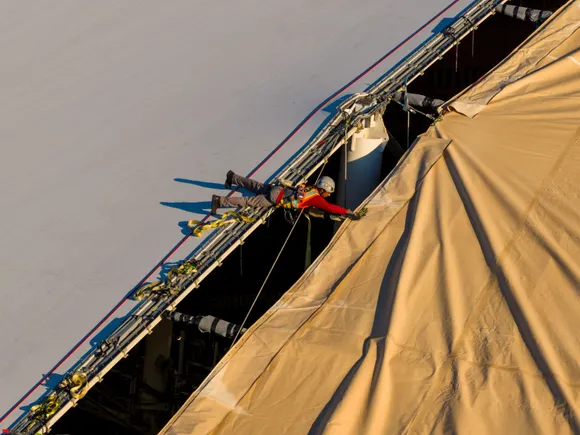
To restore the stadium, AECOM Hunt and project partners, including local contractor Hennessey Construction, ordered 400,000 square feet of polytetrafluoroethylene-coated fiberglass fabric panels from German manufacturer Verseidag-Indutex GmbH. The material is designed to withstand hurricane force winds of up to 165 miles per hour.
The 360-foot-long panels were shipped to China, Johnson said, where another company performed the arduous task of stitching the pieces together to match the stadium’s existing cable systems.
Finally, the pieces arrived in St. Petersburg. Johnson said the construction crew began installing the roof in August 2025 and completed work in November.
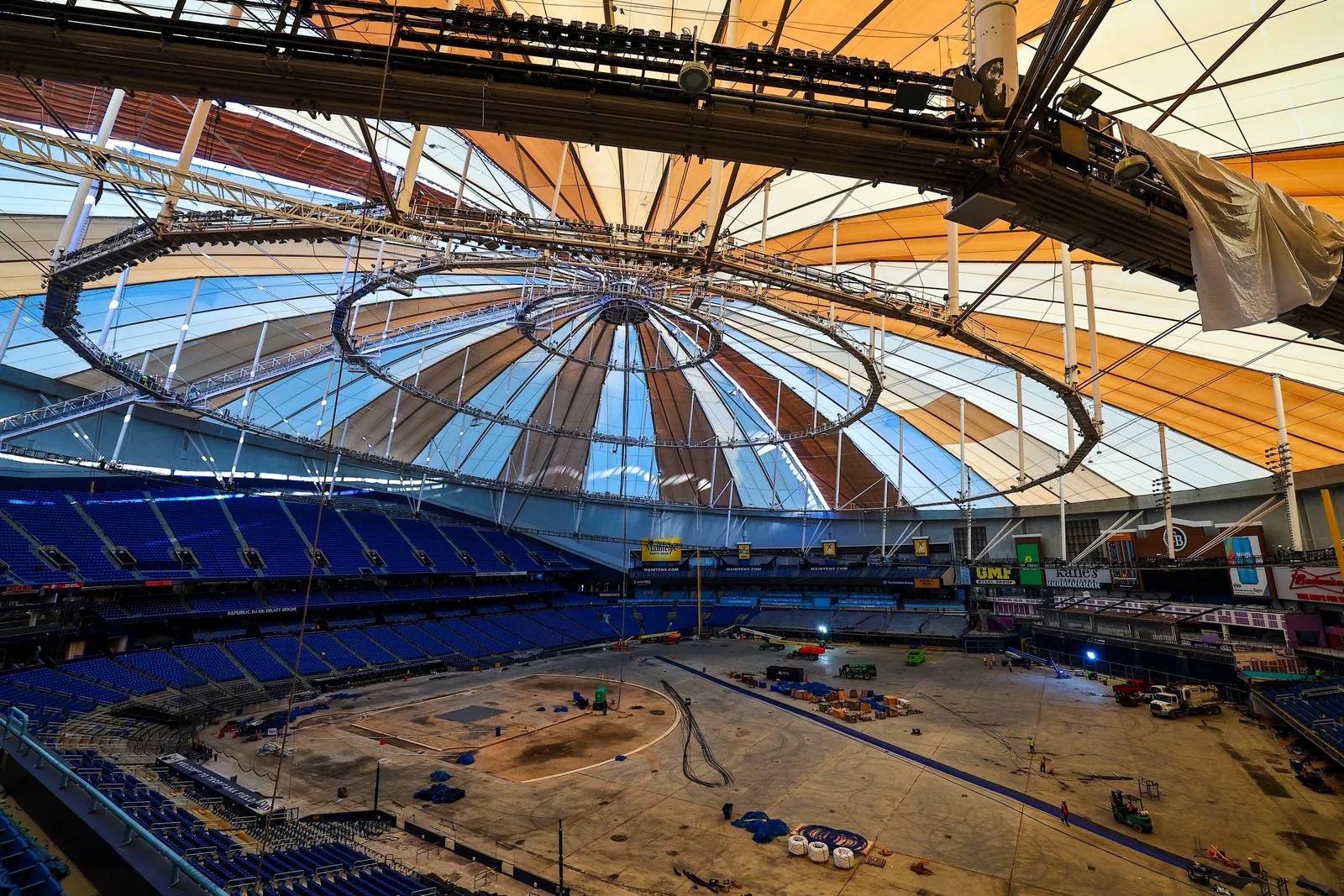
Crews work to secure massive fiberglass fabric panels to replace the damaged roof at Tropicana Field in St. Petersburg, Florida.
Permission granted by AECOM Hunt
Operating as Huber, Hunt & Nichols in the 1990s before merging to form AECOM Hunt in 2012, the contractor performed the original work at the Trop. This meant that even the biggest obstacle to the job, creating a new roof to fit the existing structure, benefited from work done decades ago.
“I think the biggest challenge from a roof standpoint was doing a damage assessment, making sure the geometry of the roof remained intact,” Johnson said. “We were able to find the original engineering drawings that we did eons ago in the 1990s, they were still in place.”
To ensure the right size and scope of the project, the team conducted 3D scans and examined the geometry of the cable system with drones, Johnson said.
Work yet to come
The timing of the hurricane threw a major curveball at the stadium plans. Due to delays in approving financing due to storm damage to the surrounding area, the Rays backed out of a deal to build a new stadium in March 2025.
Since then, things have moved again. Last month, the team unveiled plans for one nine, $2.3 billion in the area Still, that project is far from ready, even as the Rays look to throw their first pitch of the 2029 season in a new ballpark.
Despite those lingering question marks, after a season playing at nearby Steinbrenner Field, the spring training home of the Rays’ division rival New York Yankees, the Rays have returned home full time.
Johnson said the work on the stadium did more than just get the field back on track — it also incorporated work to restore water-damaged areas and install new amenities, such as bars.
“We got Major League Baseball approval this week. Everyone is good to go,” he said. “Fans will actually be walking into the stadium today. It’s the best it’s been in 30 years because we’ve also made a lot of improvements along the way.”
