

Car trailer hitch ideas that actually work in real hauling
If you’re hauling a vehicle with a trailer, the most important part isn’t driving, it’s how to secure the load. A poorly insured car can roll even if you drive carefully, and once it starts moving, it becomes very difficult to control. This is why professional haulers focus heavily on anchoring methods, not just the trailer itself. Whether you’re using a flatbed trailer, a tilt trailer, or a utility trailer, the right tie-down strategy makes the difference between a smooth ride and a serious risk on the road. In this guide, you’ll find practical ideas for hitching up your car trailer that are actually used in real hauling situations, not just in theory.

Why the right ties are more important than you might expect
The first thing you need to understand is simple. Your trailer doesn’t hold the car in place, your anchorage system does. Even a well-built trailer with a strong steel frame and a large load capacity cannot prevent movement if the vehicle is not properly secured. When you hit the brakes, make a turn, or drive over rough roads, the vehicle naturally wants to move. Without proper restraint, this movement transfers force to the trailer and the towing vehicle, which can quickly create instability. That’s why experienced operators treat lanyards as part of the basic safety system, not just an accessory.
From a practical point of view, most trailer accidents are not caused by mechanical failure, but by load shifting. A car moving just a few inches forward can change the weight of the tongue dramatically, affecting steering and braking. You might not notice it right away, but at freeway speeds, even small turns become dangerous. That’s why it’s always worth taking extra time during loading and securing.
Real risks of a poor mooring installation
Loose straps, incorrect angles or weak anchor points can lead to serious problems. The most common problem is gradual loosening. Belts that appear tight at first may lose tension due to vibration, suspension movement, or temperature changes. Once the tension is reduced, the vehicle begins to move and this movement causes the belts to become even looser. It becomes a chain reaction. In the worst cases, vehicles have come off the trailers during transport, especially when emergency braking is involved.
Understand the basics of hitching a car trailer
Before attempting advanced tying ideas, you need to understand the basics. A proper system includes tie-down points on the trailer, tie-down equipment and proper positioning. These three elements must work together. If one part is weak, the whole system fails. Most car trailers are designed with multiple attachment points, such as D-rings or stake pockets, which allow for flexible security options based on vehicle size and weight.
What are anchor points
Anchor points are fixed places on the trailer where straps or chains are attached. These points are usually welded to the frame and their strength depends on the structure of the trailer. A good trailer will have several evenly spaced anchor points so you can adjust your setup based on different vehicles. If your trailer has limited positions, it will be more difficult to get the right angles and load balance.
Types of fixing equipment
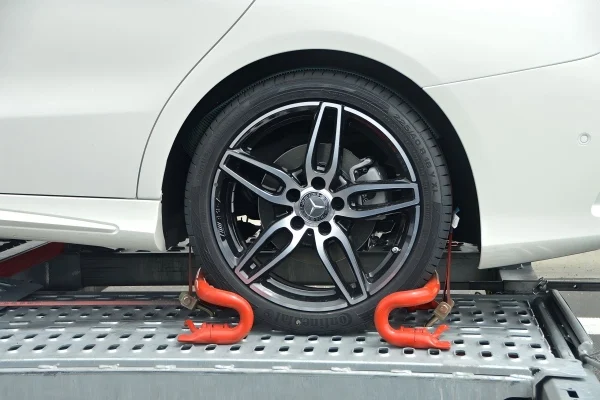
There are several types of fastening equipment, and each serves a different purpose. Ratchet straps are the most common because they are easy to use and flexible. Chains are stronger but require more experience and are usually used for heavy equipment. The wheel webs are designed to secure the tires directly, while the axle straps wrap around the suspension components. Choosing the right combination depends on the load, the type of trailer and how often you transport the vehicles.
The best car trailer hitch ideas for different situations
If you want a setup that works consistently, focus on proven methods. The goal is always the same, to avoid forward, backward and sideways movement at the same time. The following tie ideas are widely used in the industry because they are reliable and easy to repeat.
Four-point attachment method
The four-point method is the standard for vehicle transport. Secure the front and back of the car with four separate straps, each pulling outwards at an angle. This creates balanced tension that holds the vehicle in place from all directions. It is particularly effective for road transport where stability is critical. If you are new to car trailers, this is the safest method to start.
Setting up the tire fixing
Professional haulage companies often use belts over tires, especially when handling high value vehicles. Instead of being attached to the frame, the straps go over the tires and attach them directly to the trailer. This allows the car’s suspension to move naturally without affecting the belt tension. It also reduces the risk of damaging the vehicle. For long-distance transportation or frequent loading, this method is highly recommended.
Idea for attaching the axle belt
Axle belts are a more traditional solution. Wrap the strap around a solid part of the vehicle, such as the axle or control arm, and then attach it to the trailer. This method is strong and reliable, but requires attention to detail. You must avoid brake lines, wiring and sensitive components. Using protective sleeves can help prevent wear on both the belt and the vehicle.
How to choose the right anchoring equipment
The choice of fixing equipment is not just a matter of price. It is a margin of safety and reliability. Each belt or chain has a working load limit, and you should always choose equipment that exceeds the weight of your vehicle. This gives you a safety buffer and ensures that the system performs well under stress. Using underrated equipment is one of the most common mistakes among beginners.
Ratchet straps vs chains
Ratchet straps are easier to handle and are suitable for most car trailers. They allow for quick adjustment and are less likely to damage the vehicle. Chains are stronger and more durable, but are heavier and require proper tensioning tools. For standard car hauling, straps are usually the best choice, while chains are more common when hauling heavy equipment.
Understand load ratings
Always check the working load limit printed on the straps. The total capacity of all tie-downs must be greater than the weight of the vehicle. For example, if your car weighs 4,000 pounds, your combined towing capacity should comfortably exceed that number. This ensures that the system can handle dynamic forces during transport.
Anchor placement and load balancing
Placement is just as important as equipment. Even the strongest straps will not work if they are placed incorrectly. The goal is to create balanced tension on the vehicle while maintaining proper weight distribution on the trailer. This improves stability and reduces stress on the towing vehicle.
Correct anchor angles
The straps should be angled out and down. This creates both vertical and horizontal tension. If the angle is too steep, lateral stability is lost. If it’s too flat, you lose downward pressure. Finding the right balance ensures that the vehicle stays firmly in place throughout the journey.
Maintain proper load distribution
A well-balanced load significantly improves towing safety. Ideally, sixty percent of the weight should be in front of the trailer axle. This creates proper tongue weight and prevents trailer sway. Poor distribution combined with weak tie-downs is a common cause of instability on the road.
Common tying mistakes to avoid
Even experienced users sometimes overlook basic mistakes. These small mistakes can lead to serious problems if not corrected. Understanding them helps you create a more reliable setup.
Loose belts after driving
One of the most common problems is that the belts loosen after a short distance. This happens because the vehicle settles and the suspension adjusts. Always stop after the first few kilometers to re-check and tighten the straps. This simple step can prevent major problems later on.
Incorrect anchor points
Attaching straps to weak or unstable parts of the trailer can cause failure. Always use reinforced attachment points designed to secure the load. Avoid using temporary or improvised anchors, as they may not withstand the forces during transport.
Maintenance tips for fastening systems
A reliable fastening system requires regular maintenance. Straps, chains and anchor points are subject to wear. Ignoring this can lead to unexpected failure at the worst possible time.
Inspection straps
Check for wear, cuts or discoloration. These are signs of damage. If a belt shows wear, replace it immediately. Do not attempt to repair or reuse damaged equipment as it may fail under load.
Trailer hardware check
Regularly inspect D-rings, welds, and frame connections. These parts carry the load, so any weakness can compromise the entire system. Keeping your trailer in good condition ensures that your hitch system performs as expected.
Conclusion
Attaching a car trailer is not complicated, but it does require attention to detail. The best setups focus on balance, proper gear, and consistent checking. Once you understand these principles, you can adapt your method to any trailer or vehicle. Whether you’re hauling cars occasionally or running a business, mastering tie-down techniques will make every trip safer and more efficient.
Frequently asked questions
What is the safest method of anchoring a car trailer?
The safest method is a four-point tie down combined with the tire straps. This configuration secures the vehicle in all directions and maintains constant tension during transport.
How often should I check my bindings during a trip?
You should check them after the first few miles, then every fifty to a hundred miles. Regular checks help quickly detect any loosening and keep your load secure.
Can I use two straps instead of four?
Using only two straps is not recommended. Four attachment points provide balanced stability and prevent movement in all directions, which is essential for safe transport.
Do I need special straps for low cars?
Yes, low clearance vehicles benefit from tire belts or soft axle belts. These options reduce the risk of damage and provide better stability during loading and transport.
What is the biggest mistake people make when insuring a car?
The biggest mistake is not checking the belts after driving a short distance. Many people assume that the load is safe, but the initial movement can loosen the system. A quick check can prevent serious problems.
