

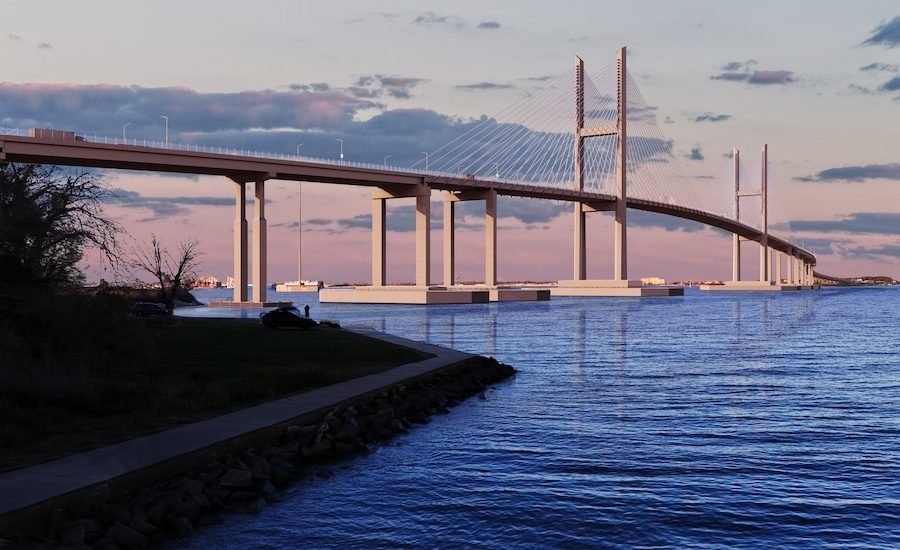

The Maryland Transportation Authority has overhauled its approach to rebuilding the Key Bridge, splitting what was originally the second phase of a rolling design-build procurement into a multicontract strategy that the agency hopes can be completed for less than $5 billion.
Under the new strategy, presented at an Industry Forum on May 19, only the 1,665-foot-long cable-stayed main span is to be delivered through design-build. Contracts for the northern and southern land approaches, and demolition and miscellaneous marine work, will be awarded through design-bid-build, according to the agency.
According to an MDTA filing, the entire rebuilding effort remains 100 percent government-funded and includes Build America, Buy America (BABA) requirements.
MDTA’s revised rebuilding approach follows its April decision to drop Kiewit Infrastructure Co. of the project amid rising costs and a lengthening of the delivery period. The most recent official estimate, released in October 2025, called for the replacement bridge to cost up to $5.2 billion and be ready by the end of 2030. Maryland had also been criticized by the Trump administration for its oversight and procurement practices for the project.
The acquisition process for the main span is scheduled to begin this summer with the MDTA issuing a request for qualifications, identifying the shortlist this fall and a notice to be published in the summer of 2027. The agency anticipates a cost of up to $4 billion, the project will include the final design, engineering and construction of all underwater and above-water elements of the main water, including a pission approach and systems to protect the main ship. such as the one that caused the original Key Bridge to collapse in March 2024, killing six construction workers.
Also this summer, MDTA will invite bids for the demolition and miscellaneous marine work contract, which includes the removal and salvage of two three-span steel plate girder units over the Patapsco River, the partial demolition of eight marine piers, the demolition of three marine foundations, the complete demolition of three marine foundations and the cleanup of 96 steel pipe piles. The contract is expected to cost $50 million to $100 million, with a notice of construction to proceed this fall.
Separate contracts for the southern and northern land approaches are due this winter, and both projects will receive a notice by spring 2027. Expected to cost up to $400 million, the southern contract includes approximately 3,000 feet of overland approach bridge, soil improvements within a wetland, and approximately 2,000 feet of road construction of approach The north contract includes approximately 2,400 feet of above-ground approach bridge, abutments and retaining walls and approximately 3,400 feet of at-grade approach road construction, with an expected cost of up to $300 million. Both projects include environmental elements, ITS, electronic toll and lighting.
The agency said in a statement that the projected cost range estimates are consistent with the figures released in November 2025 and that it is “confident in these estimates.” A definitive construction schedule will not be known until these competitive procurements are completed and contracts are awarded.
MDTA has not released the names of the contractors who registered for the May 19 presentation, or any consultants who may have been involved in the project review. Kiewit will not be able to participate in any of the new contracts.
Nor the reconstruction’s general engineering consultant, a WSP joint venture; Rummel, Klepper and Kahl (RK&K); and Johnson, Mirmiran & Thompson (JMT), nor the construction management and inspection services consultants Greenman-Pederson, Inc./Gannett Fleming, Inc. joint venture; the Michael Baker International, Inc./STV, Inc. joint venture; and AECOM Technical Services, Inc.—may participate in design-build procurement. Kiewit subcontractors are also prohibited from participating in design-build procurement, but may join the selected team after contract award.
Under its $73 million Phase 1 progressive design construction contract, Kiewit has advanced the design of the main bridge and marine approaches past the 70 percent milestone, according to the MDTA filing, and is completing the first work packages, including production piles for the main pylon and ship protection foundations, and the 36-foot-wide main line access trestles.
Because the four-lane replacement crossing will occupy largely the same footprint as its predecessor structure, most federal and state permits for the project have been completed, according to the MDTA filing. The design of the terrain approaches is progressing with signed and sealed plans, while geotechnical soundings, bathymetric soundings, scour analysis and foundation load testing of the main beam pylons have also been completed.
