

This audio is automatically generated. Please let us know if you have any comments.
Earlier this month, a key part of a massive overhaul of Interstate 80 in Illinois began.
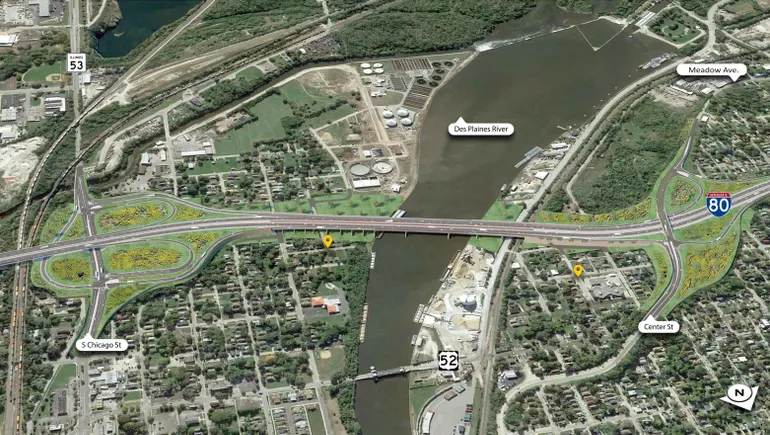
State officials and a construction crew from Coal City, Illinois-based D Construction and Kansas City, Missouri-based HNTB began work on new I-80 bridges over the Des Plaines Riveraccording to an announcement from the office of Governor JB Pritzker.
According to the announcement, the $164 million will replace the structures originally built in the 1960s. These new concrete bridges will be located 300 feet to the north and will be wider than the previous spans. The new bridges are expected to be completed in 2028, and the old bridges are expected to be demolished in 2029.
In short, the crossings are the central axes of a $1.3 billion effort to modernize and rehabilitate I-80 in Illinois, a critical thoroughfare that serves as one of three coast-to-coast highways in the country. The freeway starts in San Francisco and ends in New Jersey.
The overall rehabilitation of I-80 in Illinois will see construction crews redesign and rebuild 16 miles of the freeway, from Ridge Road in Minooka to US 30 in Joliet and New Lenox, according to the announcement.
“This milestone represents significant progress on one of our region’s most important infrastructure investments,” Terry D’Arcy, mayor of Joliet, Illinois, said in the May 22 release. “Rebuilding the Des Plaines River Bridge and the surrounding I-80 corridor will strengthen a critical transportation route that serves residents, businesses and commerce across the country.”
The city of Joliet benefits greatly from I-80 traffic: The interstate carries approximately 80,000 vehicles a day, 25 percent of which are trucks, through the city, according to the announcement. The value of merchandise passing through Will County exceeds $600 billion annually.
In October, Illinois pledged approximately $50.6 billion in infrastructure improvements across the state. Of that money, $32.5 billion goes to roads and bridges, and $18.1 billion goes to transit, rail, aviation, ports and waterways.
In particular, the city of Chicago has been busy in terms of infrastructure. A joint venture AECOM Hunt Clayco Bowa and the Chicago Department of Aviation recently began vertical construction of the new O’Hare International Airport. $1.45 billion Concourse D project.
Contractors too began construction on the $5.7 billion Red Line extensionwhich will bring rapid rail transit to Chicago’s Far South Side neighborhood.
