

Mozambique Rovuma Venture SpA (MRV), an incorporated joint venture developing the $7.2 billion Coral North floating liquefied natural gas (FLNG) project in Mozambique, has chosen a consortium led by France-based Technip Energies for the engineering, procurement, construction, installation and commissioning (EPCI&C) contract.
MRV is a joint venture owned by Rome-based Italian hydrocarbon major Eni SpA, US oil and gas giant ExxonMobil and China National Petroleum Corp., which together have a joint 70% equity interest in Mozambique’s 2,516-square-kilometer Area 4 concession, an offshore natural gas block in Cabozambique’s Rovuma province. The EPCIC contract award brings the Coral North FLNG project into the installation and commissioning phase, MRV said, with developers targeting LNG production of 3.6 million tonnes per annum (mtpa) by 2028.
The consortium led by Technip Energies, which includes Japan’s JGC Holdings Corp., through its subsidiary JGC France SAS, and South Korea-based Samsung Heavy Industries, is expected to deliver the FLNG project over the next two years, extracting natural gas from deep waters in Mozambique’s exclusive economic zone located about 50 km offshore.
Galp Energia Rovuma BV, KG Mozambique Ltd. and the state-owned National Hydrocarbons Co. (ENH), they each have a 10% stake in the Area 4 concession.
Technip Energies did not specify the exact value of the EPCIC contract, but said it is a “significant” deal, which in company terms exceeds 1 billion euros ($1.14 billion) in revenue. The company says it is booking revenue from this project in the second quarter of 2026.
In a press release, Technip Energies CEO Arnaud Pieton cited the company’s “design one, build many” approach as one of the key reasons why the company has been able to book so many offshore facilities in recent years. On June 25, Technip Energies announced that it had been awarded an EPCI contract by Norway’s Vår Energi for two of its North Sea offshore oil initiatives, the Ofelia and Gjøa Nord projects. Technip Energies signed a five-year collaboration agreement with Vår Energi in 2025.
Additional awards Show project momentum
MRCV’s award of the Coral North EPCI&C contract coincides with the recent selection of Japanese floating solutions provider MODEC as the preferred bidder for the supply of the mooring system for the FLNG project.
Looking for quick answers on construction and engineering topics?
Try Ask ENR, our new intelligent AI search tool.
Ask ENR →
MODEC will supply its SOFEC internal turret mooring system solution to MRV to secure the FLNG vessel on the Mozambique seabed at a water depth of approximately 2,000 metres.
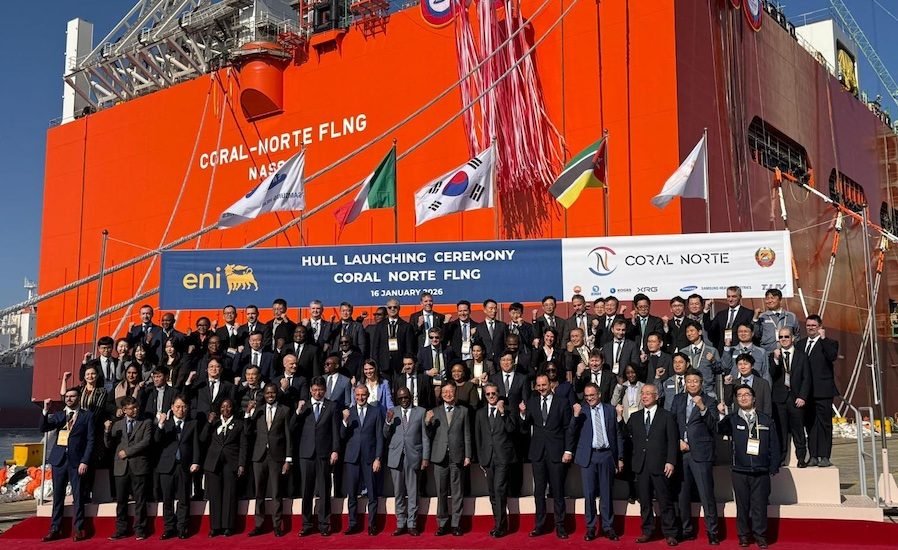
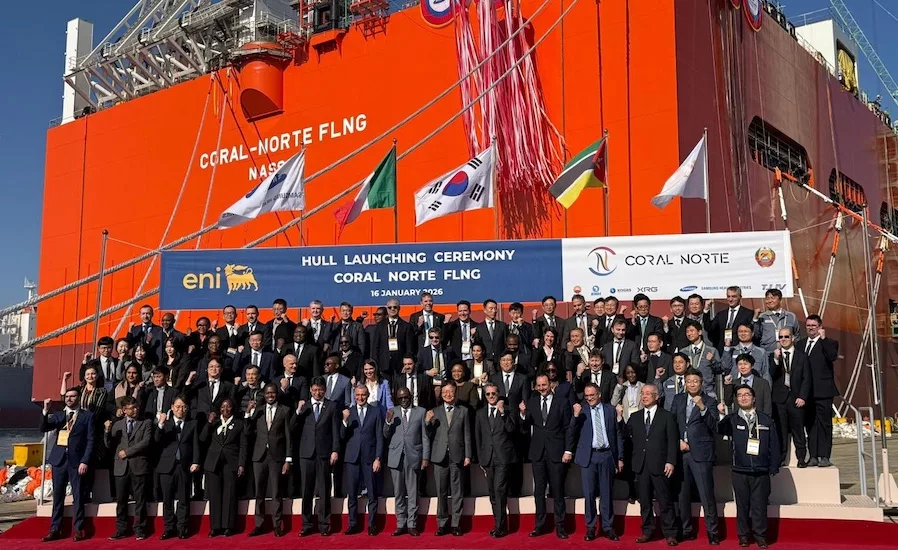
The Coral North FLNG vessel’s main hull is being developed at South Korea’s Geoje Shipyard, owned by Samsung Heavy Industries, following its official launch in January, a process led by Mozambique’s state oil and gas regulator, Instituto Nacional De Petroleo.
In December, a key contract for the procurement and installation of critical equipment for the new vessel was awarded to TechnipFMC, a UK-domiciled French-US global oil and gas company, for the manufacture and installation of all subsea production systems, including flexible flowlines, risers, subsea manifolds and umbilicals.
While the company has not disclosed the value of the subsea works deal, it notes on its project profile webpage that its products and services supplied to the Mozambique project rose to $268 million by the end of 2025, up from $93 million in 2024.
The construction of the Coral North FLNG project, which is expected to generate around $23 billion in revenue over its 25-year life, brings to two the number of major offshore natural gas extraction and processing projects in Mozambique. The Coral South project was commissioned in 2022 and became the first floating natural gas liquefaction unit built for the African continent and the third of its kind in the world.
Together, the Coral North and South FLNG projects are expected to increase Mozambique’s annual LNG capacity to seven mtpa, positioning the country as Africa’s third largest producer, after Algeria and Nigeria, which currently produce 29.3 million and 22.2 million tonnes respectively.
