

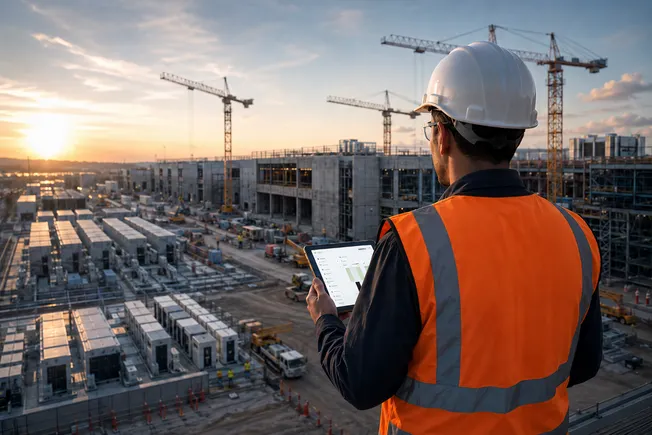
Building a data center is, in many ways, a programming problem. What to build, in what sequence, with what operations, on what date. Project teams are practiced in this part.
Where it gets more difficult is everything that happens on the other side of the fence.
A logistical problem on an industrial scale
A hyperscale data center build can involve dozens of active subcontractors and hundreds of truck movements per week, with trades simultaneously working in multiple areas simultaneously. The structural steel arrives while the electrical appliances are being staged. The cooling infrastructure arrives on site the same week as the equipment sets. Generators, UPS systems, and wiring circuits each have specific sequences, specific destinations, and specific receiving windows.
Data center customers also have access requirements that most commercial projects do not have. Secure zones, controlled entry points, strict credentials. All vehicles entering the site must be accounted for and tolerance for unplanned arrivals is low.
The result is a site with a higher density of movement than almost any comparable construction, operating under security constraints that leave little room for improvised coordination.
The gap between the schedule and the door
Most project teams invest serious effort in the build plan: critical path, business sequencing, milestone structure. The logistics layer receives less attention. How deliveries are booked, how drivers are directed, how materials are tracked once they land on site, often run in informal systems until problems surface.
The breakdown pattern tends to be familiar. Subcontractors book deliveries independently, with no visibility into what else is arriving that day. Two trucks appear at the same access point at the same time. A delivery is waiting because the appropriate crew is busy elsewhere. Materials end up in the wrong disposal area. A supplier arrives unscheduled on a day when the door is already closed. When teams improvise around these limitations, the consequences can be costly: On one data center project, a subcontractor unloaded equipment without the right crane or forklift, damaging an $80,000 asset, triggering additional reports and inspections, and contributing to the loss of a multimillion-dollar contract.
Each of them is manageable in isolation. Over months of work and hundreds of deliveries per week, they accumulate schedule slippages, cost overruns and compliance gaps that didn’t have an entry in the risk register.
How is proactive site logistics
The teams managing this asset have moved from treating logistics as a secondary process to treating it as a live project control function. In practice, this means a few specific things.
Reservations are made before the truck leaves the depot. Subcontractors and suppliers schedule their own slots through a shared system. The site team sees each arrival in advance, with matches flagged automatically rather than discovering them at the door.
Access coincides with approved reservations. Vehicles enter the correct point during the right window. Unapproved arrivals are held, not agitated. The gate functions as a controlled entrance, not an informal queue.
Drivers go to specific locations. Clear routing sent directly to the driver keeps materials landing where they’re supposed to and keeps people out of areas where they shouldn’t be.
Every move is recorded. Time-stamped digital records replace paper records and verbal confirmations, giving the site team an audit trail that doesn’t need to be reconstructed from memory later.
How does this combine on site
For many teams, the shift starts with treating site logistics as a live control layer rather than a separate administrative task. This means connecting delivery bookings, gate access, driver instructions, receiving workflows, QA/QC checks and reporting in one place, so the site team isn’t relying on scattered calls and spreadsheets to understand what’s going on.
This is where platforms like it seer fits into the data center construction workflow. Veyor helps project teams manage what is booked, who is authorized to enter, where each delivery must go, and what record is created once it arrives. The goal is not simply to digitize the door. It’s about giving contractors, security teams, suppliers and site operations a shared view of movement at a high-pressure site.
Logistics as a project control discipline
The construction schedule takes into account every crane lift, every concrete pour, every commercial delivery. The question worth asking is whether the logistics infrastructure has the same level of structure.
In a data center site that is running at full speed, you probably need it.
See how Veyor helps data center construction teams coordinate deliveries, access, routing, and site records in a single system.
