

The right farm trailer is one that handles your most common jobs without forcing you to push your limits. Start with the load you move most often and the heaviest load you expect to carry.
A farm utility trailer is one of the most practical options for everyday farm work. It can carry tools, feed, small machines, fencing material and general supplies without requiring a complicated loading system.
A farm machinery trailer is designed for tractors, mowers, skid steers, compact excavators and other machines that place much higher loads on the frame and deck.
Tie down points and D-rings should also be placed where they are useful for the gear you are actually carrying.
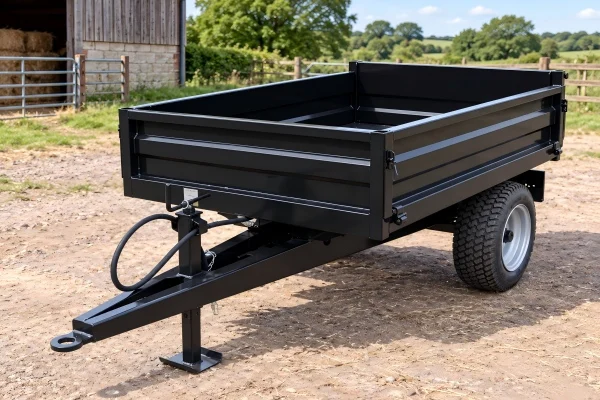
A farm dump trailer is a better choice when your primary loads are soil, gravel, manure, mulch, branches or crop residues.
Check the hydraulic cylinder, frame structure, axle capacity, tire rating and brake system before comparing just the box size.
A gooseneck farm trailer attaches inside the bed of a pickup instead of behind the rear bumper. This design moves the hitch point forward and can improve trailer stability and load distribution.
The size of the trailer should be based on the load you normally carry, not just the largest trailer you can tow. A deck that is too short creates loading problems, while an oversized trailer adds weight, cost and storage difficulty.
Measure the full load, including accessories. For machinery, check overall length, width, height, wheelbase, track width, tire width, and front or rear overhang. A compact tractor with loader and rear attachment can be much longer than the tractor itself. It also distinguishes between the size of the deck and the overall width of the trailer. The deck size is the payload area. The overall width includes tires, fenders and other structures outside the deck. This is important for both transportation and road compliance.
Do not calculate the payload from the base weight of the machine alone. It includes accessories, tools, fuel, spare parts and anything else that travels in the trailer. Payload capacity is the amount of cargo the trailer can carry. GVWR, or Gross Vehicle Weight Rating, is the maximum allowable weight of the loaded trailer.
Small farm trailers are useful for feed, tools, lawn equipment, off-road vehicles and light property maintenance. They are easier to store and maneuver. Medium trailers suit farms that regularly move compact tractors, mowers, palletized materials and mixed loads. Large trailers are best for commercial farming, heavy equipment, multiple machines, and long distance hauling. They usually require tandem axles, stronger brakes, heavier tires and a more capable towing vehicle.
Base your decision on load weight, towing distance, road conditions, and how often the trailer is used. Light loads around the farm may not justify a tandem axle configuration. Heavy equipment, highway use, and frequent transportation often make tandem axles more practical.
A farm trailer should never be selected without checking the towing vehicle. The truck and trailer work as one system.
Look at the tow vehicle’s maximum towing capacity, payload capacity, hitch rating, axle ratings, tire ratings, and tongue weight or pin weight limits. If the trailer uses electric brakes, the vehicle should also have a compatible brake controller and wiring connection. Do not compare the towing capacity of the truck with the empty trailer. Use the expected weight of the loaded trailer.
A towing vehicle that is too small may have difficulty braking, steering, climbing hills, or controlling the movement of the trailer. Even if the trailer itself can carry the load, the combination is not safe unless the towing vehicle can handle it. Always confirm towing capacity before increasing trailer size or payload.
The most common decision for many agricultural buyers is between the bumper and the gooseneck.
Choose based on trailer weight, workload, towing frequency and the vehicle you already own. For light to medium farm work, bumper traction is often sufficient. For frequent hauling of heavy equipment, a gooseneck farm trailer may be the best long-term choice.
Check the axle rating, suspension system, tire load capacity and wheel specifications. Leaf spring suspension is common on many farm trailers because it is strong and easy to maintain. Torsion and other types of suspension can be useful when a lower deck height or different ride characteristics are needed.
Power brakes are common on many American farm trailers. A properly matched brake controller helps the trailer brake with the towing vehicle instead of relying solely on the truck. Brake requirements vary depending on the weight and location of the trailer, so local regulations should always be checked before putting the trailer on the public road.
Useful features include loading ramps, tilt covers, hydraulic systems, winches, tool boxes, stake pockets, D-rings and multiple attachment points. Choose the features based on the actual job. A farmer who moves mowers may value a mesh ramp. A contractor moving skid steers may need heavy-duty loading ramps. A farm that handles manure every day may get more value from hydraulics than from additional deck length.
Both materials can work well when designed properly.
Steel offers high strength, good repairability and competitive cost. Widely used for heavy-duty farm equipment trailers and dump trailers. The main concern is corrosion. Painting, powder coating, electrophoretic coating and hot dip galvanizing can be used to protect steel. Hot-dip galvanizing is especially useful in wet, humid or coastal environments.
Steel is often the best choice for demanding agricultural work where strength and budget are more important. Aluminum may be worth the extra cost when corrosion resistance, lower curb weight, or easier long-term maintenance are higher priorities.
Most buying mistakes come from focusing on one factor and ignoring the rest.
