


Transporting parts of the Bailey Bridge to site
Credit Simrik Air
Nepal, which suffered massive flooding and thousands of deaths after a glacier collapsed on August 27, is now moving from rescue operations to future redevelopment.
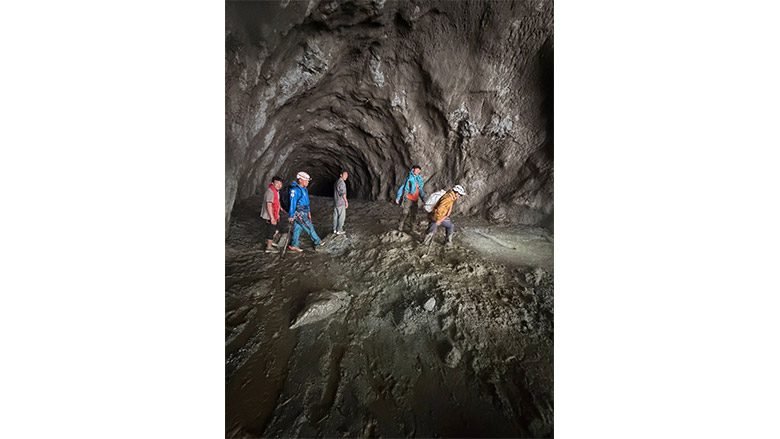
The final rescue team fought through all the obstructions inside the Chilime tunnel, the last hope to rescue the people who were trapped, to finally reach the mud-filled cavern on September 16, where five bodies were located and recovered. The recovery marks the closing phase of a mission that has stretched the limits of India-Nepal technical prowess, endurance and teamwork.
Along with the Nepalese army, rescuers from the Indian army and the National Disaster Response Force set up to deal with natural and man-made disasters worked in the tunnel, a government source told ENR. Around September 12, they had rebuilt a 1.6 kilometer access road, 400m of it completely washed away, which was the only way to reach the tunnel, the source said.
Rescue teams from India and Nepal had to force access by crossing the river, digging through flowing mud that buried machinery repeatedly, cutting 3m blocks and controlling a dangerous surge of water mixed with mud with high-capacity pumps. The first 125 m of the 215 m route to the cavern were the most poignant; with 100m of this section cleared by 24-hour non-stop digging, pumping and manual crawling with near-zero visibility.
Helicopters served as Nepal’s main lifeline during the floods, completing 1,214 sorties to evacuate 52,311 people. The total cargo delivered by air has been about 312 metric tons by Nepal Army and private helicopters. The ground load exceeds 1,900 metric tons.
“The pace of work is slow. The debris has dried up and turned into hard rock,” said Murlidhar Joshi, director of Simrik Air, which played a major role in the rescue with a helicopter that remains dedicated to flying in the crisis. Last week, he delivered solar units ordered by a monastery in the region. He told ENR that every exit had to go through the government of Nepal to ensure efficiency and integration of operations.
“At times like these, the technical knowledge, field experience and all the engineering skills we possess become more than professional assets: they become instruments of service to humanity,” said Parikshit Mehra, a government official in Telangana and a mechanical engineer involved in the Indian rescue.
India’s Ministry of Power began supplying 654 MW of power to Nepal, an emergency export triggered by hydropower losses. The agreement is valid till December 31, after which India will review Nepal’s deficit. The estimated hydropower shortfall of 400 MW is fully covered during the import window, leaving only a small overnight gap of about 70 MW managed through reservoir generation and load balancing.
India is Nepal’s only connected energy partner; China cannot supply electricity because no transmission line exists between the two countries and their two grids are out of sync.

Credit Indian Rescue Team: Indian Army, BRO, NDRF
Dead, the missing counts rise
As of September 16, Nepal’s disaster toll has risen to 1,399 dead, with 5,179 missing and 6,672 injured, including hydropower workers, villagers and road construction crews, according to the updated figure from the National Disaster Risk Reduction and Management Authority.
Casualty figures in China remain conservative at 43 dead and 519 missing, including 261 foreigners. Reuters on September 15 confirmed that reconstruction of Gyirong’s destroyed five-story immigration/customs center had not begun, with operations still focused on searching and clearing debris. The destruction had moved five kilometers into Tibet, according to news reports.
Looking for quick answers on construction and engineering topics?
Try Ask ENR, our new intelligent AI search tool.
Ask ENR →
Nepal’s government-led Rapid Disaster Needs Assessment, the multi-agency mechanism that produces data-verified estimates of disaster impact, has pegged early recovery needs at $4.8 billion.
The data source documented 68 damaged trail bridges spanning 10,671 m and 37 completely destroyed motorized bridges. Nepal has formally approached the UN-backed Loss and Damage Response Fund, while the global agency and the Nepalese government launched a fast-track appeal for $49.6 million to help 84,000 people. Only $22 million has been received, said UN Resident Coordinator Lila Pieters Yahia, who stressed that Nepal’s urgent needs include restoring the water system, mobile clinics for pregnant women and mental health support.
Nepal’s Prime Minister Balendra Shah plans to address the United Nations General Assembly in New York City on September 24 to call for global responsibility to mitigate climate impacts.
The country aims to turn reconstruction into a broader economic recovery plan, prioritizing climate-resilient infrastructure over simple replacement. Kathmandu University expert Roshee Lamichhane told Deutsche Welle, Germany’s state-funded public broadcasting network, that effective use of funds to restore lives and livelihoods and build disaster-resilient systems will determine the success of Nepal’s post-flood recovery strategy.
Sinead Magill, head of government and society at GISI Consulting Group and CEO of Palladium, which has been involved in institutional development in Nepal for years, warns that the long process of rebuilding what has been destroyed in the country must be done knowing that a similar event could happen again at any time.
“I think we have to be prepared for the disruption of the recovery [and] reconstruction, i [projects have] to be designed with that in mind,” he told ENR.
Magill adds that there needs to be a balance between short-term solutions, such as a bridge that allows people to take children to school, and building resilient infrastructure in the long term. “Too often, trade-offs are made there, which I don’t think are in the long-term interest of the country or the people,” he said.
