

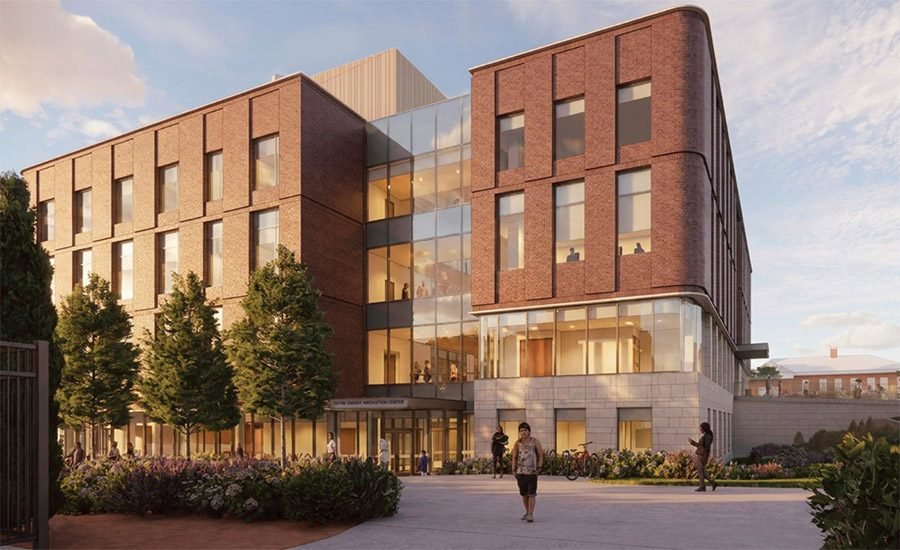

In response to the growth of AI and increased global energy demand, the University of Missouri launched construction of a $120 million energy technology-focused building on its Columbia campus, with Whiting-Turner chosen as the contractor.
Completion of the 116,000-square-foot Payne Energy Innovation Center is expected in 2028, with the intention of directing campus-wide expertise to create new solutions for how energy is produced, stored, secured and delivered.
The center is named after David Payne, an alumnus of the campus’s School of Engineering, who made a $50 million gift, the largest in the school’s history, to support academic programs and students, advance faculty research and improve facilities, including a renovation of Naka Hall, home of the electrical and computer engineering departments.
Payne is president of PayneCrest Electric in St. Louis, an electrical contracting company he has run since 1985 and has expanded to serve commercial and industrial customers across the US.
Other firms involved in the project include PGAV Architects as architect of record and lab planner, LMN Architects as associate architect for design, Horner & Shifrin providing MEP, SK Design Group as civil engineer, Walter P Moore as structural engineer and minority-owned FSC serving as building code and life safety consultants.
Areas of focus at the center are expected to include advanced energy materials, artificial intelligence, grid security, power generation storage and nuclear power.
Researchers in each of these areas will work in the planned four-level center, which is intended to be a collaborative workspace for the university’s Center for Quantum Innovation, Mizzou’s Center for AI Education, Research and Infrastructure and its Center for Cybersecurity.
The university says the development of the center is driven by the rapid growth of artificial intelligence and global demand for energy, which is expected to double in the next 25 years.
“Meeting this demand will require more than just producing additional energy,” the university said. “Aging infrastructure, cybersecurity threats, extreme weather and changing energy loads are creating new challenges for how energy is generated, stored, secured and delivered.”
At the center, “researchers will address energy challenges from production to performance, with an initial focus on high-impact areas such as advanced energy materials, artificial intelligence and network security. The work will build on the university’s strengths in nuclear energy, materials science and cyber security,” he adds.
In addition, experts in public policy, agriculture, business and other fields will explore how new technologies can move from discovery to practical use, the university says.
“By combining expertise in these disciplines, [the school] is creating an energy research ecosystem that can address challenges from all angles, from discovering new materials and strengthening the power grid to developing policies and preparing the workforce needed to bring new technologies to life,” he said. Cooper Drury, dean of the University’s College of Arts and Sciences, in a press release.
The center is planned as a partnership between the College of Engineering, the College of Arts and Sciences and the College of Agriculture, Food and Natural Resources, with expertise also drawn from the Faculty of Law, the Robert J. Trulaske, Sr. College of Business and the Missouri School of Journalism.
