
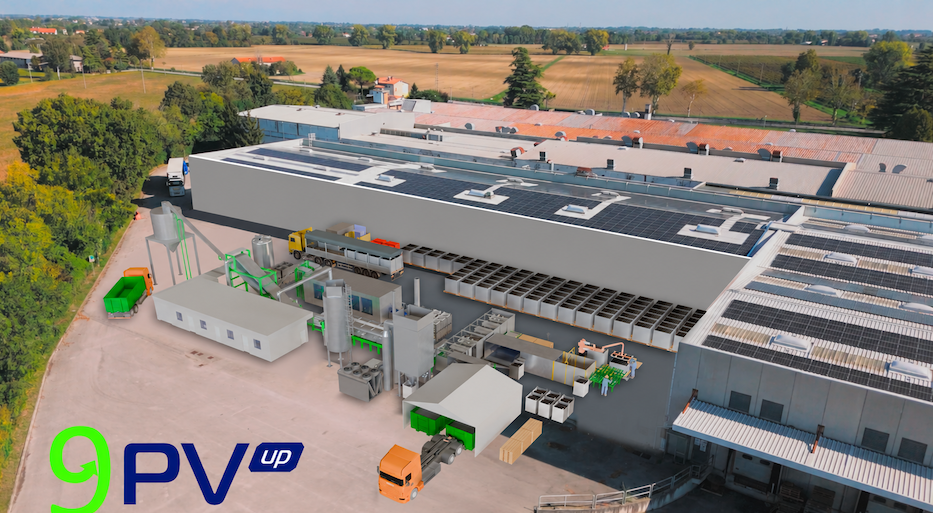

Italian e-waste recycling company 9-Tech plans to soon start construction of its first industrial-scale solar panel recycling plant near Venice that combines thermal, mechanical and hydrometallurgical treatments to recover materials from end-of-life photovoltaic modules, maximizing reuse with reduced energy consumption, chemicals and waste generation.
The company’s estimated $1.1 billion facility was pushed to secure the funds needed to sign contracts with the companies that will build it, after the European Commission named it last month as one of 46 “strategic projects” aimed at strengthening supply chains for critical raw materials across Europe.
Eight designated projects are extraction, 11 processing and 19 recycling. Three more combine extraction and processing, and another five combine processing and recycling.
The “strategic” designation does not mean the projects will definitely receive funding from the European Union, but the commission says it allows access to funds and also helps speed up projects through authorisation.
The projects, estimated together at a capital investment of $23.5 billion by the developers, include facilities for materials used by key strategic supply chains for batteries, defense and aerospace needs, and permanent magnets. They are located in Belgium, Bulgaria, Estonia, Finland, France, Germany, Greece, Italy, Lithuania, Netherlands, Poland, Portugal, Romania, Slovakia, Spain and Sweden.
“Our approach is simple: reduce dependence and increase production in Europe,” said Stephane Sejourne, executive vice-president of the Commission, when announcing the selections. “We have the resources, the projects and the funding. Now we are picking up the pace.”
The commission did not share estimated costs for individual projects, but owners who provided those figures to ENR indicated they range from a few million dollars to nearly $4 billion for Arctial’s low-carbon aluminum processing plant in Kokkola-Kronoby, Finland.
Looking for quick answers on construction and engineering topics?
Try Ask ENR, our new intelligent AI search tool.
Ask ENR →
Counter China Sidewalks
As the COVID-19 pandemic highlighted vulnerabilities in global supply chains, which have been further exacerbated when China announced new restrictions last year on the export of critical minerals, European leaders, like their American counterparts, are looking to boost domestic production.
The European Union has set a target of extracting 10%, processing 40% and recycling 25% of its annual consumption of strategic raw materials, adding that no more than 65% of any material should come from a single foreign country.
At 9-Tech The representative told ENR that it has secured about half of the investment needed for its first industrial line in Meolo, Italy, but has been waiting to have all the financing in place before signing contracts with the companies already selected to build the plant. The company hopes the EU designation will expedite access to the additional funding needed, as well as help speed up permitting and help secure customers once built.
“Being selected as a strategic project is a strong endorsement of our expansion in Hagen, [Germany]which will process and recycle battery metals,” Pure Battery Technologies CEO Staffan Ever said in a statement.
The company is set to build a $134 million expansion of an existing nickel refinery, increasing capacity to 10,000 metric tons per year. The project will include construction of new production and storage buildings, a wastewater treatment plant, expansion of existing utilities and on-site logistics, and demolition of outdated buildings, company representative Collette Hetherton told ENR. Once the financing closes, both detailed engineering and construction will be awarded through competitive processes, with the goal of completing construction in the second half of 2028, he said.
The selections follow an initial round of 47 strategic project designations last year. Sejourne told reporters that the permitting fast track available for these projects had already been accelerated to 25 through environmental assessments, with 17 obtaining construction permits.
The projects have jointly received the equivalent of billions of dollars in funding through the commission, EU member states and the European Investment Bank, with 102 applications submitted to the commission for this round of selections.
“Factories are being built. Financing is signed. European value chains are emerging,” Sejourne said.
