

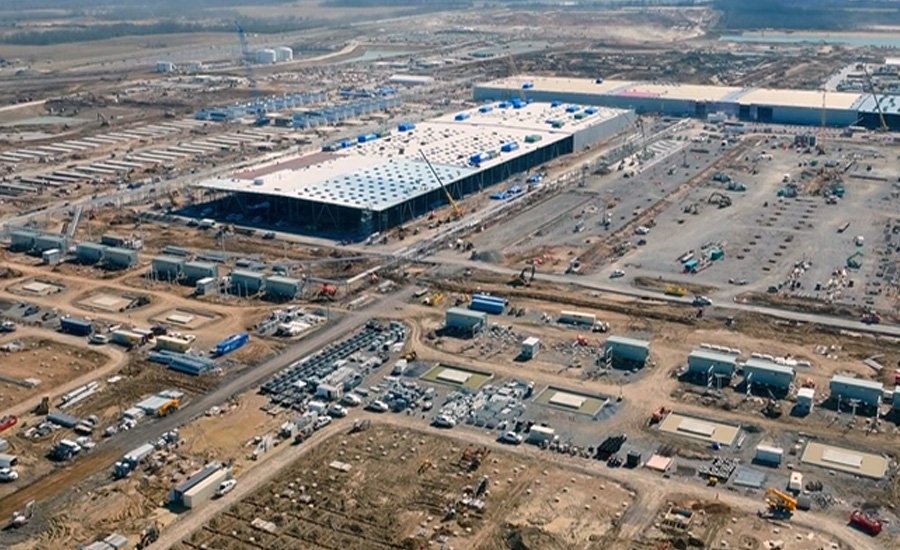
Meta’s use of billions of dollars in federal research tax credits drew fresh scrutiny from Congress on Oct. 14, as lawmakers questioned whether spending tied to the company’s rapidly expanding artificial intelligence data center construction program qualified as experimental research.
Senate Finance Committee Ranking Member Ron Wyden (D-Ore.) and six other Democratic senators, in a letter to Meta CEO Mark Zuckerberg, questioned whether the company claimed federal research tax credits for building or operating AI data centers and whether it classified the facilities as experimental “pilot models” for tax purposes.
Meta reported research tax credits totaling about $6.6 billion between 2023 and 2025, up from $700 million in 2023 to about $2 billion in 2024 and nearly $4 billion last year, according to the senators’ letter, which cites the company’s regulatory filings. The portion of these credits is tied to data center development is not publicly known. According to its own estimates, Meta says it expects to spend up to $145 billion building its AI infrastructure by 2026, double what it spent last year.
“Federal research credit can be a useful and necessary tool to support our nation’s cutting-edge research and innovation economy,” the senators wrote. “Subsidizing the creation of your own AI data center doesn’t come close to meeting that standard.”
In an emailed statement to ENR, Meta spokesman Andy Stone said the company has invested $200 billion in research and development over the past five years, including $57 billion last year.
“Unlike traditional data centers, AI-optimized data centers are inherently new and require extensive testing and experimentation that cannot be simulated in order to be properly designed and built,” said Stone. “This is precisely the kind of domestic investment that Congress encouraged when it established these tax incentives decades ago.”
The statement did not specify whether Meta claims federal research credits for construction costs or how the company distinguishes qualified experimental activities from ordinary capital construction costs — two questions ENR referred to the company.
Looking for quick answers on construction and engineering topics?
Try Ask ENR, our new intelligent AI search tool.
Ask ENR →
The scrutiny has also extended to the House. A bipartisan group of roughly two dozen lawmakers wrote to the U.S. Treasury Department, raising concerns about Meta’s apparent position that expenses associated with building its data center qualify for the research credit, Semafor reported on Oct. 15.
Allowing the credit for data center development and construction “would significantly expand the research credit beyond its intended purpose and risk turning an incentive for technology experimentation into a subsidy for capital expenditures that companies would make in the normal course of business,” the lawmakers wrote.
Where research ends and construction begins
Federal research credits generally require activities aimed at resolving technological uncertainty through experimentation. Eligible expenses may include research-related salaries, supplies, and certain contracted research costs. The IRS guidance excludes land, land improvements, and depreciable property from qualified research supplies, while allowing certain pilot model experimental expenses to independently qualify for the credit.
The distinction matters as Meta undertakes multibillion-dollar projects that incorporate specialized cooling, electrical and power infrastructure designed for increasingly dense AI computing systems.
Meta’s Hyperion campus in Richland Parish, Louisiana, has become a $27 billion development that includes buildings and a long-life power, cooling and connectivity infrastructure. Meta and funds managed by Blue Owl Capital formed a company last year to own the project, with Meta providing construction management services.
A Turner Construction-DPR Construction-Mortenson team is building the 4-million-square-foot campus, which includes extensive modular electrical and mechanical systems and could require 5 GW of power, ENR previously reported. It is expected that the maximum employment in construction will exceed 5,000 workers.

A rendering shows Meta’s planned $10 billion, 1GW data center campus in Lebanon, Ind., one of the company’s largest AI infrastructure investments.
Rendering courtesy of Meta
Meta is also developing a $10 billion-plus 1 GW campus in Lebanon, Ind., while a separate venture with BlackRock is financing a 1 GW campus in El Paso with approximately $14 billion in building development costs and supporting power, cooling and connectivity infrastructure.
In an Aug. 6 interview with podcaster Tom Shaw posted on Meta’s website, Rachel Peterson, Meta’s vice president of data centers, described parts of the company’s current infrastructure program as first-rate engineering.
“Some of the things we’re doing have never been done,” Peterson said. “They’re the first of their kind from a design standpoint to the power plants we’re putting on site, to the … technology we’re using.”
The senators’ letter says Meta 2025’s annual report acknowledges uncertainty about whether documentation supporting some of its research credits would withstand scrutiny by tax authorities. The disclosure does not identify data center construction as the source of this uncertainty.
Neither the congressional inquiries nor Meta’s response state how much of the company’s research credits are tied to building the data center. Lawmakers are looking for that breakdown, and the specific expenses Meta sustains are eligible.
Sen. Peter Welch (D-Vt.) separately asked the Internal Revenue Service on Oct. 8 to identify companies claiming research credits for AI data center expenses and whether additional guidance or regulations are needed.
“The IRS has a responsibility to ensure that tax credits are claimed as Congress intended,” Welch said in a statement.
The senators gave Meta until Oct. 31 to explain its legal justification for the credits, identify the types and amounts of AI data center expenses claimed and disclose whether accounting or law firms provided opinions supporting the company’s position.
