

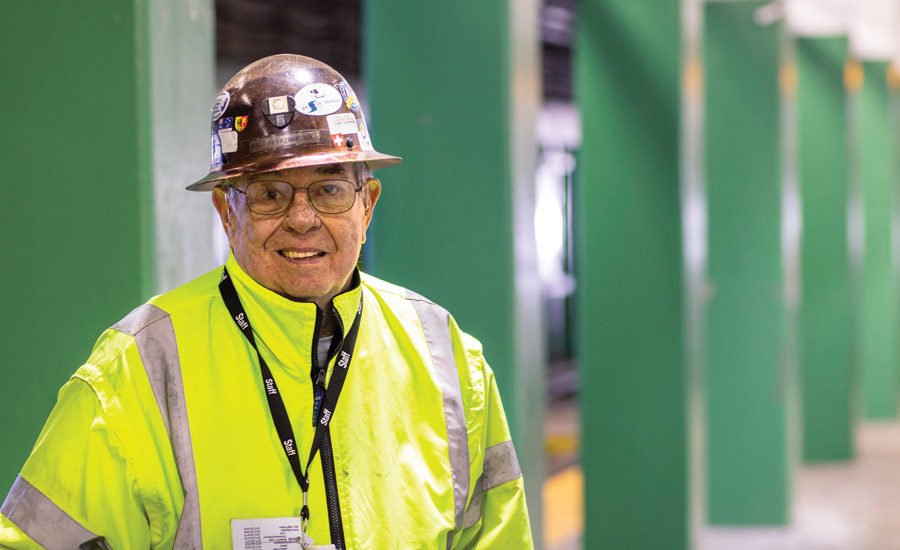
Henry Russell’s first memory from inside a tunnel was riding the Boston subway on his grandfather’s lap, a rider for the Metropolitan Transit Authority, predecessor of the Massachusetts Bay Transportation Authority . Elder Russell even let his 4-year-old grandson ring the trolley bell as they pulled into Park Street Station. “You could get away with that stuff back then, it was all family,” he says.
The tunnel boy, now 80, built a career spanning more than five decades as an internationally recognized expert in waterproofing systems, fireproofing materials and grouting for underground structures. As HNTB’s Director of Tunnel Rehabilitation and Resilience since last year, Russell has worked on projects on six continents, including the Taipei subway tunnels, Venezuelan docks and a West African liquefied natural gas plant. While his portfolio also includes some of America’s biggest infrastructure projects, such as Boston’s Central Artery and Seattle’s Alaskaway, Russell has a soft spot for some 20 projects he completed for MBTA, as he remembers to “wander around.” [the facilities] with my grandfather”.
A leader in tunnel evaluation and rehabilitation, Russell developed a systematic system for identifying structural defects that was adopted by the Federal Highway Administration and the American Association of State and Transportation Officials in the mid-2000s for its tunnel design manuals. He also chaired an International Tunneling Association task force that established structural guidelines for the fire protection of road tunnels following the 1999 Mont Blanc tunnel fire in Europe that killed 39 people when a transport truck burned on its French side. He received the association’s 2022 Distinguished Service Award for these recommendations, which were adopted by the National Fire Protection Association.
For his long career of leadership and contributions to construction in the region and beyond, Russell has been named a recipient of ENR New England’s 2024 Legacy Award.
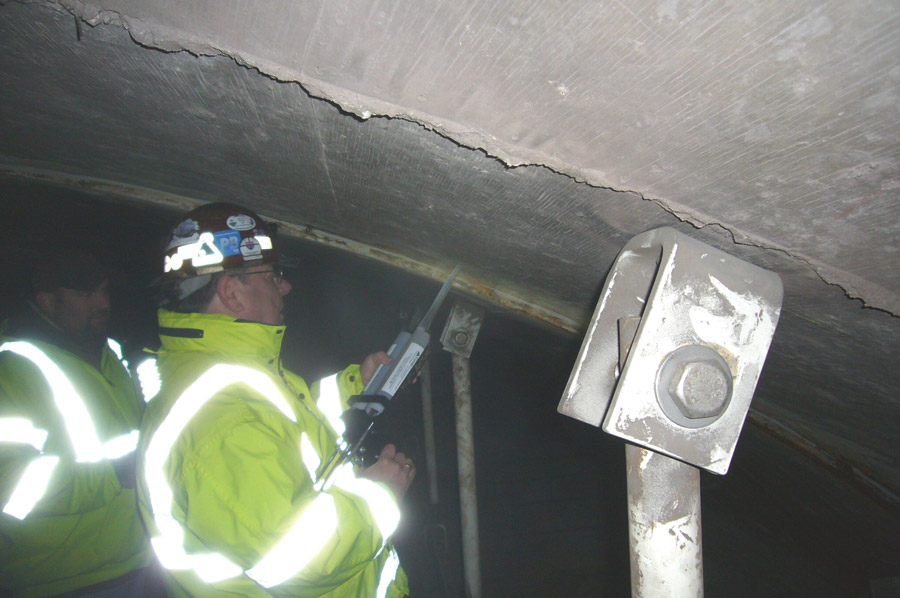
Working at the Fort McHenry Tunnel Exhaust Plant in Baltimore in 2010, Russell seals a leaky gasket in its lining segments as part of a testing program.
Photo courtesy of Henry Russell
Giving an example
Randall Essex, a former tunnel association executive board member and vice president, says Russell’s two decades as task force chair is the longest of any at the ITA. “Being able to maintain this leadership position is a testament to his willingness to share what he knows, lead by example and experience, and create well-written documents that are respected throughout our global industry,” says Essex, North’s former tunnel director. America to Mott MacDonald. Essex, who also worked with Russell at Mott MacDonald, said Russell brought ideas and solutions “without concern for company loyalty or personal financial gain. Those traits are rare in our industry these days “.
“It’s dynamic. Each project is site-specific and requires a lot of analytical thinking.”
—Henry Russell, Director of Tunnel Resilience and Rehabilitation, HNTB
Russell also helped develop Massachusetts fire regulations regarding leaking fuel storage tanks. In 2011, the Boston Society of Civil Engineers recognized him for public service for his more than 20 years on the conservation commission in Braintree, Massachusetts. He was also cited in 2016 by the American Council of Engineering Firms for community service by serving on Braintree’s public works committee. A 1961 graduate of the nation’s first public high school, English High, Russell serves on the board of his alumni association.
Still active in professional societies, he currently chairs a national tunnel repair committee for the Mining, Metallurgy and Underground Exploration/Construction Association, which recognized him for his lifetime achievement in tunnel rehabilitation in 2020. Russell is also a member of The Moles, a heavy group. construction leadership group with roots in tunneling and the Transport Research Council.
Russell has published more than 35 articles, book chapters or manuals on engineering geology, tunnel rehabilitation and grouting, as well as slurry wall construction. He continues to work in the field as a field supervisor for inspections and investigations. Russell says he was drawn to the “challenge” of tunnel engineering because “it’s dynamic – every project is site-specific and requires a lot of analytical thinking”.
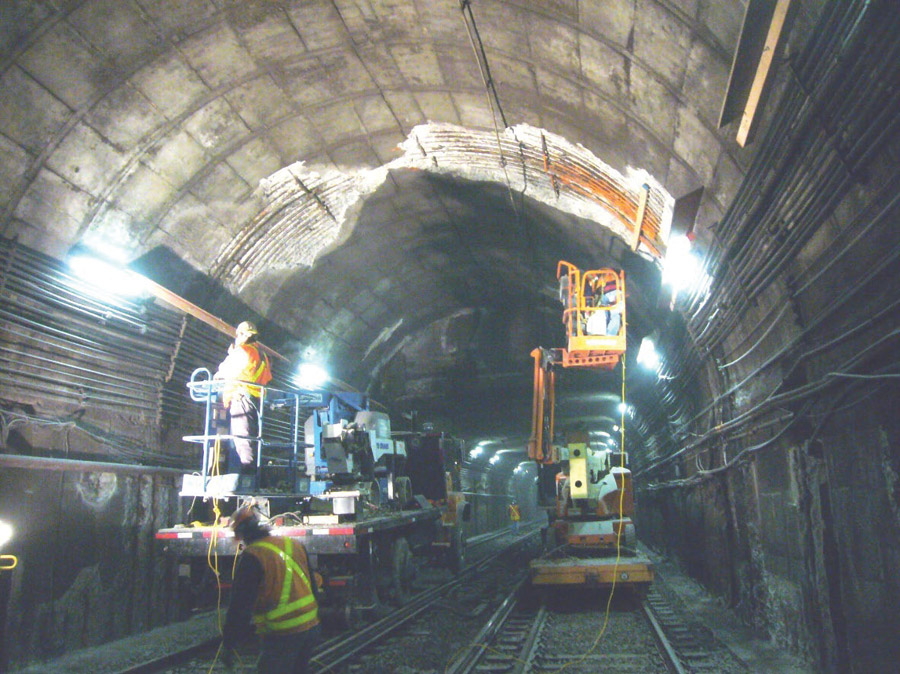
Crews perform emergency work in a Boston Red Line subway tunnel in 2007, which was the basis for an article Russell published that year in the Journal of the American Shotcrete Association.
Photo courtesy of Henry Russell
way forward
Several years after Russell’s grandfather immigrated to Boston in the early 1900s, Russell’s father and the rest of the family followed. Growing up in the city’s Dorchester neighborhood as the son of a reporter for the Boston Herald Traveler, Russell says he learned critical thinking skills at English High, founded in 1821, and how to “analyze elements in the scientific method, which I it was very helpful throughout.” my career.”
Russell and his sister, Janice Hight, were the first members of the family to attend college. He graduated from Curry College in Milton, Massachusetts with a degree in geology. While serving in the US Army Reserve from 1967 to 1973, Russell spent a year working for a small civil engineering firm before becoming a research assistant at MIT to T. William Lambe, a professor of geotechnical engineering who designed soil experiments for the Apollo space program and helped develop methods for tunnel instrumentation, including some used for several local tunnel extensions. Although he wasn’t licensed as a professional engineer until the 1990s, Russell says he “learned my engineering” from Lambe, even though he was never an enrolled MIT student.
Working for the next three years at the engineering firm James Collins and Associates, its owner urged Russell to gain experience in something “that not too many people are good at,” he recalls. “I chose tunnels because I was interested in tunnels.”
In 1976, Russell joined the tunneling group of the design firm Parsons Brinckerhoff, where he spent the next 40 years. He quickly put his geology background to good use while honing his craft working in Boston’s subway tunnels. He acknowledged that cataloging defects in concrete, masonry, steel or cast iron in tunnels is similar to what geologists do to document deficiencies in rocks. “Tunnel inspection is a natural job for a trained geologist,” says Russell.
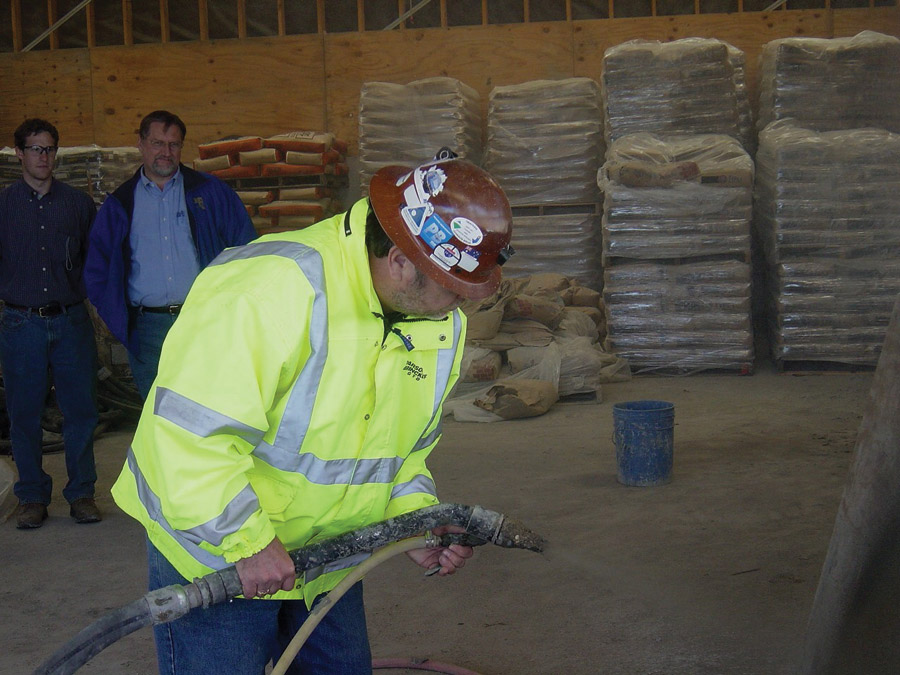
Russell demonstrates a shotcrete test on a Massachusetts tunnel project in 2014.
Photo by R. Brenn, courtesy of Henry Russell
Manual writing
This realization planted the seed for Russell’s tunnel rehabilitation guidance that eventually became the framework for federal and state transportation officials’ tunnel design manuals, which were first published in 2008. MBTA also asked Russell to improve a seven-digit alphanumeric computer code created by another. company to code tunnel structural defects. “Looking at it rationally,” he says, “I simply developed a system where simple grades were used to identify cracks, delamination cracks, etc.”
Russell’s system has simple codes, such as S for tear, C for crack, D for delamination, and R for reinforcement. “I added a numerical value to this … to identify the degree of severity and also classified the leaks,” adds Russell. “Up until that point, what was wet to you wasn’t necessarily wet to someone else… It quickly became useful and easy to do. From there, it quickly became a career for me “.
“[Russell]he wants the team to know everything related to any topic at hand. This breadth and depth of knowledge is exceptional; there is not a tunnel in the United States that we have discussed that Henry did not say, “I did the inspection.”
—Sanja Zlatanic, National Tunnel Practice Leader, HNTB
With his skill in tunnel repair and rehabilitation, Russell rose to Senior Vice President and Technical Director of Tunnel Rehabilitation at Parsons Brinckerhoff. In 1990, it was sent to Chicago after a freight tunnel under the Chicago River collapsed and flooded the city’s Loop district. “I spent $5 million on grout in one month and met with the mayor every day [Richard J.] Daley about what we were going to do next,” Russell recalls.
Later that decade, Russell served as an engineer’s representative for the Boston Harbor Effluent Tunnel project to clean the harbor’s dirty water. Untreated sewage had been dumped there for years. The only Parsons Brinckerhoff employee to work on the roughly 12-year project from start to finish, he helped inspect and evaluate more than 100,000 lining segments in the 9.5-mile-long tunnel. Tragedy struck the project in 1999 when two divers died while trying to remove fiberglass safety plugs from the 30-inch-diameter outlet pipes.
Russell later helped fix “serious leaks” in Boston’s nearly $15 billion Central Artery/Tunnel project. An adviser on the project, he also inspected the tunnel after a concrete ceiling panel fell in 2006 and crushed a car traveling on a connecting ramp, killing a passenger and injuring the driver. A section of the tunnel was closed for almost a year for repairs.
Russell says he had a “professional responsibility to the public to advise the owner/operator [Massachusetts Turnpike Authority] for not paving the way.” The lawsuits resulted in a $458.2 million settlement between the government and the Bechtel-Parsons Brinckerhoff joint venture, which was a project management consultant, as well as other design and construction. Russell “kept detailed notes that night” after the incident, he says, and as a result, “spent four years talking to lawyers.” He added: “It was unfortunate that it happened. Being in the wrong place at the wrong time for those poor people was terrible.”
After leaving Parsons Brinckerhoff in 2016, Russell worked for Mott MacDonald until 2022 before joining HNTB as a consultant. Sanja Zlatanic, HNTB’s National Tunneling Practice Leader, says Russell has mentored generations of young tunneling engineers. “He wants the team to know everything related to any topic at hand,” Zlatanic says. “Such breadth and depth of knowledge is exceptional.”
Whichever American tunnel comes up in the conversation, Russell says he’s inspected it, Zlatanic notes, adding, “He’ll say exactly what year, with all the information related to the construction method and potential problems with it specific tunnel”.
Russell says he “loves his job” and has no plans to retire as long as he’s healthy. “I have a lot behind me to train young people”, he explains, “and I like to do this, this is part of returning to your profession”.
