

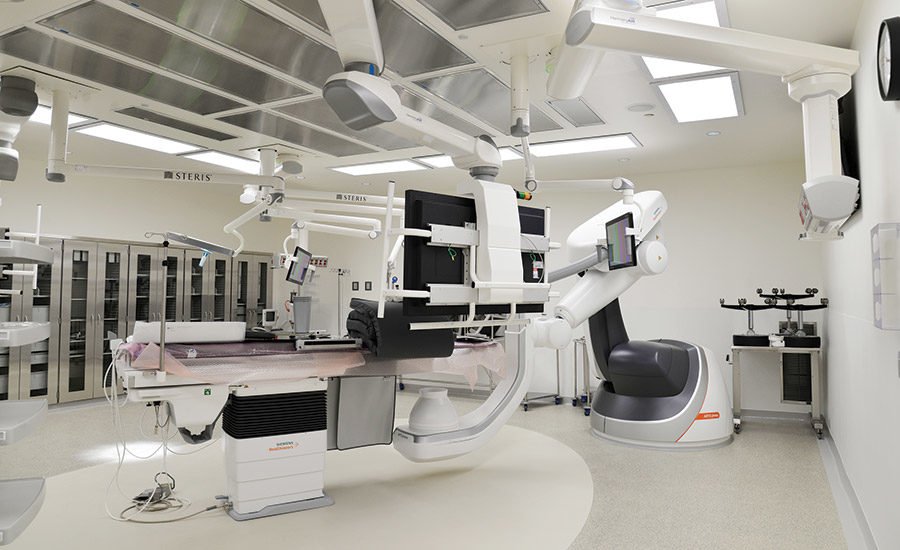
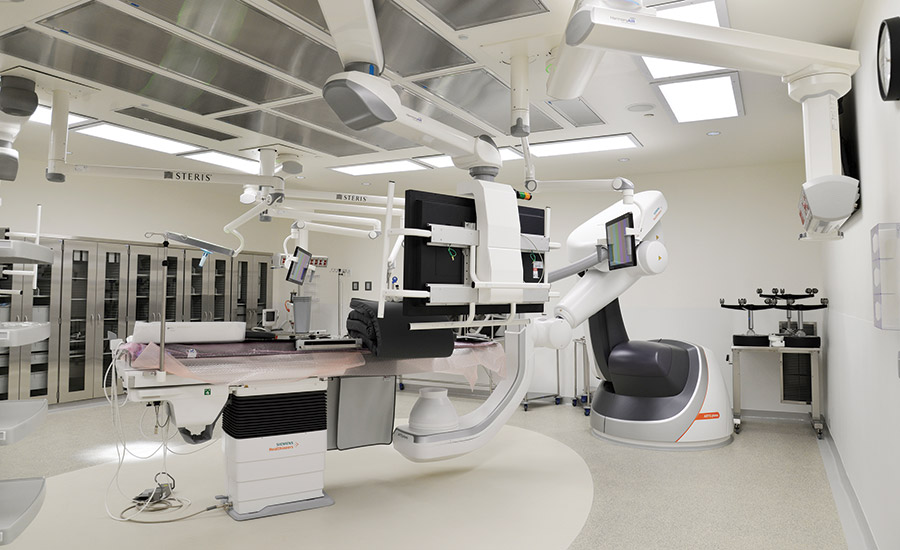
Primary Children’s Hybrid Operating Room
Salt Lake City, Utah
Best little project
Presented by: Jacobsen Construction Co.
Region: ENR Mountain States
Owner: Children’s Primary Hospital
Main design company: NJRA Architects
General contractor: Jacobsen Construction Co.
Structural engineer: Reaveley Engineers + Associates
Mechanical Engineer: VBFA
Electrical Engineer: BNA Consulting
Subcontractors: A&D Fire Sprinklers Inc.; Apache Industrial Services Inc.; Architectural Building Supply LLC; Architectural Components Inc.; DAW Construction Group LLC; Glassey Steel Works; Grow Painting Inc.; HC West LLC; Healthcare Technology Corp.; mechanical KOH; Millcreek Tile & Stone LLC; Mitchell Acoustics Inc.; Mollerup Glass Co.; Quirk Inc.; Stainless Steel Specialties LLC; Stonehard; Taylor Electric Inc.; Western veneer
Centrally located between 13 active operating rooms, this project’s workplace proved to be the most complex challenge, says Sourabh Sinha, project director at NJRA Architects. “Mitigating construction noise, dust and potential infection is of the utmost importance in an environment such as operating rooms,” he says. The solution was to cut a sealed tunnel corridor from outside the hospital directly to the workplace. Without a useful exit, workers removed a section of the exterior wall to create the endpoint from scratch. Tools and equipment arriving in this sterile environment first had to be specially cleaned and covered. Workers wore Tyvek “bunny suits” from head to toe.
Relocating the surgical gas lines to make room for this tunnel required extensive pre-planning. Quickly relocated during out-of-hospital hours, correct pipe placement was still verified with multiple layers of redundancy. “If we were to run nitrous oxide in an oxygen line, just think of the result,” says Scott Sabin, project manager for Jacobsen Construction.
The operating theater was built directly over the hospital’s histology laboratory. Steel reinforcement was added to the laboratory ceiling to support the weight of the overhead equipment. The team built dance floor scaffolding just 12 inches below the ceiling along with protective netting to keep the lab in use and sterile.
