

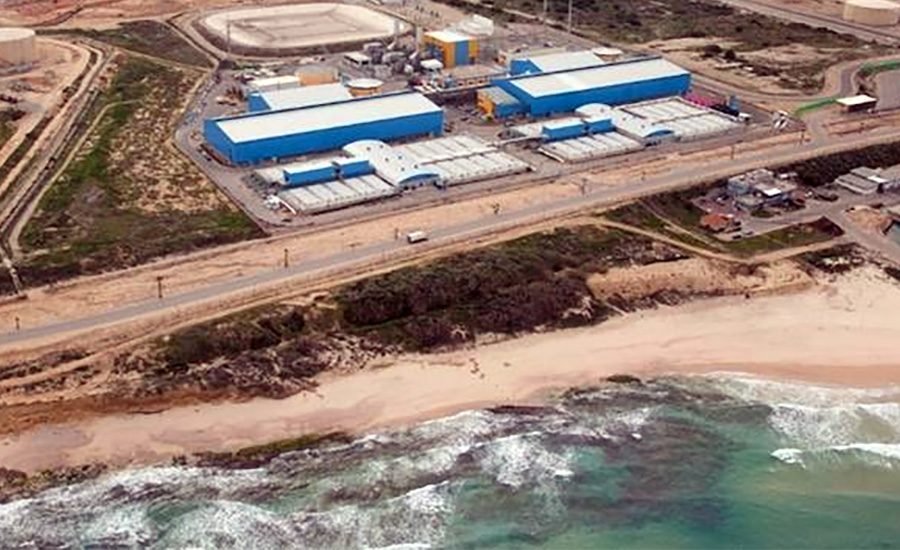
Ten days after a massive microalgae bloom disrupted most of Israel’s Mediterranean Sea desalination capacity, two plants remain shut and three are operating at reduced output in a country that gets about 80% of its drinking water from the process.
The affected plants span about 30 miles of Israel’s central and southern Mediterranean coast, including the Palmachim, Sorek A and Sorek B facilities south of Tel Aviv, and Ashdod and Ashkelon near the Gaza border.
The Israel Water Authority and the Energy Ministry said on September 6 that Ashkelon and Ashdod remained closed due to unusually high seawater turbidity, while Palmachim, Sorek A and Sorek B were only partially operating. Hadera, about 25 miles north of Tel Aviv, remains the only one of the country’s six major Mediterranean plants operating at full capacity (see map below)
Israeli officials said households and agriculture continued to receive water as the loss of desalination production was supplemented by increased pumping from the Sea of Galilee, groundwater wells and reservoirs filled by the national water company Mekorot.
“We know for sure that it’s algae,” Alon Zask, director general of Israel Oceanographic and Limnological Research, told Israeli news publication CTech. “This is an unprecedented event.”
A November 2024 State Comptroller’s Audit identified 14 seawater pollution events that shut down desalination production between 2007 and the end of 2023. Microbial pollution caused eight shutdowns, fuel or oil pollution caused four, and the remaining two followed seawater turbidity peaks related to storms and earthquakes.
Algal threat treatment systems
At Ashkelon, offshore intake pipes deliver seawater to a pumping station before passing through coagulation-enhanced dual-media filters and micron filtration. The water then enters multiple stages of seawater reverse osmosis. The system is slated for an overhaul as part of a planned expansion that would nearly double the plant’s production capacity, according to government procurement documents.
Israeli water officials say the concentration of microscopic algae and suspended material is impairing pretreatment and threatening reverse osmosis membranes. Energy Minister Eli Cohen said on September 7 that the reduced operating rates at Palmachim and the two Sorek plants are intended to limit risks to the filtration systems while preserving production.
The Water Authority and the Ministry of Energy plan to establish a reserve of replacement reverse osmosis membranes. Cohen said membranes designed to operate for about seven years could lock up much sooner under current conditions.
Authorities tried to deal with the offshore bloom last week, dispersing copper-containing compounds by aircraft along about 5.6 miles of coastline near Ascalon. Israel’s Ministry of Health subsequently recommended a temporary ban on fishing.
“We are not seeing a significant change in the level of turbidity,” Cohen said on September 7.
Mekorot is studying whether it could extend seawater intake pipes further offshore, away from areas with the highest concentrations of algae. Cohen said recommendations are expected within days. No cost estimate has been prepared.
Bloom’s origin is still being studied
Experts from Israel’s Oceanographic and Limnological Research say the algae appear to have originated near Egypt’s Nile Delta and moved north with Mediterranean currents. A marine ecologist at the agency, Tamar Guy-Haim, said blooms depend on nutrients, temperature, light, currents and mixing; Mekorot cited stormy conditions and sea water temperatures of at least 86°F.

Researchers say a microalgae bloom appears to have moved north from Egypt’s Nile Delta on Mediterranean coastal currents, disrupting desalination plants along Israel’s coast. The exact origin of the bloom is still under study.
Map/ENR
Untreated sewage from Gaza may have provided nutrients that intensified the bloom, although available evidence does not establish this as the cause. The United Nations reported on September 1 that more than 39.6 million gallons of untreated sewage per day was being poured into the Gaza environment as work continued to restore the damaged Sheikh Ajleen sewage treatment plant.
Noga Armi, CEO of the Israeli environmental group Zalul, told The Washington Post that sewage was a factor in the event.
Cohen, the energy minister, rejected that connection on Sept. 7, saying satellite images indicated the algae originated in the Nile region. Its origin remains under scientific investigation.
The State Comptroller’s 2024 audit found that raw sewage and treated effluent entered waterways near several large desalination plants and could reach offshore intake areas, especially during heavy rains.
The audit also found that the Ministry of Health had not completed a study it deemed necessary on algae and other toxins associated with invasive species. A Water Authority draft cited by the comptroller warned that climate change could make seawater quality events more frequent, threatening the reliability of water supplies and desalination plant operations; the agency’s climate preparedness work was unfinished when the audit concluded.
More capacity, more concentration
Israel plans to substantially expand desalination as the population increases and natural fresh water supplies dwindle. The Water Authority predicts that production capacity will increase from about 432 million gallons per day in 2022 to approximately 1.23 billion gallons per day in 2050.

Reverse osmosis membrane systems remove salts and other contaminants from seawater during desalination. Israel plans to stockpile replacement membranes as algal blooms threaten treatment equipment.
Photo/Adobe
This capacity is geographically concentrated. The Hadera, Sorek A and Palmachim plants accounted for around 62% of desalinated production when the State Audit carried out its audit. The addition of Sorek B increased the predicted share of these plants to about 72%.
The expansion of Ashkelon is particularly relevant to the current disruption. Procurement documents call for increasing seawater intake capacity, adding treatment equipment and increasing total production capacity to about 159 million gallons per day.
The State Comptroller found in 2023 that the Water Authority had not completed the national water sector master plan required following a 2010 government resolution. Israel has since approved a long-term desalination expansion plan, but the broader master plan remains unfinished.
The agency’s work program for 2026 lists completing and getting its approval as a core task for that year.
