


Autodesk announced on September 14 that Civil 3D, the San Francisco-based construction technology giant’s flagship design software for roads, bridges and other civil infrastructure, has become the second design tool, behind Revit, to connect to its industry cloud Form and the data layer that allows project information to move through the various stages of design and construction connected to various Autodesk design and construction planning tools.
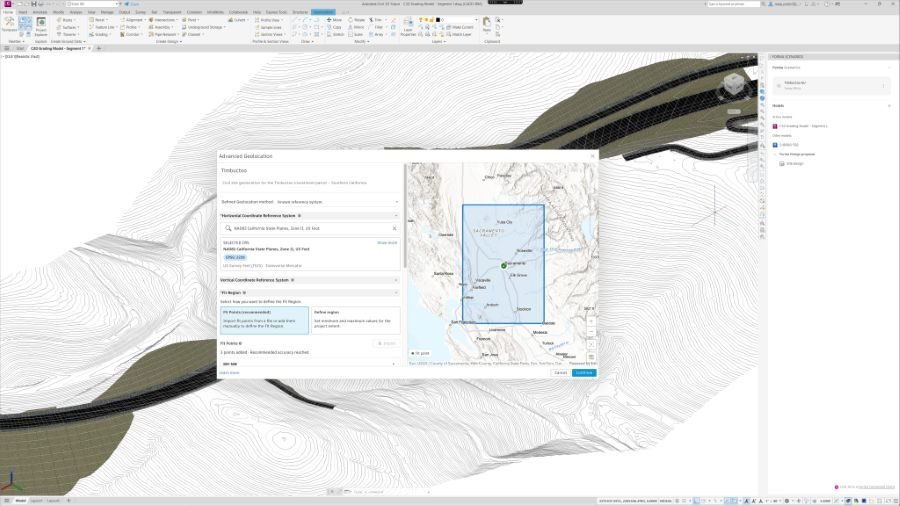
Engineers and architects can now enter Civil 3D data into Forma. The company also announced that it has added a unified geolocation and coordinate system as a foundational data layer to its civil design tools. The new coordinate system will work across Civil3D, Forma and its related civil design and construction products, including Revit. A new parametric civil design product, Forma Street Design, is being added to design streets in the new connected workflow.
“We finally created a unified coordinate system, which is something that Esri really wanted from us,” Autodesk CEO and President Andrew Anagnost said at a press conference at the Autodesk University trade show in Las Vegas. “[At Autodesk] the coordinate system didn’t really translate well across multiple products, which was very annoying to a lot of people, and it was also annoying to Esri. A coordinate system is now propagated throughout, this is a new handover that will occur [with Esri] because now we have the unified coordinate system”.
Design-to-build data transfer for civil engineering is as simple as connecting a building to a city or town’s water or power systems, or as involved as a new road or bridge now has a coordinate system.
“Today, too much of that information is fragmented across different files, different products, in some cases not even Autodesk products,” Theo Agelopoulos, AEC’s vice president of engineering and design strategy, said at a pre-event press conference.
“That’s the problem we’re really trying to solve with Autodesk Forma,” Agelopoulos said. “So we’re expanding Forma into more of the AEC lifecycle, more industries, so that information can move through the project and create what we call project intelligence.”
Designers can bring data from Civil 3D into Forma as a starting point for planning and then design, Amy Bunszel, vice president of AEC Solutions at Autodesk, said in her final keynote as leader of the combined design and construction divisions. Bunszel announced in August that he will step down once Autodesk completes its search for a replacement for the 23-year company veteran who has led both its manufacturing and AEC groups.
Looking for quick answers on construction and engineering topics?
Try Ask ENR, our new intelligent AI search tool.
Ask ENR →
Bunszel also said that Autodesk is expanding its underground sensing and modeling capabilities with ground data from Fugro, and the modeling is coming to Forma, including Fugro GeoDin, and can be shared with Esri’s ArcGIS. He said the geospatial context will expand in the next two years as the strategic partnership with Fugro expands.
More Agent AI
Artificial intelligence remains a focus, although Autodesk agents and other AI tools mentioned during the first two days of the conference were in various stages of development through 2027. Autodesk Assistant was shown answering natural language questions about site design and orientation. Demonstrated generative ability in Forma Site Design, Building Layout Explorer, iterating and comparing multifamily construction project apartment designs to client requirements. AI-based workflows in Revit were shown automating documentation.
Autodesk’s Informed Design Group showed off an AI that could source and automate the design of a tiny house in Australia with defined assemblies for everything from walls to water heaters and pipe assemblies that could connect design documents with suppliers capable of manufacturing the kit of parts.
Autodesk customers are already using agents that perform tasks such as designing non-detailed flange connectors in a drawing and are connected via a model context protocol to other agents that can help with these decisions. Anagnost said the focus on perfecting AI workflows will be good for designers and construction professionals and will necessarily change the construction project processes.
“These agents will be so intelligent that the whole concept of a request for information is erased over time,” Anagnost he said “When we talk about convergence, we’re really talking about the time between a design and making a decision or a design and making the offset go to zero or near zero, and in this world, it actually catches an RFI before an RFI is created.”
