

This audio is automatically generated. Please let us know if you have any comments.
WASHINGTON, DC – Global construction and engineering giant Bechtel has pledged $7 million over five years to the American Foundation for Suicide Prevention to increase efforts to combat suicide in the industry.
The donation is the largest AFSP has ever received, and the highest History of the Bechtel Group Foundation, according to the announcement. The funds will be used to establish programs that reach 500,000 US construction workers.
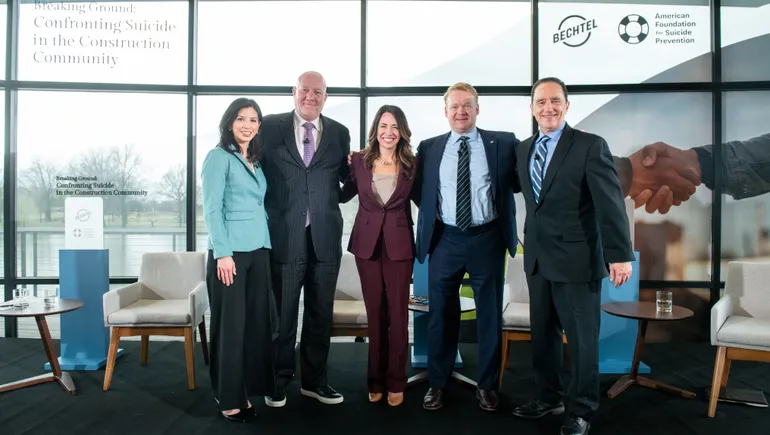
The Reston, Virginia-based contractor made the announcement at an event at the Wharf Dockmaster Building in Washington, DC, on Tuesday morning. Industry leaders and representatives of trade and labor groups attended the event which featured a panel discussion with speakers from Bechtel, AFSP and construction unions of North America.
Bechtel CEO Brendan Bechtel noted that construction has the second highest suicide rateaccording to the Centers for Disease Control and Prevention.
“This is an embarrassing statistic for us as an industry,” Bechtel said during the event.
About 56 male and 10 female construction workers per 100,000 died by suicide in 2021, according to the CDC’s most recent data. Both are higher than the national average rates of 32 and eight, respectively.
Mortality rate in construction work it was 9.6 deaths per 100,000 workers that same year, according to the U.S. Bureau of Labor Statistics, meaning construction workers committed suicide at a significantly higher rate than they died because of their dangerous work.
why now
Bechtel, who has been CEO since 2016, said that while he has been around his family’s company since he was young and worked jobs as a teenager, he has never met a direct colleague who died due to an occupational hazard, but he has known multiple people who have died by suicide.
With increased money flowing into the industry from the Jobs and Infrastructure Investments Act and the CHIPS and Science Act, construction is booming, Bechtel said. In recent decades, the industry has made strides to improve safety through investment, research and training, he said.
“There’s a playbook,” Bechtel said. “There’s no reason why we can’t do the same for mental health.”
At the same time, the opioid epidemic and the COVID-19 pandemic have taken a toll on the health of workers, particularly in construction, said NABTU President Sean McGarvey. Fortunately, McGarvey noted, the widespread problems helped workers realize that mental health struggles happen to many people.
Examples and models
The timing couldn’t be better for an investment like this, said Christine Yu Moutier, AFSP’s medical director, as the field of suicide research understands more about the issue and how to combat it.
Both Moutier and AFSP CEO Robert Gebbia described a model employed by the US Air Force to curb suicide among its members focused on education and outreach. When the program ended, the rate started to rise again, Moutier said at the event.
“One thing we’ve learned about suicide prevention, it’s not one-and-done. It has to be sustainable,” Gebbia said.
Bechtel said his company has looked at models in Australia and the United Kingdom as examples of how to curb the “sexist man” stigma that can prevent suffering workers from speaking out. For example, the MATES program in Australia focuses on raising awareness, eliminating shame for mental health issues and connecting those affected with resources.
Organizers said the details of the Bechtel/AFSP partnership are still being worked out.
“But this gives me real hope,” McGarvey said.
Bechtel also said construction safety efforts are often a collaborative effort, even among competitors. Improving the mental health and well-being of workers should also be viewed this way, Bechtel said.
“It’s not just about saving lives, it’s about improving them,” he said.
