

The most sustainable building could be the one you never replace.
Most sustainability conversations in construction are about using less: less material, less waste, less embodied carbon. This is the right instinct. But there is one question that gets skipped in the process: how long will the building actually remain in service?
At VITALSpace, a family of companies that design and manufacture steel and modular buildings for healthcare, industry, justice and mission critical, we believe this question deserves equal weight. A building with a low carbon footprint on the day of delivery is not very positive if it needs to be replaced in 15 years.
Durability is a sustainability strategy, not just a specification
Steel may seem like an unusual choice at first, but it’s actually the most recycled material in the world. Ninety-two percent of the steel is recycled. It is also a particularly unique product, as it has no loss of quality in the recycling process. When combined with the fact that steel is such a strong material and withstands harsh conditions, the decision to use steel for sustainability doesn’t seem so unusual after all.
SteelCell, one of our companies, builds prefab housing for correctional facilities using A60 Galvanneal, a corrosion-resistant coated steel that won’t crack like painted finishes do over time. In a justice facility operating at full capacity around the clock, this translates into less maintenance and fewer replacement cycles. It also means that the people who live and work within the facility benefit from a space that remains clean and structurally sound rather than one that deteriorates around them. This fact is rarely made into a life cycle assessment, but it is worth noting.
Why reuse goes beyond recycling
Longevity does not require a building to be maintained.
Portable Solutions Group, another VITALSpace company, specializes in modifying shipping containers for jobsite infrastructure: offices, sanitation units, access control points, whatever a construction or industrial site needs. When a project is finished, the unit is not demolished. It moves to the next place.
Recycling can only recover some of the raw materials originally used in construction. Reuse allows the entire asset to remain in service, requiring only minor repairs from time to time. Every year that a container unit spends working at a new location is a year that no one had to spend manufacturing its replacement.
Prefabrication reduces waste
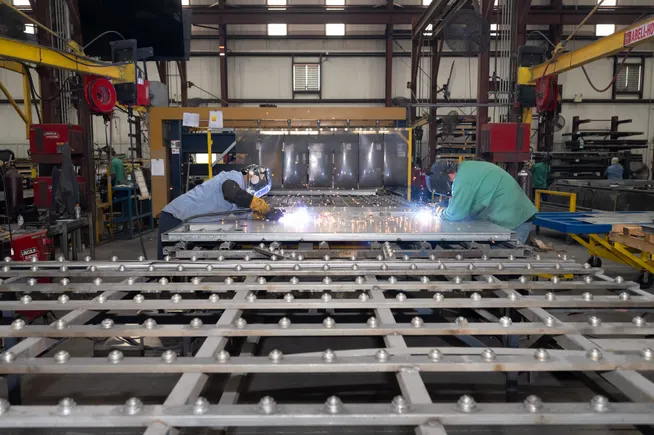
Most constructions are done outdoors, exposed to the weather and changing site conditions. Modular construction moves this work to one plant, where the same crew builds each unit in a single facility. This consistency is what makes waste reduction possible. Leftover material is saved and reused instead of thrown away.
Building modular units in a factory also has a planning advantage independent of the waste history. Crews can build modular units in parallel with site preparation and permitting, rather than waiting for the site to be ready first.
One manufacturing process, different end products
The usual criticism of modular is that it produces the same box regardless of the use case. With the right modular supplier, the output is completely adjustable. Through SteelCell, CareAffirm, Portable Solutions Group, BIG Enterprises and Connexure, VITALSpace combines more than 165 years of experience in virtually every market to meet your exact needs.
We understand that projects like health wards and detention cells at first glance have little in common. However, the steel that frames them and the manufacturing process we use is quite similar for both use cases. And that’s exactly why so many industries trust us to build for their specific needs. We understand the details that separate each room from the next and where there is operational efficiency in their overlap.
So if the question is no longer “how” will you build your next project, then it becomes “why” your next project couldn’t be modular. VITALSpace adds efficiency, safety and sustainability that is achieved through repeatable modular manufacturing processes.
Judge the building in year 20, not the day of delivery
Most buildings are assessed on delivery:
- Does it meet project specifications?
- Is it in the budget?
- Does it look as promised?
The most significant test comes later.
- Is he still acting?
- Has it been adapted, moved or found a second use?
- And when it finally reaches the end of its useful life, does the steel go back into the recycling stream or into a landfill?
Steel provides us with durability and recyclability. Modular manufacturing gives us efficiency, flexibility and opportunities for reuse. Industry experience gives us the ability to apply these advantages where they can make a significant difference.
At VITALSpace, we believe that bringing these ideas together gives us more than just a faster way to build.
It gives us a smarter way to think about the entire life cycle of the essential spaces we offer.
