

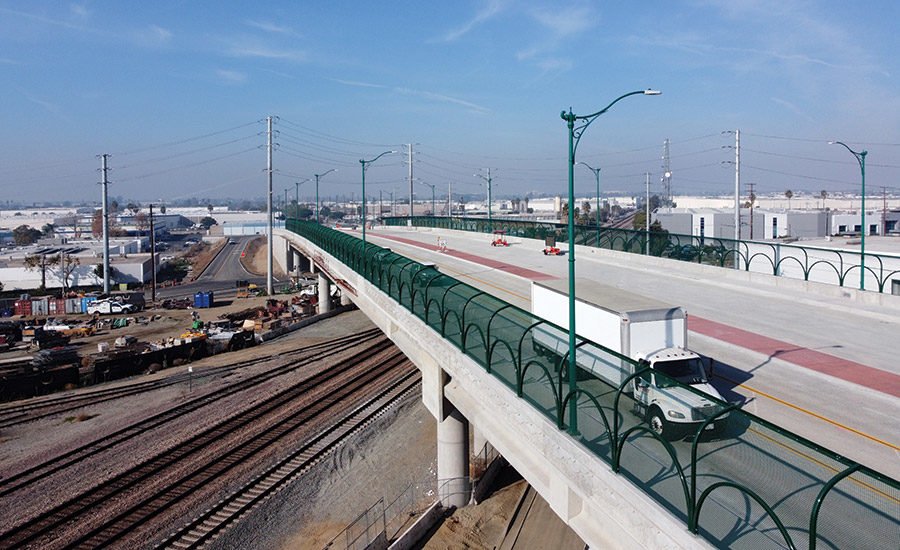
“This project is long overdue for our Southeast LA communities and will solve once and for all a major safety issue we’ve had in our backyards for years.”
—Janice Hahn, LA County Supervisor and First Vice President of Metro
The Rosecrans Avenue Bridge fixes a dangerous railroad crossing
While work continues on the $156 million Rosecrans/Marquardt Grade Separation project, the new Rosecrans Avenue Bridge opened to the public in January, bringing much-needed safety improvements to one of California’s most dangerous railroad crossings.
Approximately 45,000 vehicles and 135 trains traveled through this location in Santa Fe Springs daily between 2013 and 2019, and the California Public Utilities Commission recorded 31 vehicle and train incidents resulting in six fatalities and seven injuries.
“This new bridge will provide much-needed safety and traffic relief that area residents and businesses need,” Los Angeles Mayor and Metro Board Chair Karen Bass said in a statement. “As major rail projects like high-speed rail make their way to Los Angeles, we need to make sure our county is ready for a transportation future that’s safer, faster and more reliable.”
The Rosecrans Avenue Bridge is 581 feet long and 104 feet wide and has two lanes in each direction with a raised center median and sidewalks on both sides. By carrying vehicles over the BNSF railroad, the bridge will eliminate the possibility of collisions between trains.
LA Metro officials say the crossing will also help improve air quality by eliminating idling trains and vehicles while increasing rail efficiency. The entire project is on track for completion by 2025.
Planned investment of $1.2 million for California infrastructure
The California Transportation Commission (CTC) announced on February 1 an investment of nearly $1.2 billion in urban and rural transportation infrastructure projects in California. The appropriations include $428 million from the Jobs and Infrastructure Investment Act of 2021 (IIJA) and nearly $165 million from Senate Bill 1, the Highway Repair and Accountability Act of 2017.
Recently approved projects include a $7.88 million effort on I-8 west of SR-98 in Imperial County to remove rocks, repair pavement and fences, and restore eroded areas and washouts from Tropical Storm Hillary and a $3 million job on I-805 in Chula Vista to replace two culverts near H Street.
Since 2021, California has received more than $32 billion in IIJA funds, including more than $24 billion for transportation-related projects. The CTC included $245 million in this round of funding for comprehensive litter capture devices; restoration of the coastal embankment; improvements to bus, bicycle and pedestrian infrastructure; railroad crossings; and better alignment with the Americans with Disabilities Act throughout the state highway system.
The Mega Grant program awards $600 million to help replace the key bridge over the Columbia River
To help build a replacement bridge over the Columbia River on Interstate 5 between Oregon and Washington, the US Department of Transportation’s Interstate Bridge Replacement (IBR) Mega Program awarded $600 million in December.
The Washington State Department of Transportation and the Oregon Department of Transportation submitted a joint application in August 2023. The Mega Program was created through the IIJA to support large projects and complexes that can generate economic, mobility or national or regional security benefits.
“Replacing the interstate bridge is a critical infrastructure investment for our local communities, two states and the entire West Coast,” Oregon Gov. Tina Kotek said in a statement. “This project will help advance our goal of reducing emissions through a modern multimodal bridge and provide an infusion of federal funds to our region that will support local jobs.”
In 2023, the Oregon State Legislature committed $1 billion to complete the program, matching Washington’s $1 billion commitment made during the 2022 legislative session. Washington authorized the toll on the interstate bridge in 2023 to match existing toll authorization in Oregon. Together, these resources, as well as the Mega Program grant and other federal grant requests, will help cover the estimated $6 billion in funding needed for the construction effort.
The IBR program is actively seeking approximately $2.5 billion from other federal grant sources, including the Federal Highway Administration’s Bridge Investment Program and the Federal Highway Administration’s Capital Investment Grant Program. traffic
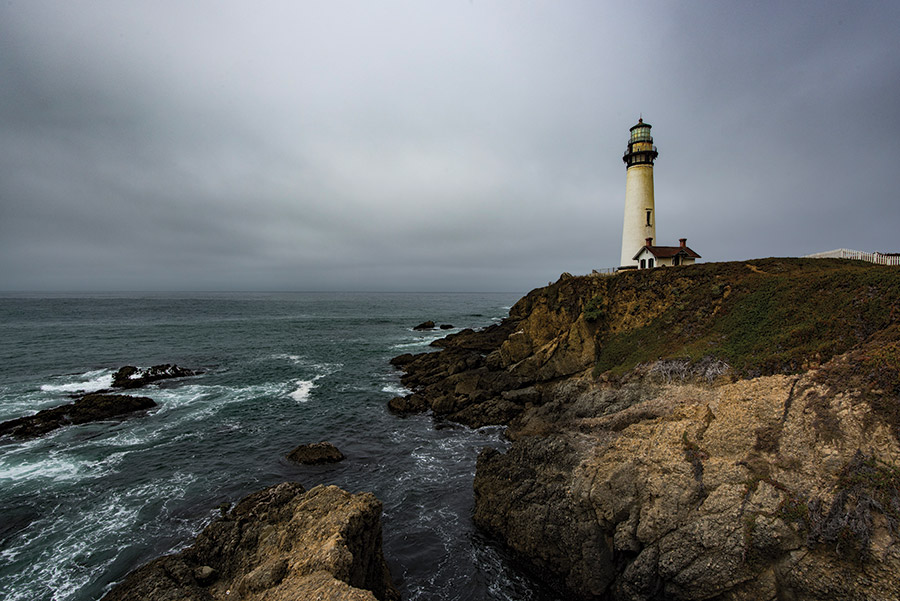
The 115-foot Pigeon Point Lighthouse in Pescadero, California will undergo a $16 million restoration in 2024.
Photo courtesy of California State Parks
Pigeon Point Lighthouse $16 million upgrade to begin in 2024
A two-year rehabilitation project will begin in early 2024 to restore the Pigeon Point Lighthouse in Pescadero, California, located at Pigeon Point Light Station State Historic Park. The $16 million effort will include the renovation and replacement of all iron, as well as the repair and replacement of all masonry elements.
Another major focus of the rehabilitation will be the upper course of the cast iron belt, or ring, where two large pieces broke off in late 2001, compromising the building’s structural integrity.
“California State Parks looks forward to once again providing public access to this historic landmark [Pigeon Point Lighthouse] that continues to guide boaters along the rocky coast of San Mateo County.”
—Chris Spohrer, Santa Cruz District Superintendent
California State Parks selected general contractor Sustainable Group Inc., Moraga, Calif., and subcontractor ICC Commonwealth of North Tonawanda, NY, to lead the project. The companies have worked together on nearly 100 lighthouses, including several built to the same blueprints as Pigeon Point, including those on Bodie Island and Currituck Beach, North Carolina, and Yaquina Head, Ore.
Named for the 1853 wreck of the Clipper Carrier Pigeon, Pigeon Point Lighthouse was first lit on November 15, 1872. The 115-foot structure is the tallest operating lighthouse on the West Coast.
Pigeon Point Light Station is also listed on the National Register of Historic Places, but has been closed to the public since late 2001 after it was deemed unsafe following an incident in which two large pieces of brick and iron fell from the upper part of the building. . The delay in repairing the structure was a result of funding problems, the pandemic and the owner’s desire to find a contractor with the necessary skills to work on this lighthouse.
California website to track infrastructure investments
A new website launched Jan. 9 outlines California’s state and federal infrastructure investments and how they are addressing issues such as climate change, equity and jobs. With $41 billion in projects currently underway and another $180 billion planned over the next decade, build.ca.gov will serve as a resource for local communities on these projects and beyond.
Build.ca.gov tracks where the money goes while showing individual projects and what they mean to the communities where they are located. The website also features several featured stories that demonstrate a display of dollars at work in every corner of the state.
