

A jailed quadruple murderer cannot sue his psychiatrist for alleged medical malpractice for “grossly negligent treatment” because that would allow him to profit from his crimes, the Pennsylvania Supreme Court has ruled.
In a low-profile Nov. 22 opinion, the Keystone state’s high court ruled that Cosmo DiNardo, now 26, was barred by the “felony conviction recovery” rule from “benefiting or to benefit, through the civil laws, from their own criminal conduct.” “
DiNardo’s July 2017 crimes horrified Bucks County and devastated the families of 19-year-old Jimi Patrick, 19-year-old Dean Finocchiaro, 21-year-old Thomas Meo, 22-year-old Mark Sturgis.
The victims disappeared over a period of days, beginning with the killing of Jimi Patrick on July 5, 2017. Two days later, DiNardo and his cousin Sean Michael Kratz, now 26, murdered Dean Finocchiaro. An hour later, Mark Sturgis and Thomas Meo were killed. Both young men were shot, but when DiNardo ran out of bullets, he drove a backhoe over Meo’s body.
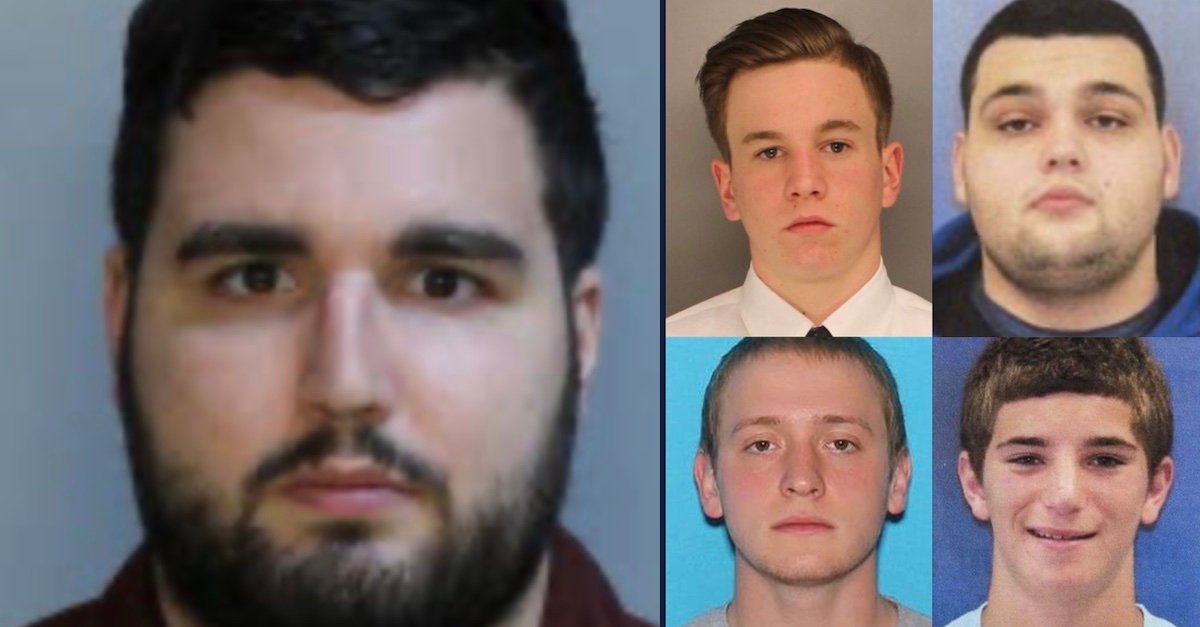
Cosmo DiNardo (left) in a 2022 Pennsylvania Department of Corrections photo; Jimi Patrick (top left), Mark Sturgis (top right), Thomas Meo (bottom left), Dean Finocchiaro (bottom right) in missing persons photos from Bucks County Sheriff’s Office.
Each of the murders took place on a farm owned by the DiNardo family in Solebury, where Cosmo DiNardo lured the victims under the pretense of selling them marijuana. The criminal complaint detailed that DiNardo shot Patrick with a rifle in a remote area of the property after handing the victim a shotgun that the killer claimed he was interested in selling for $800. DiNardo separately claimed that he intended to rob Finocchiaro, Meo and Sturgis with Kratz’s help.
Instead, he murdered them all.
DiNardo used a backhoe to dig a “deep grave” where he buried the bodies of Meo, Sturgis and Finocchiaro in a metal tank that the admitted quadruple killer referred to as a “pig roaster.” DiNardo poured gasoline over the victims’ bodies and set them on fire. Jimi Patrick was buried in a separate grave, one that was also dug with the backhoe.
DiNardo pleaded guilty to the murders in 2018; Kratz was convicted of murdering Finocchiaro and convicted of voluntary manslaughter in the deaths of Sturgis and Meo. Both murderers were sentenced to life in prison without parole.
Sean Michael Kratz (left) in a 2017 photo, (right) in a 2022 Pennsylvania Department of Corrections photo.
The case established that prior to the murders, Cosmo DiNardo had seen a psychiatrist, Dr. Christian Kohler, for treatment for bipolar disorder, schizophrenia, and schizoaffective disorder, treatment that involved taking antipsychotic medications. Kohler’s care of DiNardo before the murders was the focus of DiNardo’s failed lawsuit, which was filed by his mother Sandra DiNardo on his behalf.
The Pennsylvania Supreme Court documented that DiNardo attacked his father with a brick in December 2016, “chased him with a pellet gun” and threatened to break into his aunt’s house to “kill the parents and his aunt’s young children in an attempt to obtain firearms he believed she possessed.”
That incident made DiNardo a patient of Kohler’s, and the psychiatrist issued a recommendation for involuntary commitment to a mental health facility, the opinion noted.
While at Brooke Glen Behavioral Hospital, DiNardo threatened staff and expressed a desire to kill his family members. There, he was “considered to be suicidal and homicidal and a risk to those around him.” But when DiNardo was released a week later, the high court opinion continued, Dr. Kohler “examined him and concluded, despite his murderous conduct at Brooke Glen, that DiNardo was not a risk to himself or for others.”
In February 2017, there was another incident at Temple University where DiNardo was in a fight.
“Despite being aware of this incident,” the opinion said, Dr. Kohler “found that DiNardo was in ‘remission,'” and the psychiatrist “reduced DiNardo’s antipsychotic medication and lithium.”
Just five months later, DiNardo committed the murders.
In the Pennsylvania Supreme Court case, DiNardo asked the justices, through his mother, to find that Kohler’s “grossly negligent psychiatric care beginning in December 2016” and failure to “properly evaluate [DiNardo’s] risk of violence” entitled DiNardo to damages.
DiNardo tried to distinguish between being compensated for the alleged medical practice and profiting from his crimes.
“According to the appellant, the compensatory damages sought by DiNardo are not the result of his criminal convictions, but, rather, are due to ‘the violent psychosis caused by Dr. Kohler’s gross negligence,'” notes the opinion
DiNardo asserted that, as a matter of public policy, psychiatrists like Kohler should not get a “free pass” to, for example, take “DiNardo off all of his psychotropic medications despite having specific knowledge that DiNardo was highly dangerous for him and the others when his meds wore off[.]”
The high court, however, indicated that this case was not a particularly close call, especially since DiNardo himself admitted to four intentional and malicious murders.
“In short, our case law, while somewhat limited, firmly establishes that under both the felony conviction recovery rule and the in the same crime [Latin for ‘in equal fault’] doctrine, persons convicted of serious crimes must bear the losses resulting from their criminal acts and, as a matter of public policy, they will not be permitted to shift responsibility for such losses to others,” the Supreme Court said in Pennsylvania. “In other words, injuries arising out of voluntary tortious conduct cannot provide a basis for recovery of damages.”
Beyond that, the opinion warned, accepting DiNardo’s theories could have a chilling effect on the “practice of psychiatric medicine” more broadly:
Not only would the judiciary and the criminal justice system be adversely affected by allowing civil damages to be recovered for injuries resulting from serious criminal conduct, but, in the context of this case, there could be detrimental effects on the ‘exercise of psychiatric medicine. Allowing a mental health care provider to recover damages for a patient’s criminal conduct could undermine the trust between the patient and the psychiatrist; encourage psychiatrists to refuse to treat or avoid treating certain patients; encourage institutionalization and overmedication out of concern for financial liability if patients are released from care and commit crimes; and it would not respect the difficulty that mental health professionals have in predicting whether a person presents a risk of violence.
Even viewing the DiNardo case “in the light most favorable” to him, the judges determined, it was clear that his pursuit of compensatory damages “was not sustainable” because it ran afoul of the rule of ” non-recovery of criminal conviction”.
“[T]The theories of liability, causes of action, and damages alleged stem from DiNardo’s own voluntary manslaughter conduct, to which he pled guilty. Thus, under the noncriminal conviction recovery rule, the alleged causes of action and claims for damages are not sustainable,” the opinion concludes. “Appellant’s complaint therefore fails as a matter of law.”
A brief concurrence by Judge Kevin M. Dougherty noted that DiNardo’s guilty pleas to first-degree murder made this case clearer than other cases when analyzing the “non-recovery of felony conviction” rule.
“[B]Because the case before us concerns a guilty plea to first-degree murder, the majority appropriately declines to “address the rule’s applicability when an individual’s actions are deemed less than intentional, such as in the context of a judicial declaration of insanity”. or a verdict of guilty but mentally ill, where the calculus on the application of the rule may differ,” Dougherty wrote.
