

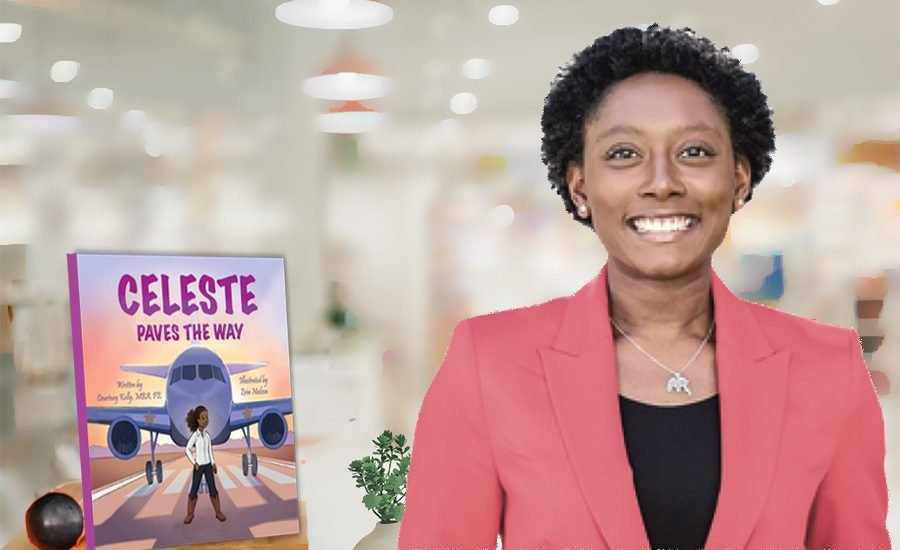
Civil engineer Courtney Kelly’s third children’s book takes elementary readers into pavement design, material testing, reinforcing steel and concrete placement—technical details she says they can handle and the construction industry needs to see.
A construction project manager and 2023 ENR Texas & Louisiana Top Young Professional, Kelly has managed major civil projects, including work at the Dallas-Fort Worth International and Love Field airports. She is also an adjunct professor at Southern Methodist University in suburban Dallas.
Your self-publishing celestial The series follows a black female civil engineer through infrastructure challenges involving coastal resilience, tunnel building and most recently airport construction. The third installment, Celeste leads the waytakes readers through the design and construction of a track, depicting laboratory testing, placing reinforcing steel, concrete paving, and other work by engineers, craftsmen, and equipment operators.
Kelly spoke with ENR about how much technical information young children can absorb, why construction should be presented as a team effort, and where the industry continues to lose women and people of color from its workforce.
The interview has been edited and condensed for clarity.

One amazing thing about your new book, Celeste leads the wayit’s how far you get to the actual work: pavement design, material testing, rebar, concrete placement and curing. Why was it important to show children how an airport is actually built instead of simply telling them that civil engineers build runways?

Maybe you like playing with clay and you realize that concrete is similar to playing with clay as a kid, and then you realize, “Hey, I can actually do material testing.” I can generate the next leading product that can revolutionize sustainability in construction.’ I’m trying to put all those nuggets in there and give kids a chance to identify with what they care about. It’s almost like a buffet of options to explore.
ENR |
Do adults underestimate how much technical material young children can understand?
I do an activity where we read Celeste saves the city and then talk about the solution: the barrier islands. Children design and build their own barrier islands.
A boy designed a bunker with a kitchen and places to sleep. Another had a bunker for the animals, and inside it they were going to provide an environment that replicated what the animals would normally see.
When I see kids using their imagination and creativity—and all of that happens in 30 or 45 minutes—it reinforces the fact that they can do it. They get it and have wonderful ideas.
They get it from the age of four. You ask them: ‘What is a civil engineer?’ and they say, “She’s like Celeste.” They understand that engineers tackle problems and make sure our world and planet are taken care of.
ENR |
Celeste does not build these projects alone. We see engineers, craftsmen, equipment operators and other specialists working together. Is teaching kids how construction actually happens, and that it takes an entire team, part of the mission?
When kids say, “I want to be a policeman, a doctor, or a lawyer,” I want them to consider construction as a viable and professional career choice. I want them to see construction management or being an equipment operator as something that can provide a very stable career path for them and their families.
It shouldn’t be dismissed as, “Oh, you just want to be a construction worker.” It’s, “No, I want to be a construction worker, and that will allow me to provide the lifestyle I want for myself and my family and do things that help society.”
ENR |
There’s one other thing you’re doing that’s barely getting attention: Celeste is a black engineer, and no one in these books seems particularly surprised that she’s the engineer in charge. Was this normality deliberate?
Even now, I have cases where people make assumptions. A guy asked me, “Are you the elevator operator?” And I’m like, really? It’s the year 2026.
The best thing to ask is, “What is your position in the project?” Then I can tell you that I am the project manager, and you should probably address me accordingly.
I can laugh, but that’s part of the problem. If I were younger in my career, maybe in my third year, and faced this kind of passive-aggressive jokes, I might be questioning my decision: do I really want to stay in this industry and should I?
Part of what I’m doing is normalizing women in leadership positions, normalizing women of color in leadership positions, and everyone is okay with that. But neither is Celeste doing it all alone. It’s Celeste and a team of people.
ENR |
You’ve seen it from many angles: as an engineer, an adjunct professor, through professional organizations, and now through the children who read your books. Where do you think we are losing girls and boys of color from the engineering pipeline?
Around middle school is when they start to lose that confidence. Part of that comes from social norms, things they’re seeing on social media or in pop culture. Part of this comes from people’s perception of what girls should and shouldn’t do.
I was at an event in Boston and a girl asked me after reading the book, “Did you write this book to show girls that they can do all the things boys can do?”
The fact that he asked this question means that he had some doubts.
My role is to provide a point of contact they can come back to. They can read these books. They can see Celeste’s career path. You can see my career path by reading my bio.
But it takes more than me. It takes reassurance from different areas for them to believe in themselves and push past the disbelief they may be receiving to continue down the path to a career in construction or engineering.
ENR |
You have been in construction and engineering for about 15 years. How different is the industry Celeste is in than the one you entered?
But I think this is only the tip of the iceberg. There is a lot of work to be done. We need engineers. We need construction professionals. We need architects. Where will this labor come from?
If people don’t see this as a career option they’ll enjoy and can provide for their families, and then they have to deal with the added baggage of not being seen as enough, not being given opportunities to lead, or not being respected even after they’ve been given that mantle, we’re going to lose people.
We also lose people as they progress in their careers. You see all the guys getting promoted and none of the women getting promoted, and you start to wonder: when are we going to see a woman with that particular title?
Maybe they’ll say you’re good enough to be a project manager, maybe even a senior project manager. But when will we see more women directors, more women business unit leaders, more women regional leaders? That’s when you really start to make the change.
People need heroes. People need to see that there is someone who has gone before them, someone tangible who can offer them a path to follow.
ENR |
If a six-year-old meets Celeste today and follows her through all three books, what do you expect him to believe is possible that he didn’t believe before?
I always finish books with some kind of challenge. Celeste is almost talking to you and asks, “What’s your dream? What do you want to be when you grow up?”
The world is watching and waiting to see what you do to make a difference.
I hope she uses Celeste’s lessons (teamwork and perseverance) to know she will get there eventually.
Looking for quick answers on construction and engineering topics?
Try Ask ENR, our new intelligent AI search tool.
Ask ENR →
