

Midwestern design firms are coming off a strong 2025, but remain cautious as they monitor rates, rising costs and other economic uncertainties that could cloud the outlook for 2026 and beyond.
The ENR Midwest 2026 Top Design Firms Ranking gathered submissions from 105 firms. Total revenue was $11.24 billion in 2025, compared to $10.62 billion for 120 companies a year earlier.
Companies say the AEC industry in the Midwest is being driven by a combination of public infrastructure investment, private sector expansion and evolving project delivery methods. But challenges such as rising costs and higher interest rates remain, forcing companies to adapt with new strategies to sustain growth and meet demand.
Indianapolis-based American Structurepoint had a strong year in operations, highlighting both the resilience of the public infrastructure sector and the growing complexity of modern construction and design work, says Steve Davidson, chief strategy officer.
“Continued infrastructure investment by states and the federal government has created a steady demand for our design services,” he says. “We have also seen significant growth in the private sector books of our business.”
Speaking of the Milwaukee region, Scott Lindvall, chief operating officer of HGA, which was founded in 1953 and has offices in Milwaukee and Minneapolis, agrees that the AEC market “remains resilient. But there is continued tension around financing and projects.”
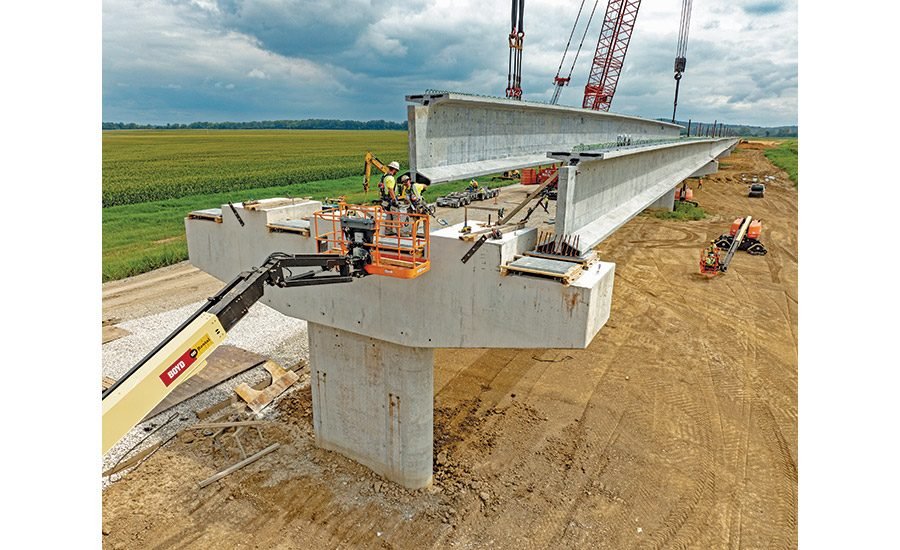
One of American Structurepoint’s public infrastructure projects is the Ohio River Crossing (ORX) bridge approach project, which the company calls a critical component to improving regional mobility and long-term economic connectivity in southern Indiana. Key components of this nearly $1.4 billion design-build project include complex coordination, phased delivery and careful consideration of constructability and community impacts, the company says.
Another of the firm’s projects is the rehabilitation of Interstate-90 in Cuyahoga County, Ohio. In addition to several miles of pavement replacement, the company developed what Davidson says “is an innovative solution to design a new drainage system that fits the original interstate footprint. This design minimizes the impact on the busy corridor and reduces the risk of flooding.”
While innovation remains essential and the public infrastructure sector is strong, at the same time, private developers continue to invest in residential, industrial and technology-related developments, further strengthening the Midwest’s stability, Davidson says.
“Science and technology projects are an increasingly important market for our architecture group, and we continue to see strong interest in multifamily projects,” adds Davidson. “Industrial and site development projects continue to be in demand as the public and private sectors continue to make investments in economic development.”
RS&H, a national architecture and engineering firm with offices in Chicago and St. Louis, also says its pipeline is being fueled by a combination of both public and private sector opportunities.
“Transportation remains a stable sector, although the timing of program delivery has been influenced by funding flow and policy direction,” says Bob Jones, vice president and national director of RS&H’s project control group. “Offsetting this variability, we have seen strong performance in our federal and aviation markets, as well as growth in the private sector vertical, bolstered by long-standing customer relationships. In addition, the defense market has emerged as an area of significant opportunity, with increased funding and demand creating new avenues for expansion.”
“Institutional work is also a key driver in the higher education, health care and research facilities sectors, reflecting owner confidence in long-term regional growth,” added Chris Hopper, executive vice president and general manager of Skanska USA Building, speaking of the Cincinnati area.
Lindvall also highlights infrastructure as a major growth area, adding that energy, especially for data centers, is becoming an increasingly important part of the equation. This comes even as communities across the Midwest push back against proposed data center projects, raising concerns about where the facilities will be located and how they will be powered.
“The region is seeing growing demand for data centers and the power and cooling infrastructure that supports them, driven by AI and expanding digital activity,” says Lindvall. “Even without large-scale facilities locally, Wisconsin companies are bringing expertise throughout the supply chain, and siting discussions are likely to intensify in the coming years.

American Structurepoint is providing survey, environmental and highway design services for a pavement replacement project along Interstate 90 in Cleveland.
Photo courtesy of American Structurepoint
Sustainability objectives
Milwaukee County has a plan to reduce carbon emissions from county operations and adapt to climate change, Lindvall says.
The goal of the county’s 2050 Climate Action plan is to achieve carbon neutrality, or net zero carbon emissions, in county operations by no later than 2050. It is also aimed at improving the resiliency of county operations and helping the county in its bid to become the healthiest county in Wisconsin.
HGA is providing energy consulting services to Milwaukee County on its project to replace the nearly 100-year-old Milwaukee County Security Building.
“This follows a trend that others in the community and around the country have prioritized: investing in infrastructure improvements and addressing years of deferred maintenance,” says Lindvall. “Many homeowners are facing rising energy costs and aging steam equipment and are considering moving away from steam as their primary heating source and converting to low-temperature hot water.”
He says these conversions would allow for reduced carbon emissions and the ability to electrify some heating/cooling systems using heat recovery chillers or heat pumps. These systems can be combined with thermal energy storage, geothermal and even waste water heat exchange to further increase efficiency.
“There are many variables to consider when selecting systems, including distribution, which can often be difficult to convert or replace depending on routing and conditions,” notes Lindvall.
“To avoid waste, owners are reusing existing buildings that require modifications to engineering systems or taking advantage of bundling HVAC loads with central plants,” he says.
Lindvall notes that demand for sustainable construction is robust and Milwaukee is taking a vital role.
“Innovation in sustainable construction remains strong, with high-rise wood buildings positioning Milwaukee as a leader in this technology,” he says.
Alternative delivery
Despite demand, the overall industry continues to struggle with rising costs for materials, labor and equipment. Inflationary pressures have forced companies to rethink how they plan and execute projects. In response, companies are adopting alternative delivery methods that emphasize early collaboration and proactive decision-making.
“We continue to improve our innovative alternative delivery methods as a way to address rising costs,” says Davidson. “Early contractor involvement and proactive cost estimating allow us to evaluate material, phasing and constructability decisions during design, rather than reacting later in the process. By identifying risks early and exploring cost-effective alternatives, we help clients maintain budget control while delivering resilient, high-quality solutions.”
RS&H is taking a similar approach by integrating cost considerations early in the design process.
“By leveraging contractor-level estimates and real-time pricing information, we help clients align scope and budget before finalizing plans, reducing the risk of surprises later,” says Jones. “Transparency and collaboration are key. Early discussions with customers allow us to explore alternatives, such as adjusting materials, sequencing or delivery methods, to mitigate exposure to volatile markets.”
“Transport remains a stable sector, although the timing of program delivery has been influenced by funding flow and policy direction.”
—Bob Jones, VP of RS&H
RS&H adds that it incorporates escalation and risk factors into its cost models, ensuring decisions are based on market conditions and enabling it to deliver value while navigating a challenging cost environment.
Early collaboration and cost transparency are also essential to dealing with high interest rates, the companies agree.
“By accounting for increased freight costs in our independent cost estimate contracts and integrating contractor-level estimating into the design process, we help clients make informed decisions that align with their financial goals,” says James Shaw, vice president and infrastructure division leader at RS&H. “This proactive approach minimizes risk and ensures projects remain viable in a volatile economic climate.”
Lindvall notes that interest rates remain a concern.
“On a day-to-day basis, the most prominent issue among developers, designers and contractors is the effect of high, albeit slightly reduced, interest rates and high construction costs,” says Lindvall.
Those concerns in Milwaukee have had an impact on “lenders who are still taking a cautious approach, causing some projects to be put on hold or delayed, with some previously approved developments now sitting idle while teams reassess next steps,” he says.
Looking ahead, Lindvall says there is cautious optimism for a thriving AEC industry in 2026 if economic conditions improve, but there are many variables at play.
Strong fundamentals
Overall, the outlook for the construction industry remains positive as the Midwest region continues to benefit from a strong infrastructure base, population stability and ongoing economic development initiatives. Sustainability and resilience are also increasingly important as they define how projects are designed and executed.
“We are optimistic about the future,” says Davidson. “Infrastructure needs across the country continue to grow, and communities are focused on solutions that are resilient, sustainable and cost-effective.”
Despite the obstacles, RS&H is also optimistic.
“While near-term challenges such as political uncertainty, funding timing and workforce constraints persist, the underlying demand for infrastructure and technical innovation remains strong,” says Jones. “Aging infrastructure, evolving delivery methods and the need for advanced solutions present significant opportunities across all sectors.”
The federal market, in particular, is poised for robust near-term growth.
“With a diversified portfolio and a customer-focused strategy, RS&H is well-positioned to navigate uncertainty and seize long-term growth opportunities,” says Jones.
