

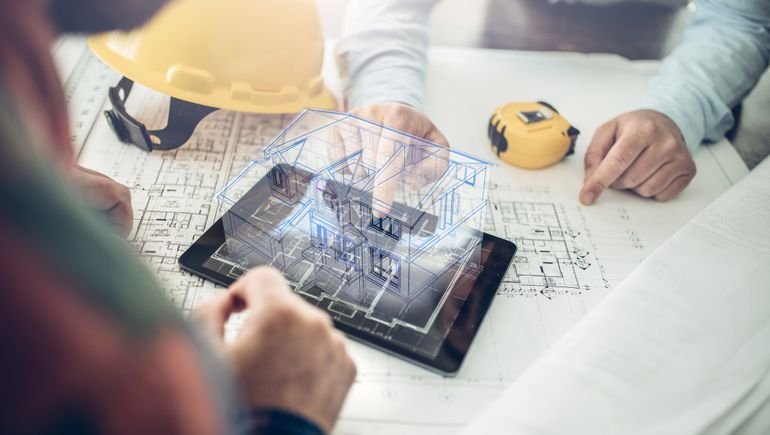
The shift from computer-aided design (CAD) to building information modeling (BIM) marks a major overhaul of construction project workflows, including those used in design, collaboration, project management, and project management. ‘facilities. And for AEC professionals, keeping up with this change is absolutely crucial.
CAD brought about a transformation, replacing hand drawing with the ability to create detailed designs on computers. It brought precision and speed to the drawing process. BIM, however, takes things further. It integrates data into three-dimensional models, providing a complete picture of a building’s life from conception to completion. BIM solutions for the AEC industry improve accuracy, teamwork and efficiency, leading to better project outcomes.
The move from CAD to BIM is about a new way of thinking and working on construction projects. BIM’s data-rich, three-dimensional models are game-changers, offering a detailed view of every aspect of a building’s life. This leads to significant improvements in the planning, execution and management of construction, both in projects and in buildings.
The origins and development of CAD + BIM
The history of computer-aided design dates back to the early 1960s, when the first attempts were made to automate traditional drafting processes. Below is a brief timeline of the progression of CAD developments and their creators:
decade of 1950
1957: The Pronto system, developed by Dr. Patrick J. Hanratty, marked a first adventure in computer-aided drawing. This laid the foundation for the future development of CAD technology.
decade of the 1960s
1963: Ivan Sutherland developed Sketchpad, one of the first interactive computer graphics systems, which allowed users to create and manipulate shapes.
decade of the 1970s
Patrick J. Hanratty: Often referred to as the father of CAD, he founded the MCS company and developed the PRONTO CAD system in the mid-1970s.
decade of the 1980s
1982: Founded by John Walker and twelve others, Autodesk introduced AutoCAD, becoming a leader in 2D and 3D design software.
decade of the 1990s
1988: PTC introduced Pro/ENGINEER, one of the first solid modeling CAD systems based on parametric functions, a major advance in 3D design.
1992: The term Building Information Model, BIM, emerged, focusing on information-rich 3D models.
2000s
Dassault Systèmes – Creators of CATIA (Computer-Aided Three-Dimensional Interactive Application), a powerful CAD software widely used in the aerospace and automotive industries.
Early BIM software gained traction, emphasizing data integration and parametric modeling.
BIM adoption expanded into the architecture, engineering and construction sectors.
2002: Introduction of the IFC format for interoperability between BIM software.
2010s:
2012: Trimble acquired SketchUp from Google, contributing to the evolution of easy-to-use 3D modeling software.
2000-2010: BIM adoption expanded to the architecture, engineering and construction sectors.
2010s: Government BIM mandates implemented for public projects to drive industry-wide adoption.
2010s: BIM software began to use cloud technology to improve collaboration.
2012: BIM platforms integrated simulation tools and expanded their lifecycle capabilities.
Continuous Development: Continuous improvements to BIM software to address interoperability, simulation and collaboration features.
Limitations of CAD and the transition to BIM
As CAD became the industry standard, certain limitations became apparent. Traditional CAD tools were innovative when they first appeared, but have struggled to keep up with the demands of today’s complex construction projects. These tools fell short in the areas of collaboration and information management, issues that became more pronounced as projects grew in size and scope. Deficiencies in CAD systems, which led to inefficiencies and errors, hindered collaboration between architects, engineers, contractors and the necessary parties and increased project costs.
In response to these challenges, the industry recognized the need for a more comprehensive and collaborative approach to construction technology. BIM emerged as a response, introducing 3D parametric modeling along with rich data attributes.
BIM services not only addressed the geometric representation of structures, but also integrated information about materials, costs, schedules and other necessary aspects of project management and information sharing. This evolution was intended to improve collaboration, reduce error and provide a more accurate representation of the building’s life cycle.

Permission granted by Hitech Digital
challenges
Despite the many benefits, adopting BIM is not without its challenges. It is clear that smaller companies are not using BIM software at the same rate as larger companies.
In 2021, 97% of large companies (50 or more employees) adopted or were currently using BIM for billable projects, while only 52% of small companies (fewer than 10 employees) used BIM. software1 Only 8% plan to acquire it eventually, highlighting the implementation problem when used on a smaller scale.1
For some, it may be costs, while for others, it may be a lack of demand from consultants and clients.
Looking at how BIM is further used, 91% of companies using BIM for billable work use it for design visualization, while only 32% use BIM for estimates/quantity estimates, 31% for energy and performance analysis, 28% for management. model data during construction, and only 6% use BIM for 4D scheduling and sequencing1.
Looking at this data, we can see that there is a discrepancy between understanding and learning the full use, scope and intent of BIM software. Also, there can be confusion about which uniform standards to follow. Although there are recommended BIM standards, this is often relative to the region and can affect the change and use of the software.
The future of BIM
The evolution from CAD to BIM marks a transformative period in construction technology. BIM’s advantages in accuracy, collaboration and efficiency highlight its place in modern construction practices.
As the construction industry advances, technology must keep up. BIM solutions, once mainly used in architecture and buildings, are now being adopted in civil, structural and facilities management. It is expected to grow and include more players as needed.
Enhanced collaboration could lead to smoother data sharing and teamwork during the design, construction and use phases. This could lead to a move towards more cloud-based services.
The fusion of BIM with AR and VR could be another direction. This would allow participants to see and engage with BIM models in real environments, improving design conversations, construction preparation and facility maintenance.
BIM data is valuable not only for visualization but also for analysis. This would involve a deeper integration of data analytics and artificial intelligence in BIM to extract useful and meaningful insights, optimize design decisions and predict potential problems through phasing.
Although already present, sustainability analysis tools will progress to assess environmental impact data, energy efficiency and more accurate life cycle assessments. In terms of implementation, we can see the use of BIM on a much larger scale, bringing more regulations to standardize projects.
BIM will continue to grow and adapt to the construction industry climate as it has in the past.
Case studies
Hospital in Egypt
Need: The company was working on a $5 million SF hospital in Egypt, where it was necessary to ensure optimal and effective use of the available area, implement proper material planning and execute life cycle assessments.
BIM solution: Develop a coordinated Revit model with information-rich components and families, and extract material BOQs and required quantity on-site. Using crash coordination to ensure proper large-scale planning Adhere to COBie and LOD400 standards to ensure consistent and reliable details and data.

Permission granted by Hitech Digital
US Dormitory Building
Need: Current modeling approaches lacked information and functionality for sequencing and programming. Tedious and lengthy coordination and unclear timelines in the current approach.
BIM solution: A model with enhanced capabilities was needed to enable staged simulation of the construction and visual activities of the time period. This included a 4D BIM scheduler through Navisworks to express a timeline relative to each stage. All documentation and drawings for construction sequencing were phased out of the model and shared with the client to support better project management.

Permission granted by Hitech Digital
Need 3D Revit models to streamline your BIM workflows? Contact us NOW!
[1] resp., 2022 Business Survey Report (The American Institute of Architects, October 2022), 42-43.
