

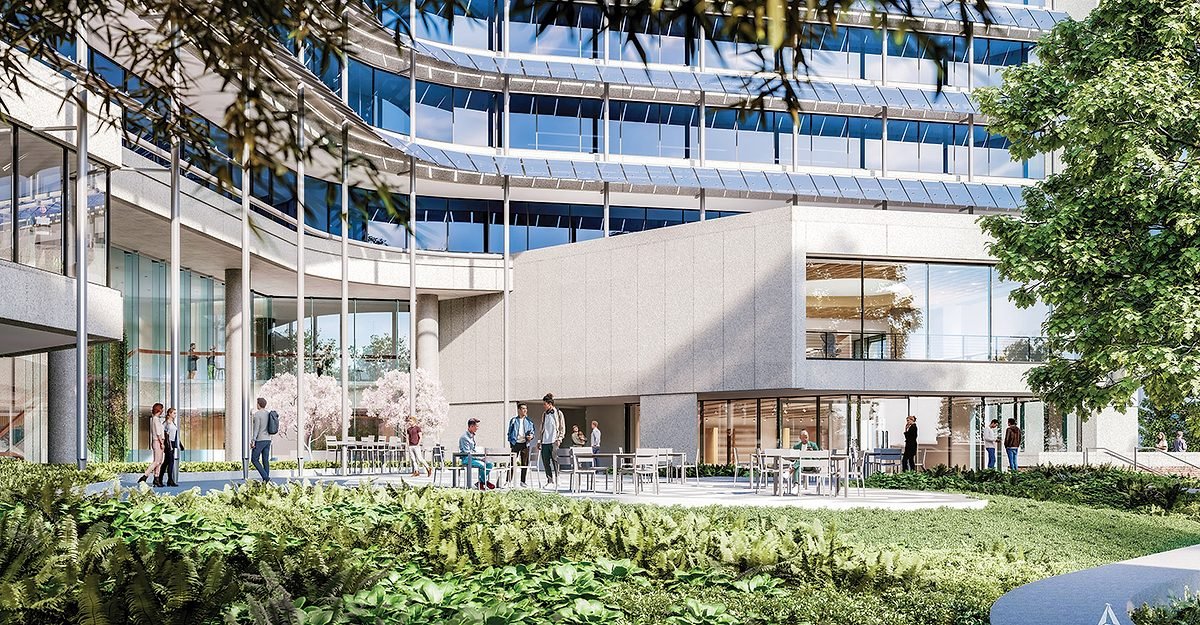
While adaptive reuse has been common practice within the AEC sector for decades, a greater focus on decarbonization along with net zero and net positive goals, in the US and around the world, is driving new interest. Companies in the sector say they are seeing more building renovations in their portfolios and more requests to reuse materials that would otherwise go to waste.
Jennifer Devlin-Herbert, principal, partner and CEO of EHDD Architects, says the firm, which is now overseeing the $66 million remodel of the American Institute of Architects’ headquarters building in Washington, DC, sees easily 60 to 70 percent of its work that would be considered “transformations” of older buildings.
“The buildings that already exist have an enormous amount of structure and materials that put them ahead of anything new built in terms of embodied carbon and materials.”
The AIA headquarters building is an example. It is an example of the square, concrete-heavy Brutalist architecture style popular in the 1950s. Many of these buildings are reaching the end of their 50-year life cycles. But these buildings “have good bones,” notes Devlin-Herbert. The basic structure of buildings can be saved and reused, while “components are added to make a better skin, [and to make the building] more energy efficient. You can then add layers of warmth and materiality and enhance daylight through different mediums. But you can keep the bones.”
Other firms involved in the AIA renovation, which will be completed this month, include Hood Design Studio, Hartman-Cox Architects and Point Energy Innovations. Turner Construction is the contractor, with Stephen Ayers, former architect of the Capitol, serving as consultant on the project.
Jimmy Mitchell, sustainability manager for Skanska USA, says companies interested in repurposing old buildings often focus on elements that can be added to the exterior envelope to push efficiency to the levels required in today’s market. Adding insulation and air barriers can improve the performance of the existing structure, “and then you do things like run ducts up to your roof if you have rooftop solar panels,” he says.
For the renovation of the AIA headquarters, the project team reused the exterior structure and much of the concrete. The reuse strategy has ultimately saved the group more than 26% in embodied carbon compared to a building constructed with all new materials, and the project has achieved 90% diversion of construction waste, according to EHDD.
AIA hopes to use the building as an example to its architect members of how they can save and retrofit buildings that would otherwise be demolished and replaced to attract remote or hybrid employees back to the office and reduce embodied carbon.

↑ ↓ An Arup team member on a substation project in North London convinced the project developer to reuse steel, rather than incorporating new materials, for the fences. His experience working collaboratively with the entire team inspired a new “game guide” to help companies reuse materials that would otherwise be wasted.
(SEPARATE) Photo courtesy of Arup; (bottom) photo by John Sturrock

Zoning law changes
State and local governments have begun changing zoning codes to allow more flexibility in the types of structures that can be built, which supports the construction of adaptive reuse projects, says Kyle Tourjé, executive vice president of structural engineering firm Alpha Structural, Inc.
Looking for quick answers on construction and engineering topics?
Try Ask ENR, our new intelligent AI search tool.
Ask ENR →

BEGIN
In early 2026, a California law went into effect that allowed local governments across the state to amend zoning codes to incentivize adaptive reuse. Los Angeles is one city that quickly responded by issuing an adaptive reuse ordinance to establish zoning incentives to help transform underutilized old commercial buildings into new housing. “With the changing demands for office and retail space, ARO is a unique opportunity to create more housing, revitalize vacant spaces and revitalize commercial corridors,” said Director of City Planning Vince Bertoni. “Sometimes the greenest building is the one that’s already built.” He says the ARO will help reimagine existing spaces to create new housing opportunities for residents “and do it in a sustainable way.”
Tourjé says the zoning changes are driven by a few different factors. The downtown commercial market has never fully recovered from the post-COVID glut of now-vacant buildings. Also contributing are growing efforts to reduce material costs, which continue to rise in today’s economic environment, and to reduce embodied carbon.
“What’s so good about the [zoning changes] it’s that you don’t have as many structural improvements as you normally need, or you can avoid tearing the building down and spend a lot more money rebuilding it and years on city approvals and reviews and environmental studies. You can just buy the building, redesign [it] for a different use, then follow through with tenant improvements on a much easier scale.”
Waste reduction
“The buildings that already exist have an enormous amount of structure and materials that put them ahead of anything new built in terms of embodied carbon and materials.”
Jennifer Devlin-Herbert, Director, Partner and CEO, EHDD
It’s not just buildings that are being reused more often. For the first time, the US Green Building Council has added credits to its most recent update, LEED Version 5 released in April 2025, for material reuse. It was included as an option in the previous version, but “we really wanted to elevate reuse, whether it was whole-building reuse or material reuse,” says Shawn Wood, the group’s senior director of circularity and materials.
Front and center is the credit for reusing materials and buildings, but LEED also recognizes reclaiming materials rather than sending them to demolition. Every pound of material recovered from a project and sent to a reuse market counts two pounds toward the city’s metrics for waste diversion.
Even when a building is slated for demolition,
materials can be recovered. Mitchell says a Skanska project team recommended that bricks that would otherwise have been sent to a landfill be salvaged from a dormitory demolition project at Clark Atlanta University. The university agreed and the bricks are sent to a local non-profit for storage. Skanska helped establish the nonprofit in 2011 as a hub to provide logistical support for both stockpiling materials that would otherwise go to waste and getting needed materials to construction crews.
Mitchell says one of the challenges companies face when reusing materials can be finding places to store them. In New York City, there is no centralized hub because warehouse space is very limited. “It’s very expensive to store things there, so we have more than a network of hundreds of groups.”
Design for circularity
LEED v. 5 also includes a pilot credit, Design for Circularity, focused on how a building can be dismantled in the future to facilitate the recovery of materials for reuse. “It’s really about thinking about the next generation that will face the end of their physical or useful life of a building,” says Wood. Design and construction teams miss an opportunity when they don’t think about the building beyond its purpose. It also serves as a sort of “material bank” that is a treasure trove of potentially valuable materials.
Ben Glover, director of global circularity, resource and waste management skills at UK-based Arup, says the industry lacks the data needed to identify which materials might be useful decades from now, when a building is at the end of its useful life. 3D building modeling rarely considers end-of-life use of materials.
“Really, every element of this model needs to be documented, understood, and have a teardown or reuse date when [the structure] it’s ready to be dismantled, so we’re starting to create a real picture of the existence of buildings that are there,” he says. “It’s cutting edge and it’s early days, but clearly we’ve got to get there.”


Bricks from an Atlanta college dorm that would have gone to a landfill were collected and sent to a local reclaimed materials center so they could get another life as part of a future construction project.
Photos courtesy of Skanska
Glover led the development of the company’s Reuse Playbook, which helps everyone on a project team, from construction crews to program managers, identify what they can do to reduce waste and reuse as much as possible while designing and building projects. One of the final chapters in the playbook calls for companies to start collecting that data, Glover says.
The playbook’s genesis was Glover’s realization in 2019 that the developer of a high-profile substation project could save significant costs and reduce emissions by incorporating reclaimed steel, rather than new, to enclose the station. “Through this project I realized that the way we design things at the moment is quite linear … when what we needed is … collaboration between the designers and the people who procure the materials,” he says.
Glover established a steel supply early in the project and worked with everyone on the team. “This collaboration led to the reuse of steel in this project.” The Brent Crosstown substation in North London was completed in 2023.
Council executive Wood points out that companies need to be aware that in their race to reduce embodied carbon, they should consider whether the materials they choose to use are not products that would be problematic for contractors tasked with refurbishing or demolishing a building that has reached the end of its useful life.
As an example, Wood says a construction crew might decide to use foam to better insulate a building. “Fifty years from now, when this building has to come down, the demolition contractors will be very upset because they know it will be impossible to separate this foam from the structural elements,” he notes.
Wood says the kind of data cataloging Glover suggests would help.
