

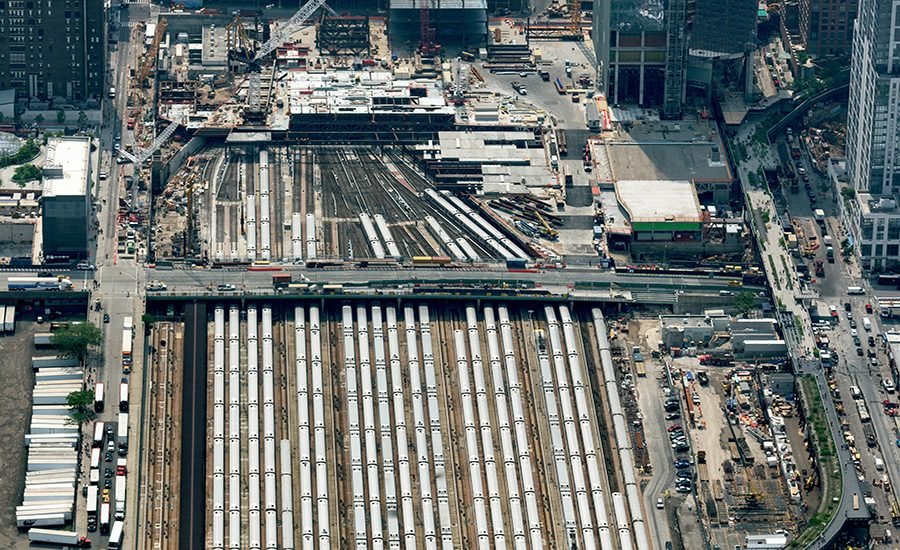
Halmar and Skanska have been selected by federal officials to lead the rebuilding of Penn Station in New York City, putting the newly formed Penn Transformation Partners joint venture at the center of one of the nation’s most complex active rail infrastructure projects, as the project targets a late 2027 groundbreaking.
The selection by the U.S. Department of Transportation and Amtrak caps a months-long procurement and moves the project into a preconstruction phase that is expected to include contract negotiations, permitting, operational studies and financial close before work begins. Federal officials said the next phase also includes completing the service optimization study led by the Federal Railroad Administration and advancing preliminary design.
Financial details of the deal were not disclosed.
The team was selected from competing proposals led by Macquarie-backed Grand Penn Partners and Fengate-backed Penn Forward Now. The award follows a procurement process launched after the federal DOT and Amtrak, which owns the rail hub, changed the lead authority for the project from the New York Metropolitan Transportation Authority to a public-private partnership, or P3, model.
“The rapid completion of a rigorous procurement process represents more than meeting a very ambitious milestone; it demonstrates that Amtrak and USDOT are capable of making this vision a reality,” Andy Byford, special adviser to the Amtrak board overseeing the project, said in a statement.
Transportation Secretary Sean Duffy and Federal Railroad Administration officials also announced an additional $200 million for design and permitting work. The latter is investing $200 million to support critical design and enable work on the transformation of New York Penn,” agency Administrator David Fink said in a statement.
New York Gov. Kathy Hochul said the project “must accomplish two things: dramatically improve the experience for every rider passing through Penn Station, from the A train to the Acela, while ensuring that the costs are not borne by commuters or New York taxpayers.”
According to a person familiar with the winning company and the project, but not authorized to speak publicly, the Halmar-Skanska team is a split structure as 50/50 development partners and 55/45 construction partners. Initial public materials released by the transport department only identified Halmar as the selected lead developer before issuing an update clarifying Skanska’s role.
Peter E. Cipriano, CEO of Penn Transformation Partners, told ENR in a statement that calling the upgrade “the most complex and important infrastructure project of our time, working together with a world-class team of builders and designers, Amtrak, New Jersey Transit, the MTA and our community partners, we will deliver a new Penn Station.”
RELATED
Amtrak’s Penn Station take list puts delivery risk center stage
Plans released this week call for a new Eighth Avenue train entrance and concourse, replacement of existing concourses, additional retail space, improved orientation and at least limited traffic capacity while preserving Madison Square Garden above the station.

Amtrak’s Penn Station schedule targets innovation by late 2027.
Chart: Amtrak
ENR previously reported that Penn’s redevelopment requirements call for consolidating passenger traffic into a single-level arrangement intended to improve station movement and orientation. Achieving this change could require demolition of existing slabs, relocation of utilities and reconstruction of fire separations while maintaining code-compliant egress during phased construction.
These outages could be particularly sensitive because passenger traffic, fire safety systems, platform access and rail support spaces would need to remain functional as demolition and systems work in stages through the existing station.
The decision to keep Madison Square Garden in place preserves some of the project’s most important structural constraints. Previous concept materials released by Halmar relied on internal reconfiguration and new access points rather than moving the arena, which likely required temporary shoring, vibration control and construction in narrow phases over active tracks and platforms.
The challenges remain below the concours level. Existing track and platform arrangements include old interchanges, limited clearances, and shared operations between the Amtrak, Long Island Rail Road, and NJ Transit rail systems.
Federal officials have also promoted at least limited running, allowing trains to continue through Penn Station instead of terminating there, as part of future operational improvements.
Continuous operation could alter assumptions involving track assignments, platform usage and train movements by allowing some commuter services to continue through the station rather than terminating there.
Construction staging can be just as important. ENR reported in January that reconstruction scenarios would likely rely on coordinated outages, overnight work windows and temporary traction power, signal and communications systems to preserve daily rail operations.
The region has already seen how access coordination can affect the delivery of active rail after Penn Station Access became the focus of a public dispute between the MTA and Amtrak over missed outage windows, force account staffing and access coordination.
At the same time, Halmar recently completed a major Penn Station access milestone involving the installation of an approximately 180-foot-long, 370-ton bridge over the Bronx River in an extremely restricted corridor between an existing Amtrak bridge and adjacent development.
The operation relied on Hilman rollers and a heavy-duty air winch system, with crews pre-assembling the structure off-site before putting it in place.
A coalition of city, state and federal officials has spoken out for months about the need to get the project back on a solid footing. In late April, lawmakers released a statement framing the Penn Station redevelopment as “an opportunity to do something truly transformative.”
A public presentation of the design is expected soon, according to the team’s expert, as the schedule is now based on permits, commercial closure, outage planning and operational assumptions still being studied by the Federal Railroad Administration.
