

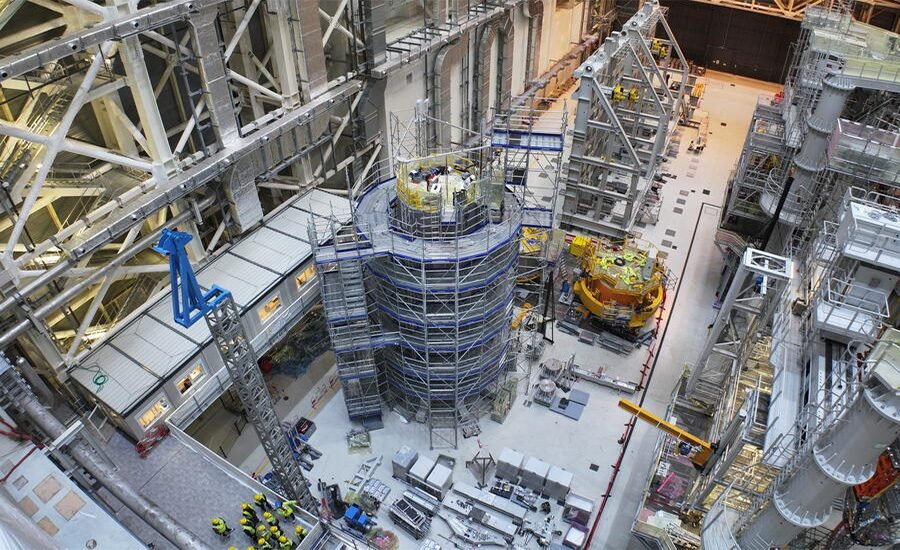
The US program managing one of the most technically demanding manufacturing projects in energy construction has completed delivery of all components of the core solenoid magnet system at the ITER fusion reactor in Cadarache, France, paving the way for first plasma operations planned for 2034.
US ITER, the national program based at Tennessee-based Oak Ridge National Laboratory, completed final shipments of the core solenoid last month, according to an April 27 announcement from the ITER organization.
More recent deliveries included bars and cables for electrical connections between the magnetic modules. The six modules, support structure and tooling components had been delivered earlier. ITER is supported by a coalition that includes the US, European Union, China, India, Japan, South Korea and Russia, and is designed as a research facility to demonstrate sustained clean energy fusion reactions, not to produce power for the commercial grid.
“The completion of the core solenoid magnet highlights America’s ability to design and deliver the world’s most complex fusion systems,” said Kevin Freudenberg, acting director of the US ITER project. “Congratulations to the entire team that contributed, including those at Oak Ridge National Laboratory who led the work and our suppliers who manufactured critical components.”
The central solenoid, a 59-foot-tall, 14-foot-wide superconducting assembly, was fabricated during a 15-year manufacturing effort at the General Atomics Magnet Technologies Center in Poway, Calif.
Each of the six modules weighs more than 135 tons and is wound from approximately 3.7 miles of niobium-tin superconducting wire sourced from Japan.
As part of a construction risk management strategy, General Atomics also produced a seventh spare module, set aside in case any of the six primary modules needed replacing. The completed assembly is part of a larger magnetic system weighing 3,300 tons that interacts with nine sectors of vacuum vessels within the tokamak complex.
Looking for quick answers on construction and engineering topics?
Try Ask ENR, our new intelligent AI search tool.
Ask ENR →
The manufacturing challenge was unlike anything previously attempted in magnet manufacturing. “We’re talking about orders of magnitude of scale,” said Nikolai Norausky, program manager for General Atomics’ core solenoid project, during an August 2025 ceremony at the Poway facility marking the project’s completion.
“We had to develop a modern supply chain,” he added. “Often our suppliers were dealing with the biggest, or heaviest, or most precise aspects of their technologies, and we had to bring all of that to develop the manufacturing know-how and tooling, in order to produce the core solenoid magnets.”

Components developed through US ITER at Oak Ridge National Laboratory support the assembly of the ITER fusion reactor in France. The program manages the design, manufacture and delivery of key systems in the United States, including the reactor core solenoid magnet.
Image courtesy of ORNL/US ITER
Assembly is underway in southern France under the direction of the ITER organization, with technical support through an agreement with the US ITER project team at Oak Ridge.
As of April, five of the six modules had been stacked, and the sixth, which arrived last September, was scheduled to be added to the stack later this year, according to the ITER organization.
Once completed, a compression structure will apply downward precompression to the stack of modules before the entire assembly is moved into the center of the tokamak pit.
Milestone performance requirements mirror those of the wider ITER project. ENR reported in July 2020 that building the tokamak components to tight tolerances would be “like assembling a three-dimensional puzzle on a complex timeline,” in the words of then-ITER Director General Bernard Bigot.
The 23,000-ton tokamak, more than three times the weight of the Eiffel Tower, is housed in a seven-story, heavily reinforced concrete building on a 180-hectare site near Saint-Paul-lez-Durance, 47 miles north of Marseille along the Mediterranean coast.
RELATED
After a decade of work, assembly of the fusion reactor begins
Costs, mounted policy scrutiny
As ENR previously reported in July 2020, ITER was running a decade behind schedule and about 50% behind previous cost estimates. Outside observers have cited total program costs of up to $65 billion, though ITER officials dispute that figure, noting that member nations contribute primarily through in-kind systems. The current cost of the European Commission’s program, valued in euros, is approximately 22,000 million euros.
The Trump administration’s 2026 U.S. Energy Department budget request proposed cutting ITER funding as part of what it described as a “reassessment of how the project fits” into the U.S. fusion strategy — a policy shift that comes as U.S. ITER formally closes its core solenoid delivery obligations.
The supply chain ecosystem developed during enterprise building is increasingly informing business fusion development. ITER’s head of communications, Laban Coblentz, told RealClearScience in February 2025 that, a decade ago, there were maybe five fusion companies worldwide; although that number had grown to approximately 45, a growth he described as parallel ITER manufacturing milestones.
“I think this approach, perhaps inadvertently, has created a global supply chain of fusion,” Coblentz said. “As private sector companies are gaining momentum, we’re seeing them use supplies from ITER to address their designs.”
Livermore, Calif.-based Inertia Enterprises, a startup founded in 2024 to commercialize laser-based inertial confinement fusion technology developed at Lawrence Livermore National Laboratory, raised $450 million in Series A funding and aims to begin construction of a grid-scale pilot plant in 2030.
Co-founder and CTO Mike Dunne told ENR in February 2026 that because the company is leveraging known physics, “we can confidently focus our efforts and investments on scaling the technology and building a manufacturing supply chain that can deliver fusion power to the grid.”
Massachusetts-based developer Commonwealth Fusion Systems won $863 million from global tech investors in its latest funding round late last year, bringing the total to nearly $3 billion to advance work on a planned 400 MW power plant in Virginia to produce commercial-scale fusion power using a different approach: developed in collaboration with MIT high-temperature superconducting magnets. That plant will begin construction in 2027, the firm says, adding that its pilot plant in Devens, Mass., is also expected to be operational next year.
Last month, Cpmmonwealth applied to connect with multistate grid operator PJM Interconnection, the first merger company to take that step.
