

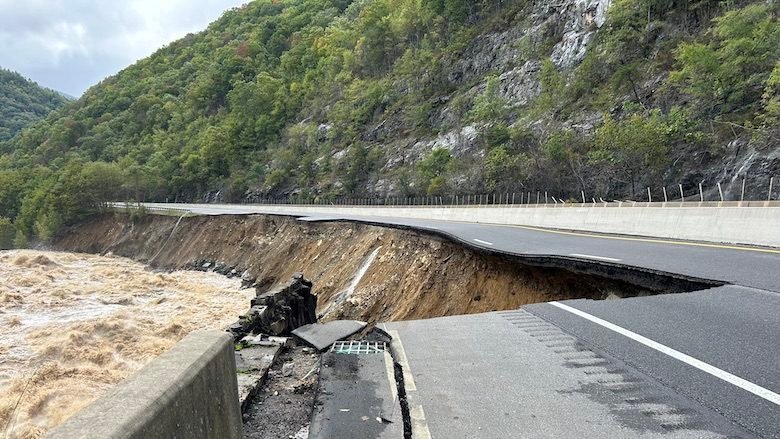

Interstate 40, closed in late September when flooding from Hurricane Helene caused multiple landslides and lippage in the Pigeon River Gorge between North Carolina and Tennessee, is expected to partially reopen on New Year’s Day in 2025, more than three months after the storm. Long-term rebuilding plans are still in early development.
The North Carolina Department of Transportation (NCDOT) announced Nov. 5 that it expects contractors to complete a stabilization project to secure the westbound lanes of I-40 in the Pigeon River Gorge, where waters washed away the eastbound lanes of the interstate in four long stretches during the immediate aftermath of Helene.
Contractor Wright Brothers Construction and GeoStabilization International are stabilizing several thousand feet of lanes through earthen walls as part of an $8.5 million contract, per NCDOT. The operation involves inserting long rods into the rock below the road, filling them with grout to attach the rods to the rock, and spraying concrete on the cut face to hold the rods in place and create a solid wall.
Crews will also install a concrete safety barrier along the five miles of westbound lanes in North Carolina, separating eastbound and westbound traffic from the double tunnel to the Tennessee state line. For four miles of I-40 in Tennessee, there is already a two-lane pattern open to local traffic only. According to NCDOT, a daily average of 26,500 vehicles crossed the corridor by 2023.
Completion of the work will provide enough space for vehicles to travel at 40 mph in one lane in each direction for a 9-mile stretch of the gorge that covers areas of both Tennessee and North Carolina. The setup will also provide another contractor with enough space to safely complete long-term repairs for years to come.
NCDOT has contracted with RK&K to design the reconstruction, Ames Construction as the contractor and HNTB as the project manager. No timeline has been set for the selection of a design or the start of construction, and no general cost estimates have yet been identified.
NCDOT also continues to work on local roads washed out by stormwater, including south of Asheville in Chimney Rock and Bat Cave, where they have also had to fight social media misinformation about US Hwy 64/74A, which was washed away by the Broad River. .
A widely shared video purported to show a West Virginia mining crew reopening the road in town, but NCDOT spokesman David Uchiyama told ENR that while the intentions are appreciated and the volunteers from all over the country have helped the region in several areas, the miners created a road not sufficient to support vehicle traffic that was also on private land outside the scope of transport officials.
State crews created some of the first connections for the area via ATV trails to reach residents stranded off US 64/74A, and contracted crews are working to move the Broad River west to restore a temporary two-lane gravel road. , the construction of which is expected to be completed in four to six weeks.
For the foreseeable future, he adds, the road will remain for local, construction and emergency traffic only while NCDOT drafts a contract to build a new road in the approximate location of the old one. It is expected to be a progressive design and build project with a design and build award expected in late November. The approximate construction estimate, including river relocation, is two to three years.
Progress of water restoration works
In Asheville, work continues to clear debris and repair water infrastructure as turbidity in the city’s main reservoir remains high, although spokesman Clay Chandler said in a Nov. 15 update that boil water advisories could be lifted on November 20 and that the water treatment plant is there. reached a capacity of more than 20 million gpd.
“We have been able to feed a sufficient amount of filtered water into the distribution system without mixing it with raw water,” he said, adding that filtered water has been added to the system for about a week. “The system has been largely reversed and the vast majority of raw water has been replaced with treated water.”
A sampling process will now begin on Nov. 16 to collect 120 samples, which could be completed by the afternoon of Nov. 19, telling the city if it can lift the boil water advisory.
A contractor from the U.S. Army Corps of Engineers conducted a site visit Nov. 11 as part of an effort to build an interim pretreatment system, according to a Nov. 14 update from the city. Materials and equipment for the project could arrive as early as the weekend of November 15, with the system expected to be operational in late November or early December.
Asheville has also been conducting research sampling at dozens of sites in its system for lead, aluminum, iron, manganese and more as part of a storm-specific water sampling plan. The 8 ppm chlorine treatments after Helen that were allowed by state and federal environmental agencies have been reduced to 2.5 ppm. Reports show aluminum levels between 0.05-0.2 ppm aluminum, 0.3 ppm iron and 0.05 ppm manganese, with no reports of coliform or E.coli since the storm.
While lead has been found in several local elementary schools through testing, Asheville water officials stress that the lead came from older pipes owned by private customers and not from the reservoir. Bottled water is being provided to these schools and filters are being installed to reduce lead while assessments of their plumbing can be conducted to locate sources of lead exposure.
