

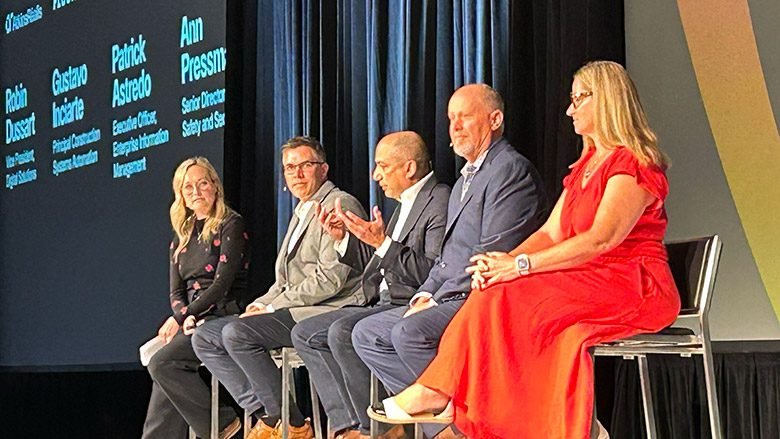
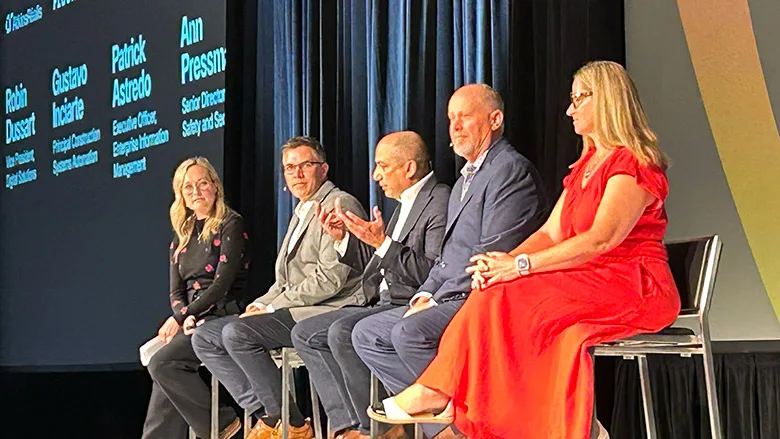
After splitting from Swedish positioning and hardware giant Hexagon AB last June, Octave Inc. went public on the NASDAQ in May and has rebranded many of its software products. But an overall strategy for the new company hadn’t emerged until the June 17-18 Octave Live road show in Austin, Texas.
For construction, this means more integrations across a broad portfolio, as well as more AI agents within that portfolio.
folio The maker of technology products as varied as the BricsCAD family of design tools and the OnCall public safety and dispatch platform used the event to say it is now a provider of project lifecycle information.
“Design, build, operate and protect are still silos, each with its own customer-driven workflow,” said Kyle Wessells, vice president of global portfolio marketing at Octave. “What’s at stake is cost overruns, increased risk and operational inefficiency.”
Octave CEO Mattias Stenberg said several products will bring together several pillars of lifecycle design, construction, operation and protection.
The company defined different areas where its offerings live, such as data and intelligence, scale and complexity, and performance and results.
Hxgn SDx2 was renamed InConcert by the new company, touted as a design information platform that can handle several different types of data that are required in construction. EPCs such as Burns and McDonnell use it on large infrastructure projects because it can take or output BIM, GIS and other schemes.
Looking for quick answers on construction and engineering topics?
Try Ask ENR, our new intelligent AI search tool.
Ask ENR →
“What we’re trying to do is instead of reinventing ourselves for every client or every project, we’re looking at how we can take the data from all of our applications and bring it to this. [platform] environment, and then it builds from there,” Vivek Mokashi, Octave’s chief technology officer, told reporters and analysts.
Stenberg echoed that sentiment, at least as far as AECO customers are concerned, in his keynote remarks at the conference. At the time of the spin-off last year, Hexagon was a software and hardware giant with very little uniformity across both sets of offerings and even within its software business, as geospatial intelligence, asset operations, quality, public safety, physical security and industrial cybersecurity existed alongside design and construction tools.
With the rise of agent AI, Stenberg said these silos will necessarily change, and Octave is already investing in its agent AI data layer analytics tool called Octave Aria (formerly the Hxgn Alix generative AI platform, launching in 2024). When it was renamed in March, Octave announced that it would exist as an analytics tool for the underlying data layer, capable of providing insights to project teams or owners throughout the lifecycle of a project or asset.
“Ninety-six percent of AEC data is unused,” Stenberg said. “The system was never built to pass data to the next stage. Everyone in AEC sees their silo. Between the silos is where risk, cost and failure live.”
Octave’s head of product Jay Allardyce used his prime time to argue that AI will have limits when it comes to designing, building and maintaining large infrastructure and design assets. Construction software won’t go away, he adds, because of more connected workflows. Architects, engineers, and construction professionals will be even more needed to add context that is often missing from agent AI.
Octave has the breadth of portfolio to participate in this change, particularly with large clients such as Burns & McDonnell and Fluor, Allardyce said.
Almost every AEC software vendor now says connected intelligence is the future of construction, but actually creating ways for data to flow across different schemes, like Octave’s “pillars,” is the only way to reduce real risk, he added.
