

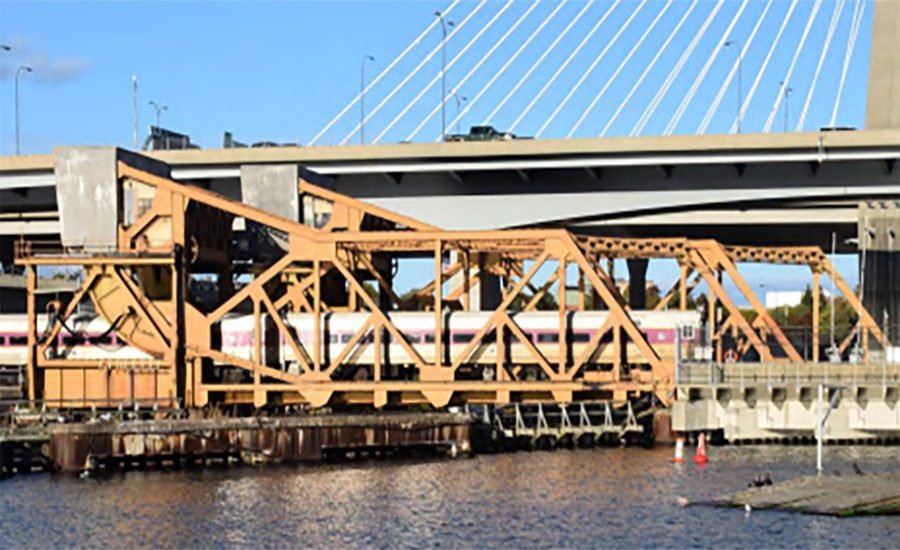

Skanska Civil Northeast/Koch JV has won a $1.06 billion design-build contract from the Massachusetts Bay Transportation Authority to replace the aging Draw One rail bridges at Boston North Station, one of the Northeast’s most operationally constrained commuter rail corridors.
“The Draw One Bridge replacement is one of the most important rail infrastructure projects in Massachusetts history,” Gov. Maura Healey said in a March announcement to move the project forward.
The project will require crews to maintain continuous Amtrak and MBTA service during years of phased construction. The MBTA selected the joint venture after a multi-phase procurement; VHB, an engineering and design firm based in Watertown, Mass., is serving as the design partner on the contract.
“Replacing the Draw One bridges is one of the largest infrastructure investments in the MBTA Commuter Rail system,” said VHB Design Director Ricky Carey. “Once completed, these new structures will provide lasting benefits to one of the region’s busiest transport corridors.”
The award covers the replacement of two adjacent 1930s-era swing spans that cross the Charles River with three new two-track vertical lift spans that expand the corridor from four to six lanes while modernizing signaling, controls and approach infrastructure.
The added capacity is intended to improve train flow at the north station and reduce delays on the MBTA’s north-side commuter rail network, the agency said. The overall program budget is approximately $1.286 billion, according to project materials, with the award of $1.06 billion covering the main design and construction deliverable.
Construction is scheduled to begin this month, with completion expected in the fall of 2032, a timeline the MBTA attributed to the design-build delivery method, which the agency said shortened the projected schedule from the initial eight years.
Looking for quick answers on construction and engineering topics?
Try Ask ENR, our new intelligent AI search tool.
Ask ENR →
The corridor serves more than 11 million riders each year and is critical to the MBTA’s effort to eliminate a longstanding operational bottleneck north of North Station, where more than 1,100 passenger trains cross the Charles River each week through infrastructure that federal officials say is beyond its useful life.
The Federal Transit Administration’s final environmental assessment, completed in January 2025, documented 165 unique delay events on the bridge between 2019 and 2021, with average operational delays of nearly 25 minutes per event.
“We are proud to partner with the MBTA on this transformational infrastructure investment that will improve reliability and support the growing transit needs of the region,” said Paul Pedini, Skanska USA Civil Senior Vice President. “By leveraging innovative design and construction solutions, our team will deliver a future-ready rail network, maintaining uninterrupted service for the passengers who depend on it every day.”
In addition to the replacement spans, the project includes the demolition of the existing bridge structures, a new rail operations control facility, expansion of the North Station platform capacity, and track, signal and drainage system improvements. The team said it will deploy alternative technical concepts to reduce water work and simplify the construction scene.
RELATED
Expressway design begins for complicated Boston Bridge replacement
The US Coast Guard Bridge Permit Notice characterized the effort as a six-phase construction program spanning approximately six and a half years.
Initial work includes removing debris from the older bridge structures and constructing a temporary bridge before crews replace the active spans sequentially. Temporary workhorses and boats will be used on the Charles River; The Coast Guard said shipping channels are expected to remain open except during short-term closures coordinated with waterway users.
Federal funding has been critical to the project’s progress. In October 2024, the U.S. Department of Transportation announced a $472.3 million grant for the broader North Station Design 1 Bridge Replacement effort under the Bipartisan Infrastructure Act.
STV too ready the comprehensive benefit-cost analysis that allowed the MBTA to secure the Mega Grant –the largest federal grant award in MBTA history, according to STV.
The environmental review was completed through an environmental assessment led by a TLC, with the US Coast Guard and the US Army Corps of Engineers as cooperating agencies. Federal documents characterized the project as critical to preserving and expanding future passenger rail capacity at North Station as regional passenger demand continues to grow.
