

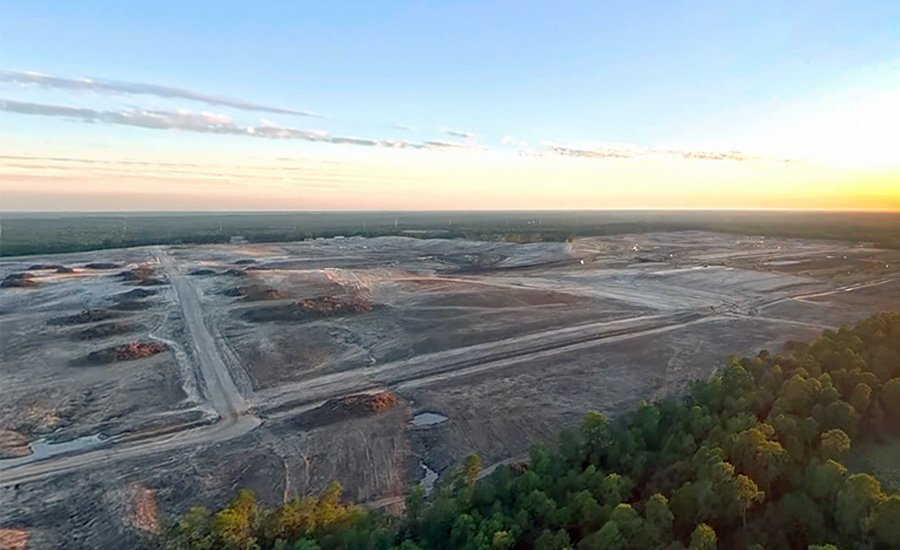
SpaceX sued Texas Attorney General Ken Paxton and Grimes County on Sept. 8 to block the release of records related to Terafab, its planned semiconductor manufacturing complex in southeast Texas.
The lawsuit, filed in Travis County District Court in Austin, followed a state open records ruling ordering the release of most of the disputed materials. KBTX, which reviewed the request, reported that the records include project costs and financial information, land acquisition material, structural design information and tax incentive negotiations.
Already public state and local records reviewed by ENR reveal the scale of the planned project in Grimes County, about 20 miles east of College Station. Texas announced Terafab on Aug. 6 as a first-phase investment of more than $16.8 billion, with 3,000 jobs and a planned 100 million-square-foot facility.
Elon Musk called Terafab “the most epic chip-building effort — combining logic, memory and advanced packaging all under one roof” aimed at producing AI chips at scale “for use on Earth and in space.”
A Grimes County public notice estimated $55 billion in capital investment for the initial phases and up to $119 billion if additional phases are built in and around Gibbons Creek Reservoir.
Eight Texas Jobs, Energy, Technology and Innovation (JETI) program applications divide the proposed construction into four phases. The project crosses two local school districts, requiring separate JETI applications for the portion of each phase within the Anderson-Shiro Consolidated Independent School District and the Iola Independent School District.
“Each phase would be able to manufacture semiconductors independently,” the applications state. “After completing construction of each phase, the applicant will determine whether to proceed with construction of future phases” to expand manufacturing capacity.
Looking for quick answers on construction and engineering topics?
Try Ask ENR, our new intelligent AI search tool.
Ask ENR →
The filings also explain the $16.8 billion first-phase figure announced by Gov. Greg Abbott (R). Eligible investment for Phase 1 totals approximately $10.37 billion on the Anderson-Shiro side and $6.43 billion on the Iola side, or approximately $16.8 billion combined.
Beyond the Chip Fab
JETI applications describe Terafab as an advanced computing and semiconductor manufacturing complex led by a group of affiliated companies that includes SpaceX, Tesla and xAI.
“TERAFAB is designed to consolidate the full semiconductor production lifecycle, including integrated circuit design, photomask generation, wafer fabrication, advanced packaging, and system-level integration, with supporting power generation and spatial computing test facilities, into a single, co-located campus,” the applications state.

SpaceX’s Terafab launch presentation depicts a conceptual semiconductor manufacturing campus. The proposed Grimes County development also includes on-site power generation, water treatment facilities and other supporting infrastructure. Click to enlarge.
Rendering courtesy of SpaceX
The configuration is intended to “materially reduce production cycle times, improve design iteration speed and improve supply chain resiliency for critical IT technologies,” according to the documents. They say Terafab is expected to incorporate sub-2-nanometer class semiconductor processes through partnerships with established equipment manufacturers and suppliers.
The scope of construction extends beyond semiconductor manufacturing. Eligible property programs identify fab buildings, cleanrooms and sub-fabricators, a central utility plant, substations, water treatment and recycling systems, industrial wastewater treatment, on-site power generation, and a spatial computing test facility.
Applications also include gas turbines, utility-scale battery storage, transformers, backup generation, refrigeration systems, and compressed gas and chemical distribution infrastructure.
Under the county’s tax abatement agreement, the facilities are expected to rely on electricity generated by on-site power plants rather than the grid. The project is also expected to use surface water from Gibbons Creek Reservoir instead of groundwater and include wastewater treatment and water reuse systems.
The reinvestment zone encompasses more than 22,000 acres around the reservoir, although the designation does not mean all of that land would be developed.
A separate road use agreement designates six county roads around the project area for construction traffic, with the company responsible for maintaining the routes during construction and repairing construction-related damage.
A decade of phased construction
Construction of the first phase is scheduled for 2026-28, with commercial operations expected to begin in 2028. The separate applications for the two school districts represent about $16.8 billion in eligible investment during this phase.
The investment would increase considerably if the subsequent phases were to proceed. Phase 2, scheduled for 2029-31, is about $38.6 billion in combined eligible investment across the campus. Phase 3, scheduled for 2032-34, is another $38.6 billion. Phase 4, scheduled for 2035-36, totals about $25.3 billion.

Tesla is hiring an internal construction management team for Terafab. Current openings in Anderson near the project site include civil and senior construction project managers, site superintendents and construction logistics personnel responsible for developing bid packages and scopes of work, evaluating proposals, managing contracts and coordinating architects, engineers and trade contractors.
One post says the civil construction project manager “would oversee the overall execution of the construction site from innovation to fabrication preparation,” including drafting RFP scopes and selecting contractors for heavy civil and utility work. Another places a senior construction project manager in charge of the work from preliminary to design, construction, commissioning and delivery.
The releases do not identify the outside firms that would perform the work, and no architect, engineer, general contractor or construction manager has been publicly named. But the listed responsibilities place Tesla personnel directly over contracting, design coordination, and contractor execution.
Musk provided another indication of this owner-led approach on Oct. 7, writing to X that his companies would “build and run the fab.” He said Taiwan Semiconductor Manufacturing Co. could sublease part of Terafab, but declined a larger operating role.
The scale is tied to expected demand for semiconductors at Musk’s companies. JETI documents say Terafab aims to reduce reliance on external suppliers and support the large-scale deployment of AI-enabled systems in transportation, robotics and aerospace.
Public incentives, private records
Texas and Grimes County are committed to several layers of economic development support.
In his Aug. 6 announcement, Abbott touted a $30 million Texas Enterprise Fund grant and said Terafab qualified for JETI. His office describes JETI as a program aimed at attracting large, capital-intensive projects while “ensuring robust reporting and transparency.”
Grimes County approved tax abatement and economic development agreements on June 3. Qualifying real property and new tangible personal property are eligible for a 100% reduction in the county’s taxable value for up to 10 consecutive years, with SpaceX required to pay $20 million annually in lieu of taxes from 2027 to 2036 going forward. The deal calls for at least $5 billion in capital investment and 1,800 full-time equivalent jobs, while a separate Section 381 settlement provides additional incentives to the county after the abatement period.
The eight JETI agreements separately provide taxable value limitations across the two school districts. TeraFab AI says it considered sites in Texas, Arizona, New Mexico and Nevada, evaluating taxes, labor, permitting speed and availability of infrastructure, including power, water and fiber.
“Absent the limitation, the project’s IRR would fall below the minimum investment threshold and competing jurisdictions (eg, Arizona) would present a more favorable after-tax return, in which case the project would likely move out of Texas,” TeraFab AI said in the state.
The disclosure dispute began after two Grimes County residents requested records associated with Terafab and the county’s tax abatement negotiations. Grimes County asked the attorney general’s office for a ruling on what it could withhold.
KBTX reported that Paxton’s office concluded on July 28 that some attorney-client communications could remain confidential, but ordered most of the requested records released.
The Sept. 8 lawsuit seeks to prevent disclosure while it challenges that decision. The dispute now before the Austin court is over how much more of the negotiations and project information behind the incentives should be made public.
