

John F. Fish is president and CEO of Boston-based contractor Suffolk Construction, one of the nation’s largest builders, ranked No. 23 on this year’s ENR Top 400 with $7.6 billion in revenue.
More than a decade ago, Fish saw growing inefficiencies and declining productivity during the construction process and decided to make an investment of more than $100 million in data, technology and innovation initiatives to better position Suffolk for the future. Today, Suffolk’s “clean data lake” contains approximately 293 terabytes of structured construction data, the equivalent of approximately 75 billion PDF pages.
Fish spoke to ENR about Suffolk’s “Job Site of the Future” strategy to incorporate artificial intelligence into its processes. The initiative was formally launched on June 9 after years of internal investment and testing. The AI-enabled operating model is the first of its kind, says Fish, and aims to transform project delivery. In innovation workspaces at project sites, engineers using AI tools have access to real-time project data. These “AI engineers” focus on delivering improvements in three core areas: design, programming and process. This interview has been slightly edited for clarity.
ENR: Suffolk AI engineers are now embedded directly into workplaces and participate in critical project meetings. How did you get project stakeholders on board?
John F. Fish: Let’s take a step back, because I want to unpack you a little bit. We all know that construction costs today are greater than the value of the construction. You and everyone at ENR also know about the labor shortage. You also know five out of two, five out, two inches. You also know we have no immigration policy and whatnot [the state of] interest rate I often tell the story of the Empire State Building being built in 13 months, and now it takes five years to build a building like that at the end of the day. So something has to give.
We are aware of all this and the low margins contractors have to deal with.
All of these factors are really compromising the ability to make the American dream a reality for people. And what I really mean by that is that the only way people build wealth in America—I’m generalizing—is through home ownership, and right now that home ownership problem is out of reach for 27- to 35-year-olds. So if we don’t solve this problem in theory, the founding principle of the American dream is at risk, and a lot of people don’t see it that way. But that’s how I see it. People say we [are] 4 million units short. we [are] About 8 million housing units are sitting in America today, so when I think about that, I think that’s the overall picture of our country: the commercial, residential, and retail market right now is basically at a standstill.
So while I’m thinking about it, just [a study of AI in construction] with the Massachusetts Institute of Technology Media Lab. As a result of this [research, we asked ourselves] can we build a building with 20% less cost and 25% less schedule?
And did that lead you to the workplace strategy of the future?
He created the three-step process in the workplace of the future. It’s creating a seamless platform in the business, taking the master builder back to its core, like we did in the 30s and 40s, but bringing in technology and artificial intelligence and machine learning, so you see we’re bringing that into this master builder process. The idea came to create this perfect platform that is described in the paper, and the perfect platform is really at a high level that is procured, then designed and then built. So it’s turning the traditional process on its head a bit.
Looking for quick answers on construction and engineering topics?
Try Ask ENR, our new intelligent AI search tool.
Ask ENR →
Not engineer-procure-build, but procure-design-build?
exactly So if you look at your regular shop drawings on a typical residential project, it has doors, frames, kitchen cabinets, floors and you know exactly what you need. You don’t need shop drawings later, in theory, following this process four or five years down the line. The designer then incorporates these elements into their design. You know your cost, you know your deliverable, which is important, and then you know how to build them into the whole project. So the theory is to have Suffolk Design, of which we have 125 architects, structural engineers and mechanical engineers right now, we’ll probably have 250 a year from now, do that design. We have Freedom Source, which is a procurement group, and then we have Liberty, which is our construction group and has about 1,500 carpenters and laborers right now in the country. So the idea, the workplace of the future is really about solving the problem of the perfect platform.
So how do you integrate procurement, design and construction into this seamless platform that can achieve 20% lower costs and 25% schedule savings?
The idea was to start with three particular environments in Suffolk that are investment environments that I have created as a business owner. Let’s do three things instead of boiling the ocean. AI for design, AI for programming, AI for process. I will give you an example process. We’re doing a job in the data center, about a $2 billion job, [with] Bills worth $200 million per month. It takes between three and three and a half weeks to make the requisition. Can we harness AI to shrink to a week? We’re two weeks in right now. The idea is to eventually get down to a week at the end of the day.
What about design and construction?
Let’s program. When we re-sequence a job or something doesn’t arrive at the right time, the critical path is interrupted because the delivery date of the material or something happens on a job. How long does it take us to resequence a critical path in a large scale $2 billion job? Sometimes it takes a week to 10 days to do it. Can we do it in two and a half days with AI? The answer is yes. Ok, back to the design. When the customer gives us all the material cutting sheets, because they supply a lot of equipment to the data centers, how long does it take us to incorporate, not to coordinate, but to incorporate material material that the customer has already purchased into the overall design at the end of the day? Therefore, the workplace of the future must embrace three particular use cases: design, programming, and process, and solve problems on the spot with people in that workplace. We’re harnessing AI in a way that won’t take your job. We prove it to them. We’re looking for your role, not your job. In a workplace, there are people who make demands. They don’t want to be doing requirements for three and a half weeks. They’d rather be doing something else, so you’re doing chores that would otherwise frustrate people who are repetitive, and we’re putting that in the hands of the AI.
How does this work physically in this workplace?
At the workplace of the future we have a full-time AI engineer, with a 2,000-square-foot trailer that attaches to the existing construction trailer with a glass panel, so people can look in from a curiosity point of view. The entire workplace is all digitized. You are creating an environment that speaks to what you are trying to achieve. It’s not threatening, and there’s someone who has a background in construction, but dominates the AI. and can make people feel comfortable asking any question at the end of the day, even what they consider a stupid question.
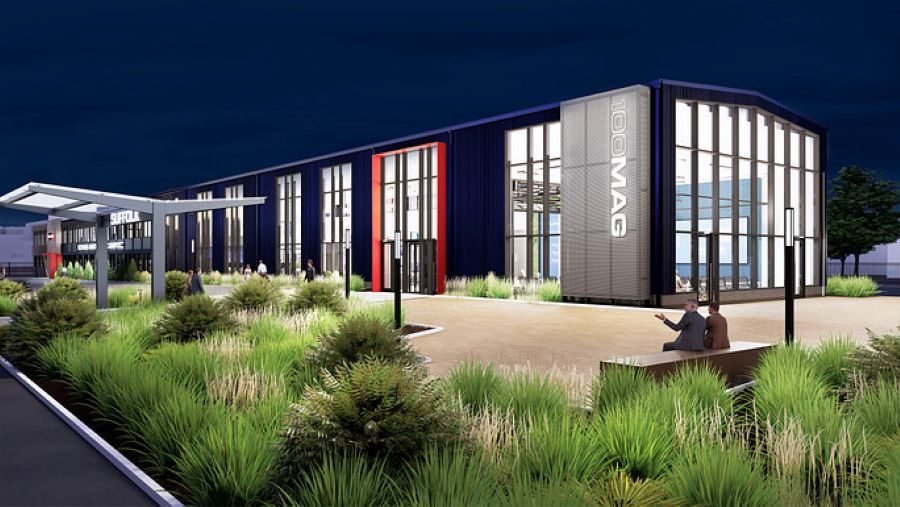
What is the relationship with 100MAG, your modern construction process group based in Suffok’s expanded office and warehouse at 100 Magazine Street in Boston?
The idea is that we take the idea in the field, we digitally transfer it to 100MAG at the core of the company, and we’ll probably have 10 to 12 AI engineers and people working together to take those ideas that were conceived and transfer them into something practical from a workplace solutions standpoint, and then put a training program around it. Workplace of the future, 100MAG, ideate, develop, train and then we collaborate.
Our fourth environment is in Bangalore, India. We just opened our office [there] six months ago, and the idea is that I don’t use it as labor arbitration. I do it as an intellectual arbitrage, okay? Because there are really bright and smart PhDs out there that we can leverage to drive our AI strategy, the workplace of the future, our 100 Mag, and our collaboration at the end of the day.
Can you give me an example of how AI has helped in a project with the Job Site of the Future strategy?
When I tell you about procure, design and build, which is turning your head, okay, it’s not design, procure, build. When you hire Suffolk, what I want to be able to say to a customer is we’ll give you that hire and then we’ll give you options of three very specific off-site manufacturing capabilities for sections of the building. Only three, not 17, three. The three that can create more value and more predictability.
Take a mechanical room. We are making the world headquarters of the Dana Farber Cancer Institute right now. It’s a $1.2 billion job. The mechanical room in the Dana Farber building that is coming out of the ground right now was about 32,000 square feet. We’re doing off-site fabrication in the mechanical room and we’re taking it in pieces. The mechanical room is 24,000 square feet. We’re saving 9,000 square feet of building ceiling because we’re coordinating off-site manufacturing in the machine room. Can we do it with a power room, and can we do it with a third building component that makes sense? Maybe swim pods or something. Standardization is the key at the end of the day.
I know Suffolk’s clean data lake is key to this whole process, but is there any AI you can mention that you know is used in this strategy?
Light table Right now—because we have our own architectural, mechanical, structural group—we call them televisions. When we get involved in pre-construction. We have two stages of TVs: technical validation reports. OK, we’ll take the design into a mature design document. We will leverage Light Table with our own engineers and architects, and give a full report to the architect of record and the client, not point fingers when someone calls out the level of detail. They are 400 and they are not right. This is where the drawings are from a reference comparison point of view, and then they go out with the construction documents. We will do another technical validation report.
And that’s how you’re getting to 20/25?
If we can anchor that to the pre-construction process, leveraging AI, getting things geometrically, dimensionally correct and coordinated, and now also specifying material upfront, so it’s really there, so ultimately we don’t want to be doing shop drawings four years from now, three years from now. The level of predictability, and I can assure you that 20% cost savings and 25% schedule savings.
